Bullock Cart Wedding in Jharkhand Promotes Dowry-Free Marriage and Cultural Heritage
Total Views |


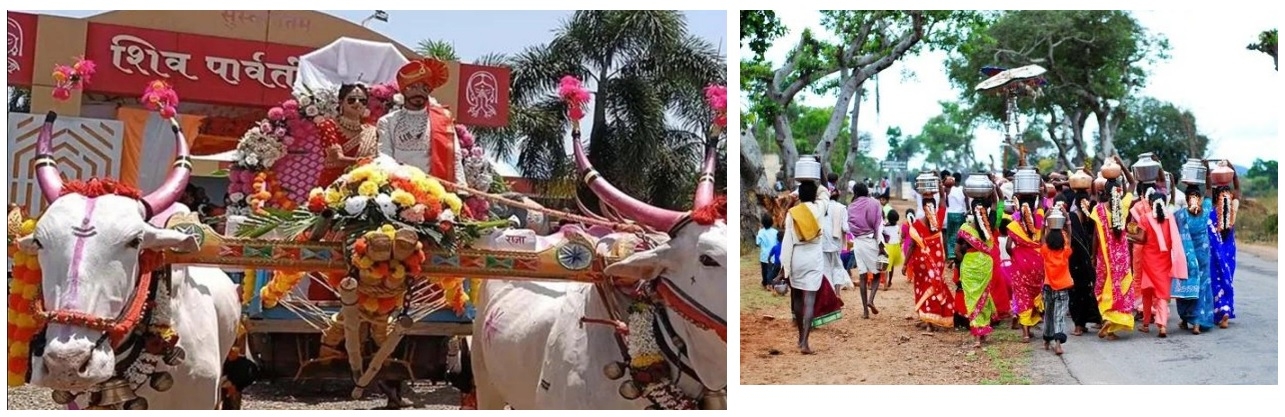
In an era when lavish weddings, luxury cars and extravagant celebrations have become the norm, a young groom from Jharkhand’s Bokaro district has won widespread admiration by choosing simplicity over spectacle. By arriving at his wedding on a beautifully decorated bullock cart instead of a luxury vehicle and solemnising the marriage without accepting dowry, he turned his special day into a powerful social message advocating traditional values, cultural pride and the eradication of the dowry system.
The unique wedding took place in Kasmar block of Bokaro district, where Janardan Kumar Mahto, a resident of Teliadih Tangtona village, married Shweta Kumari of Mungo Bagda village. Rather than leading a grand procession of expensive cars and blaring DJ music, the groom travelled to the bride’s village in a flower-adorned bullock cart, accompanied by relatives, friends and villagers celebrating with traditional music and folk performances.
The sight of the decorated bullock cart moving through village roads immediately drew the attention of local residents. People gathered along the route to witness the unusual wedding procession, with many appreciating the couple and their families for reviving traditions that have gradually disappeared from modern weddings.
Unlike contemporary marriage processions dominated by loud sound systems and Bollywood music, the atmosphere at this wedding echoed with the melodies of Kudmali folk songs, performed by local artists. Traditional instruments and cultural performances created a festive environment while showcasing the rich heritage of the region.
Adding to the cultural significance, the procession also featured traditional horse dance performances, an important part of local celebrations. Wedding rituals were conducted according to Kudmali customs, highlighting the community’s commitment to preserving its identity and passing its traditions on to future generations.
However, beyond its traditional charm, the wedding carried a much deeper social message.
The families of both the bride and groom made it clear that the marriage was conducted without any exchange of dowry, demonstrating that successful marriages are built on mutual respect, understanding and equality rather than financial transactions.
Speaking after the ceremony, groom Janardan Kumar Mahto said the decision was deliberate and aimed at inspiring society.
“Our objective was not merely to organise a wedding but to spread awareness that relationships are founded on trust, respect and values—not on dowry or extravagant spending. We hope more young people will reject this social evil and preserve our cultural traditions,” he said.
His statement resonated strongly with many villagers and social activists, who described the wedding as an example of how meaningful celebrations can inspire positive social change.
The bride’s family also welcomed the initiative, saying they were proud to be part of a marriage that promoted dignity and equality rather than material expectations.
For decades, the dowry system has remained one of India’s most persistent social challenges despite being prohibited under the Dowry Prohibition Act, 1961. Although legal safeguards exist, the practice continues in many parts of the country, often placing severe financial burdens on families and contributing to domestic violence, harassment and other social problems.
Social reformers have repeatedly stressed that eliminating dowry requires not only stricter enforcement of the law but also changes in public attitudes. Weddings like this one demonstrate that young couples themselves can become agents of change by rejecting outdated customs and encouraging society to embrace more equitable traditions.
The decision to use a bullock cart instead of modern vehicles also carried symbolic significance.
For generations, bullock carts were an integral part of rural life, serving as the primary mode of transport for agricultural communities. Although they have largely disappeared with urbanisation and mechanisation, they continue to represent simplicity, sustainability and a close connection with village life.
By choosing the traditional mode of transport, the groom paid tribute to his roots while also reminding people that celebrations need not depend on luxury or excessive expenditure to be memorable.
Local residents praised the initiative, saying it reflected the values of humility, environmental consciousness and respect for cultural heritage.
Several elders attending the wedding remarked that the ceremony reminded them of weddings held decades ago, when communities celebrated together without lavish displays of wealth.
Many young attendees also expressed appreciation for the couple’s decision, saying it demonstrated that traditions can coexist with modern thinking. They noted that while education and development are important, preserving cultural identity and rejecting harmful social practices are equally essential.
The wedding has since attracted attention beyond Bokaro, with photographs and videos circulating widely on social media. Many users applauded the groom’s stand against dowry and called the ceremony a refreshing example of responsible social leadership.
Several people also highlighted the environmental benefits of simple weddings, arguing that reducing unnecessary expenditure, excessive decoration and fuel-intensive processions can make celebrations more sustainable while easing financial pressure on families.
Experts say India’s wedding industry has grown into a multi-billion-dollar sector, often encouraging families to spend beyond their means. In contrast, community-driven celebrations that prioritise traditions and social values offer an alternative model that focuses on relationships rather than material display.
The Bokaro wedding has become an example of how individual choices can inspire broader conversations about social reform. While one ceremony alone cannot eliminate deep-rooted customs like dowry, such initiatives help challenge long-standing stereotypes and encourage others to rethink conventional practices.
Community leaders in the area have welcomed the message, expressing hope that more families will conduct marriages without dowry and avoid unnecessary extravagance. They believe that promoting simple weddings can reduce financial stress on families and strengthen the institution of marriage by emphasising equality and mutual respect.
As India continues to balance rapid modernisation with its rich cultural heritage, stories like this highlight that progress does not always require abandoning tradition. Instead, traditions can be preserved while discarding harmful practices that no longer have a place in society.
For Janardan Kumar Mahto and Shweta Kumari, their wedding was more than a personal celebration—it became a statement of values. By replacing luxury with simplicity, rejecting dowry and embracing their cultural roots, the couple demonstrated that meaningful change often begins with individual choices.
Their unique marriage has left behind not only cherished memories for their families but also an enduring message: that the strongest foundations for any marriage are love, trust, equality and respect—not wealth or social status.