'Quad Fuel Security Forum' Highlights Critical Domain Of Indo-Pacific Energy Geopolitics
Total Views |


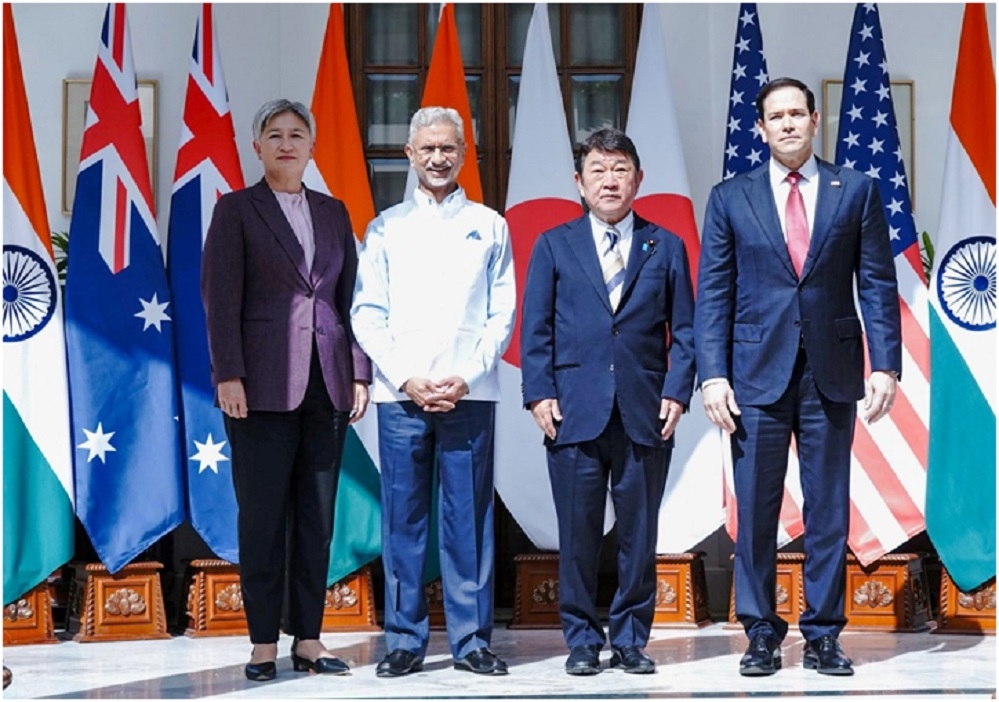
New Delhi : The decision by the Quad countries — India, Australia, Japan and the United States — to establish a Quad Fuel Security Forum marks a significant expansion of the grouping’s strategic agenda beyond maritime security and supply-chain resilience into the critical domain of energy geopolitics.
Announced after the Quad Foreign Ministers’ Meeting in New Delhi on Tuesday, the initiative reflects growing concerns among Indo-Pacific powers over the vulnerability of global energy markets amid intensifying geopolitical instability, maritime disruptions and strategic competition. The meeting was attended by External Affairs Minister S Jaishankar, US Secretary of State Marco Rubio, Australian Foreign Minister Penny Wong, and Japanese Foreign Minister Toshimitsu Motegi.
“India, Australia, Japan and the United States of America are united by a common vision for a free and open Indo-Pacific, underpinned by robust economic and energy systems,” a Quad Statement on Indo-Pacific Energy Security issued following the meeting reads.
“Recognising shifts in the global energy landscape and escalating geopolitical complexities, we are accelerating collaboration to ensure energy stability and security. We recognise impacts of disruptions to global markets, particularly in relation to oil, gas, and petrochemical products as well as essential goods and critical downstream derivatives such as fertilisers, fall heavily on the Indo-Pacific region. Our leaders have expressed a clear collective intent to cooperate on energy security and resilience.”
According to the statement, the four Quad member countries have decided to convene a Quad Fuel Security Forum “to coordinate high-level discussions and facilitate cooperation”.
It further states that the four countries reiterated their strong commitment to ensure well-functioning, stable, transparent, secure and resilient energy markets; reaffirmed the importance of resilient and diversified supply chains, including energy products and other downstream commodities; and reinforce the importance of secure and uninterrupted trade flows, including the safety of navigation and the protection of critical maritime routes and infrastructure, as essential to global economic stability and energy security.
The grouping reiterated the importance of ensuring unimpeded freedom of navigation and uninterrupted flow of global commerce, “including in the Strait of Hormuz, and opposing any restrictive measures hampering the flow of commercial vessels”.
The Quad statement’s direct referencing of concerns over the Strait of Hormuz and uninterrupted maritime commerce is particularly significant because nearly a fifth of the world’s oil trade passes through this sea route, making it one of the world’s most critical energy chokepoints. Any instability in West Asia immediately affects Asian energy markets.
The initiative emerges against the backdrop of instability in West Asia and attacks on commercial shipping in the Red Sea and adjoining waters. Since late 2023, maritime attacks by armed groups in the region have forced shipping companies to reroute vessels around the Cape of Good Hope, significantly increasing transport costs, insurance premiums and delivery times.
For Indo-Pacific economies, especially energy-import dependent countries, these disruptions have translated into higher fuel costs, inflationary pressures and concerns over fertiliser and food security.
“In light of the recent disruptions in global energy markets, the Quad has launched the Quad Initiative on Indo-Pacific Energy Security,” K Nagaraj Naidu, Additional Secretary (AMS) in the Ministry of External Affairs, said while addressing a special media briefing following Tuesday’s Quad Foreign Ministers’ Meeting. “The effort is aimed at leveraging the unique resources that our Quad partners bring to the table, and the idea is to come up with an engagement plan that will focus on technology, management, international market analysis, and emergency response.”
Naidu said that during the meeting, there was a long discussion on how to ensure affordable energy to countries like India with 1.4 billion people.
“Similarly, Australia was sharing their experiences, and Japan was sharing its experiences,” he stated. “Overall, I think the idea was how do we ensure that as Quad partners we can work together to ensure freedom of navigation, unimpeded commerce, because the rights and the safety of our seafarers is also involved.” According to a separate joint statement issued following the meeting, developments in key maritime regions have underscored the vulnerability of critical sea lanes and the risks posed to the uninterrupted flow of commerce.
“These challenges carry significant implications for the Indo-Pacific, which remains central to global trade and connectivity,” the statement reads. “Disruptions to maritime transport and supply chains have far-reaching consequences for global fuel, food and fertiliser security as well as the safety of seafarers.” The emphasis on protecting uninterrupted commerce through critical maritime chokepoints such as the Strait of Hormuz underlines the Quad’s concern that disruptions in sea-borne energy flows could destabilise the wider Indo-Pacific economy. As the region accounts for the bulk of global energy demand growth while remaining heavily dependent on imported hydrocarbons, the proposed forum could emerge as an important pillar of the Quad’s evolving geo-economic strategy.
The forum complements broader Quad efforts aimed at supply-chain diversification and economic resilience. By discussing fuel security collectively, the four countries are effectively seeking to create an informal energy resilience framework that reduces dependence on any single supplier, transit route or geopolitical bloc. This is especially relevant after the energy market disruptions caused by the Russia-Ukraine War, which exposed vulnerabilities in global energy systems and demonstrated how energy exports can become geopolitical instruments. For Japan and India in particular, diversification of suppliers and routes has become a strategic necessity rather than merely an economic preference.
Although the statement does not explicitly mention China, the geopolitical context strongly indicates that the initiative is partly aimed at countering vulnerabilities arising from Beijing’s growing strategic influence across the Indo-Pacific.
China dominates several sectors critical to global energy transition and supply chains, including rare earth processing, battery manufacturing and clean-energy infrastructure. Additionally, Beijing’s expanding maritime footprint in the South China Sea and Indian Ocean has heightened concerns among Quad members regarding sea-lane security.
By institutionalising fuel security coordination, the Quad is signalling that energy flows, maritime commerce and strategic supply chains are now part of the broader Indo-Pacific balance-of-power competition.
The initiative also aligns with increasing efforts by Quad countries to build alternative strategic and economic frameworks independent of Chinese dominance.
According to K Yhome, Fellow at the Shillong-based Asian Confluence think tank and an expert on Indo-Pacific issues, in the backdrop of the ongoing US-Iran conflict, the blockade of the Strait of Hormuz has impacted all the countries in the Indo-Pacific region.
He said that the Quad members would want to ensure that there is a certain channel through which they can communicate, and they could hold dialogue on the energy security front.
“So, the fact that they have issued a statement on energy security that involves the United States itself, which is also involved in the conflict in West Asia, sends a positive message for the Quad members and especially countries like Japan and India,” Yhome said. “I think it’s a message to the countries in the Indo-Pacific also that this Quad mechanism is serious about the stability of the region and also that it is taking cognisance of the troubles that the region is facing.” He said that Tuesday’s statement is also a message to China as well as to the other countries in the region. “To China, of course, it’s certainly the message that the Quad countries could build alternative or have the capacity to develop, to put in place alternative energy supply lines,” Yhome said. “And that the Quad members would come to the rescue of the other countries of the region in times of difficulties.”
Put together, the proposed Quad Fuel Security Forum represents a major strategic development because it institutionalises energy cooperation at a time of growing geopolitical fragmentation, maritime insecurity and supply-chain competition.
The initiative reflects the recognition that energy security, economic resilience and strategic stability are now deeply interconnected in the Indo-Pacific. It also demonstrates the Quad’s evolution into a multidimensional geopolitical framework addressing both immediate crises and long-term structural vulnerabilities.