India Slams Pakistan At UNSC, Says States Sponsoring Terrorism Must Be Held Accountable
Total Views |


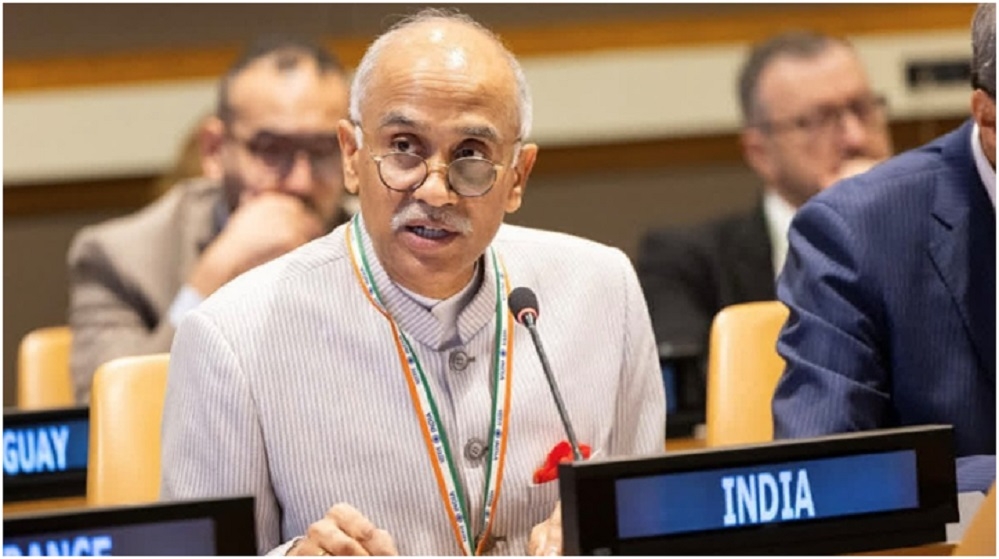
New Delhi : India on Wednesday launched a sharp attack on Pakistan at the United Nations Security Council (UNSC), accusing it of sponsoring cross-border terrorism, targeting civilians and violating international humanitarian law.
Speaking at the annual UNSC Open Debate in New York on "Protection of Civilians in Armed Conflict", India's Permanent Representative to the UN, Harish Parvathaneni, said India remains "deeply concerned about the persistent threat posed by cross-border terrorism."
"India has been a victim of such form of terrorism for decades. States that sponsor, shelter or support terrorism must be held accountable," he said.
Parvathaneni asserted that terrorism in all its forms has been one of the gravest threats to civilians worldwide and said no cause or grievance can justify deliberate attacks against civilians.
India also reiterated its commitment to the UN Charter and said protecting civilians during armed conflict remains central to maintaining international peace and security.
Referring to the UN Secretary-General's report, the Indian envoy noted that more than 37,000 civilian deaths were recorded across 20 armed conflicts in 2025, even though it marked the first decline after three consecutive years of rising casualties.
"Continued civilian casualties, displacement, destruction of critical infrastructure and attacks on hospitals, schools, medical personnel and humanitarian workers remain deeply concerning," he said.
Calling for zero tolerance to the loss of civilian lives, Parvathaneni said parties involved in armed conflicts must ensure safe and unhindered humanitarian access while respecting international humanitarian law.
He also raised concerns over the increasing use of missiles, bombs, drones and emerging technologies, including artificial intelligence and autonomous systems, in populated urban areas.
"The growing trend of use of drones to deploy explosive weapons in urban areas is especially concerning," he said, adding that safeguards must be put in place to prevent misuse and unintended harm to civilians.
Slamming Pakistan, Parvathaneni said, "It is ironic that Pakistan, with its long-tainted record of genocidal acts, has chosen to refer to issues that are strictly internal to India."
Citing findings of the United Nations Assistance Mission in Afghanistan (UNAMA), he alleged that Pakistani military forces were responsible for a large number of civilian deaths and injuries in Afghanistan due to cross-border armed violence.
"The United Nations Assistance Mission in Afghanistan has reported that in the first three months of 2026, 750 civilian deaths and injuries were documented in Afghanistan as a result of cross-border armed violence perpetrated by Pakistani military forces, most of which occurred due to air strikes," he said.
According to Parvathaneni, UNAMA attributed 94 out of 95 incidents of civilian casualties to Pakistani security forces.
Referring to an alleged strike in Kabul earlier this year, the Indian envoy said, "The world has not forgotten that it was during the holy month of Ramadan in March this year, at a time of peace, reflection, and mercy, that Pakistan conducted a barbaric airstrike on the Omid Addiction Treatment Hospital in Kabul."
"According to UNAMA, this cowardly and unconscionable act of violence claimed the lives of 269 civilians and injured a further 122 in a facility which can by no means be justified as a military target," he added.
Parvathaneni further alleged that the strikes took place after tarawih prayers, when patients were leaving the mosque. "It is hypocritical to espouse high principles of international law while targeting innocent civilians in the dark," he said.
The Indian envoy also referred to displacement caused by violence in Afghanistan and said UNAMA had assessed that over 94,000 people were displaced due to cross-border armed violence against Afghan civilians.
Drawing a historical reference, Parvathaneni said Pakistan's actions reflects "repeated attempts over decades to externalize internal failures through increasingly desperate acts of violence both within and beyond its borders".
"During Operation Searchlight in 1971, Pakistan sanctioned the systematic campaign of genocidal mass rape of 400,000 women citizens by its own army," he said.
"With no faith, no law, and no morality the world can see through Pakistan's propaganda," he added.
In his remarks, Parvathaneni stressed that the protection of civilians must remain at the centre of the Security Council's efforts to maintain international peace and security.
"The international community must collectively work to restore and ensure respect for international humanitarian law, strengthen accountability, ensure humanitarian access, protect medical care, responsibly govern emerging technologies and thereby alleviate the suffering of civilians affected by armed conflict," he said.