Tech, Sustainability, Standards: The Growing Importance Of The India-Nordic Summit
Total Views |


As
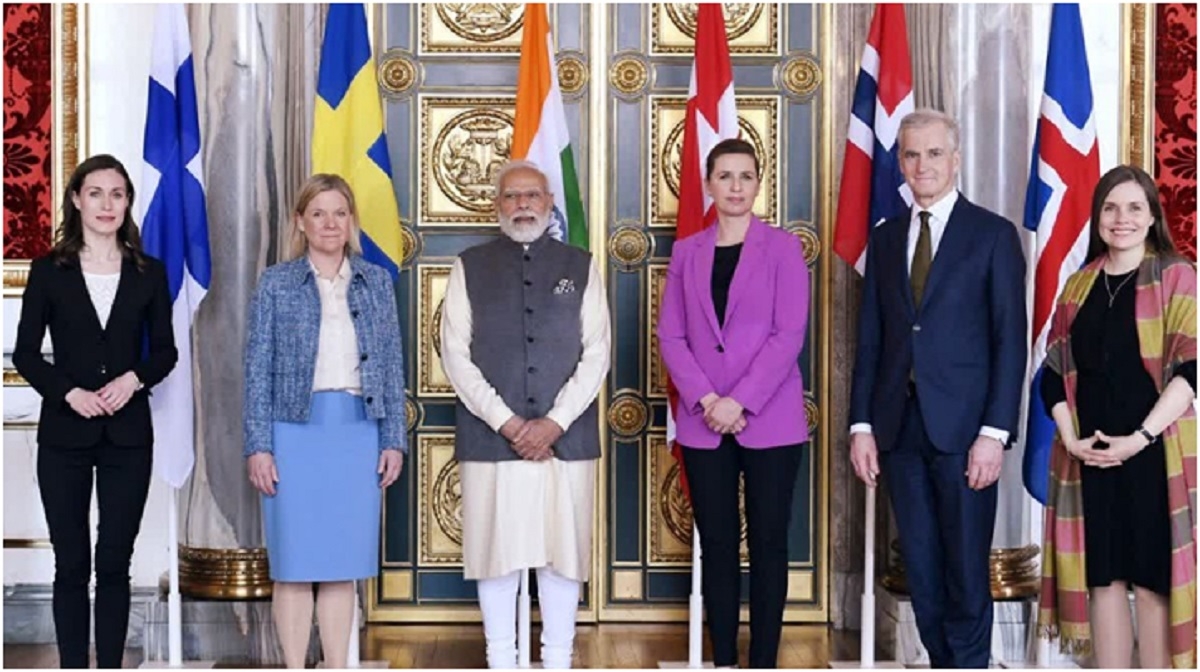
Prime Minister Narendra Modi prepares to travel to Norway for the 3rd
India-Nordic Summit on May 18-19, the meeting reflects how a once low-profile
engagement has grown into a strategically relevant partnership.
Bringing
together India and five innovation-driven European nations — Denmark, Finland,
Iceland, Norway and Sweden — the summit now sits at the intersection of
technology partnerships, climate action, supply-chain resilience and digital
governance in an increasingly fragmented global order.
“Nordic
countries are important partners of India in tech and innovation,
sustainability, renewable energy, and digitisation,” Sibi George, Secretary
(West) in the Ministry of External Affairs, said while addressing a special
media briefing here Wednesday ahead of the Prime Minister’s visit. “The Summit
will be an opportunity to review the progress of India-Nordic relations since
the second India-Nordic Summit held in Copenhagen in May 2022.”
Modi
will be joined by Prime Minister of Norway Jonas Gahr Støre, Prime Minister of
Denmark Mette Frederiksen, Prime Minister of Finland Petteri Orpo, Prime
Minister of Iceland Kristrún Frostadóttir, and Prime Minister of Sweden Ulf
Kristersson for the summit. The summit will build upon the two previous summit
held in Stockholm in April 2018 and in Copenhagen in May 2022, and will impart
a more strategic dimension to India’s relationship with the Nordic countries,
especially in technology and innovation, green transition and renewable energy,
sustainability, blue economy, defence, space and the Arctic.
Rising
Importance Of Nordic Economies
According
to George, India’s relationship with Nordic countries has been on an upward
trajectory since the last Summit in Copenhagen, with deeper trade and
investment linkages and growing sectoral cooperation in the areas where Nordic
countries have great strengths.
“India’s
bilateral trade in goods and services with Nordic countries has reached US$ 19
billion, with exports at US$ 9.5 billion and imports also at around US$ 9.5
billion,” h stated.
“Over 700 Nordic companies operate in India, and around 150
Indian companies have a presence in the Nordic region.”
George
further stated that very important milestones in India’s engagement with Nordic
countries have been reached in the last few years.
“This
summit will help in expanding our multifaceted cooperation with the region and
provide an opportunity to exchange views on global and regional issues of
mutual interest,” he stated. “It will also impart a more strategic dimension to
our relationship with the Nordics in tech and innovation.”
Modi
will also hold bilateral meetings with the Prime Ministers of Denmark, Iceland
and Finland on the margins of the 3rd India-Nordic Summit.
Past
Engagements With Scandinavia
Since
the first leaders’ meeting in 2018 and the second in 2022, the summits have
shifted from symbolism to problem-solving — pairing India’s scale and market
with Nordic strengths in green tech, maritime capability, digital governance,
and advanced manufacturing.
The
Nordics consistently rank high on innovation, transparency, sustainability, and
human development.
For India, this grouping offers trusted technology partners
in areas where standards, resilience, and ethics matter as much as price. These
include clean energy systems and storage, smart grids and green hydrogen, water
management and circular economy, digital public services, cybersecurity, and
telecom standards.
This
is cooperation where governance quality and tech credibility are central —
useful for India’s long-term capacity building.
Nordic
economies are laboratories for decarbonisation — offshore wind, carbon capture,
green shipping, sustainable urbanism. India brings deployment scale and demand.
he summits have become a venue to translate climate ambition into bankable
projects like offshore wind and grid integration, green shipping corridors and
port electrification, waste-to-energy, wastewater reuse, district heating
analogues, green finance and blended funding models
This
aligns with India’s energy transition while avoiding over-reliance on any
single supplier ecosystem.
With
Norway, Denmark, Finland, Iceland, and Sweden deeply invested in Arctic
research and maritime industries, the dialogue now spans Arctic governance,
polar research and climate science, future shipping routes as ice recedes,
green shipping technologies and standards, and resilient sea-lane management
from the Indian Ocean to the Northern Sea Corridor.
Emerging
Arctic Geopolitics
For
India, this widens its maritime outlook beyond the Indo-Pacific into emerging
Arctic geopolitics tied to climate and trade.
In
a world shaped by tech restrictions and supply-chain shocks, India and the
Nordics share an interest in diversifying away from concentrated manufacturing
hubs.
This cooperation spans advanced materials, specialty steels, and clean
manufacturing, telecom, semiconductors (design, equipment niches), and
photonics, EV ecosystems, batteries, and rare-earth processing know-how, and
standards-driven manufacturing for global markets. Nordic leadership in
e-governance and data protection dovetails with India’s digital public
infrastructure. The summits provide a channel to collaborate on
privacy-preserving digital services, artificial intelligence (AI) ethics,
safety, and public-interest use cases, cybersecurity norms and resilient
networks, healthtech, edtech, and GovTech pilots at population scale.
While
not a formal defence bloc, the format enables quiet progress in dual-use
technologies (sensors, materials, maritime systems), aerospace components,
maintenance, repair and overhaul (MRO), and advanced manufacturing situational
awareness at sea and in the Arctic, and civil defence, resilience, and
emergency response models.
Eyes
On Nordic Pension Funds, Climate Finances
Nordic
pension funds and climate financiers are among the world’s most active. Indian
cities and states offer a pipeline of climate and urban projects.
According
to Robinder Sachdev, strategic affairs expert and president of the New
Delhi-based think tank Imagindia, in the big picture, the India-Nordic
relationship is important because the US’ policies towards Europe are forcing
European countries to look for alternative partners.
“The
Nordic countries are more exposed to these policies, given President Donald
Trump’s claims over Greenland,” Sachdev told ETV Bharat. “This gives an
opportunity for India to widen and deepen its ties with the Nordic countries.”
He
also pointed out that the Nordic countries have some of the biggest sovereign
funds. “Given their anathema towards China, India has been a more attractive
investment destination,” Sachdev said. “One top priority for Modi during the
India-Nordic Summit will be to promote ease of doing business in India.”
Unlike
large multilateral forums, the India–Nordic format is small, leader-driven, and
implementation-oriented. It enables faster decision cycles, sector-specific
tasking between summits, business and innovation track linkages, and continuity
across political cycles due to shared policy cultures.
Put
together, the India-Nordic Summits have matured into a quietly strategic bridge
between a rising Indo-Pacific power and Europe’s most innovation-intensive
sub-region — where climate action, clean tech, maritime futures, digital trust,
and resilient supply chains converge into practical cooperation.