From Broken Stones to Unbroken Faith: The Somnath Saga


| S |
oon after India attained independence, on 13th November 1947, the Union Home Minister, and deputy PM Sardar Patel went to Somnath, stood solemnly on the shores there, looking at the ruins and made a pledge, a pledge to reconstruct the temple. India’s first great stirring of cultural renewal, a public recovery of civilizational self-respect.
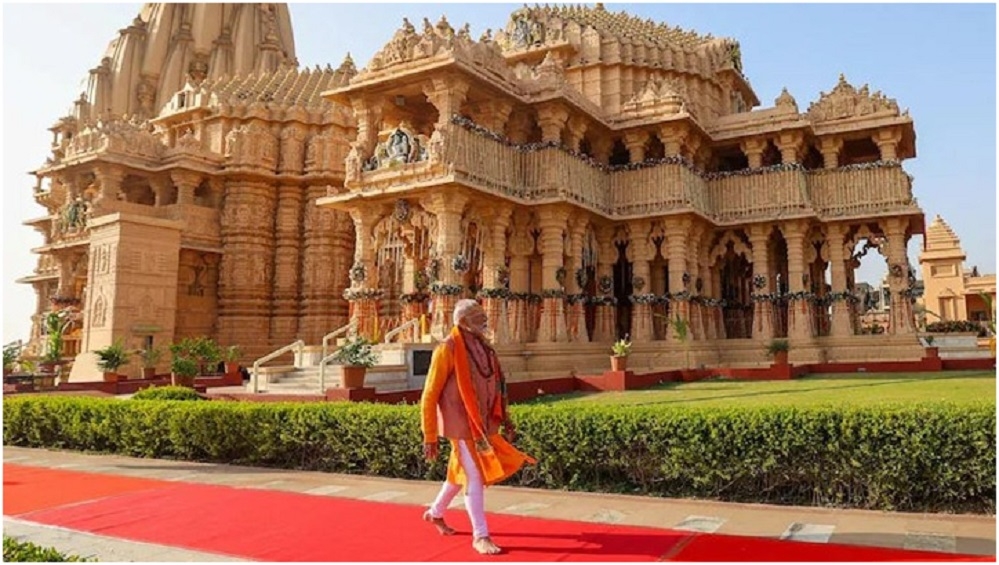
And now, as Prime Minister Narendra Modi presided over the Somnath Amrut Mahotsav on May 11 within the temple’s restored radiance, that same resolve is gathered again and set alight. The Vishesh Maha Puja, the Kumbhabhishek, the Dhvajarohan, and the immense presence of people together declare an unbroken passage—from ruin to rebuilding to resurgence—binding Patel’s vision to today’s assured Bharat in one continuous civilizational arc. This legacy, enduring and instructive, calls each generation to cherish heritage, safeguard unity, and step forward with steady faith in India’s timeless spirit, toward a future prosperous, harmonious, and whole.
It was Mark Twain, who famously said that Varanasi is older than history, tradition, and legend. But probably he had not visited Prabhas Patan and seen Somnath. Bhagavata Purana has it that Moon was cursed by his father-in-law, Daksha, and to escape the curse, Moon prayed at this very site on to Shiva, hence “Lord of the Moon, Somnath. Long before any temple rose, Prabhas Patan was already a home. Settled from 3000 BCE (pre-Harappan agriculture and cattle-keeping), it endured beyond the Indus Valley’s decline, leaving behind Red Polished Ware and early scripts. By the early centuries of the Common Era, it stood as an unpretentious Early Historic town. Offshore, stone anchors resting in 7–10 metres of water still testify to ancient maritime trade—this shoreline was a working threshold and a gateway, not a mere scenic margin. Here, settlement and sanctity grew side by side, braided together across time.
Ancient texts name Prabhasa as tirtha: the Mahabharata marks it as the place of Krishna’s end; Long before stone learned to imitate eternity, this coast functioned as a sacred crossing between land and sea, the everyday and the metaphysical. Its earliest forms were simple—wood and thatch—yet they mattered, because they marked the point where the human heart turned, seeking the divine.
The first verifiable temple rose around 649 CE under the Maitraka rulers of Vallabhi, establishing a substantial Shaiva presence in stone. By the 9th–10th centuries, in the Chaulukya/Solanki era, Somnath had become a major pilgrimage centre, counted in name with Kashi and Ujjain. B.K. Thapar’s 1950–51 excavations revealed a large, exquisitely carved tri-anga sandhara prasada—sanctum, vestibule, and hall—aligned to the east, with a Lakulisa niche confirming Shaiva identity and fragments of a 10th-century entrance pavilion. Scholars dispute the precise dating (late 9th or mid-10th century), yet agree on the larger truth: the shrine had reached a stature that would soon be tested. That test came in waves. In 725 CE, the Umayyad general Junayd ibn Abd ar-Rahman al-Murri attacked, leaving ruins in what is recorded as the first Islamic assault. The greater cataclysm arrived on 8 January 1026, when Mahmud of Ghazni, on his fifteenth expedition, targeted Somnath with deliberate intent. Al-Biruni, who accompanied the forces, described a temple richly endowed by centuries of offerings—gold, silver, pearls, jewels, and village revenues. The linga was broken; the treasury was emptied. Crucially, archaeology shows that fragments of the temple were buried in a foundation pit with minimal weathering—evidence not of centuries of rubble, but of immediate gathering of sacred remnants and rapid clearing of the site. And by 1038, a Kadamba king of Goa made pilgrimage to Somnath, proving swift resumption of worship or, at the very least, swift return of intent. The form was shattered; the civilizational consciousness remained, a seed waiting for its season.
So the pattern repeated: destruction met by a quiet, determined return. In 1169, the Solanki king Kumarapala raised the fifth major stone temple, as recorded in the Bhadrakali Temple inscription at Prabhas Patan. It names his spiritual guide—Param Pashupata Acharya Shriman Bhavabrihaspati—states that Bhimdev built the fourth stone temple after destruction, and that Kumarapala raised the fifth, a royal chronicle rendered in stone. Then came the early 14th century: Ulugh Khan, general of Alauddin Khalji, sacked the temple in 1299; defenders Vaja Malasuta and Padamala fell at the entrance. The linga was reportedly carried toward Delhi, though Rajput tradition holds that Biram Dev of Jalore intercepted and recovered it, an emblem of local guardianship. Soon after, the Chudasama king Mahipala Deva rebuilt in 1308, and his son Khengara reinstalled the linga between 1331 and 1351. The cycle continued: Zafar Khan destroyed the temple in 1395 and reportedly replaced it with a Jumma mosque and an administrative outpost (thana), shifting from plunder toward religious supplanting. Mahmud Shah I Begada returned to desecrate it in 1451. Portuguese forces under Dom João de Castro raided and plundered in 1546. Aurangzeb’s orders brought demolitions in 1665—priests killed, a calf slaughtered inside the premises, the structure razed—and again in 1706, attempts not merely to damage stone but to erase presence. Yet the tirtha persisted.
Even as ruin, memory refused to die. Around 1782–1783, Maharani Ahilyabai Holkar of Indore drew on her personal treasury to commission a new stone temple on or near the ancient site. That sincere structure became Somnath’s functioning heart through the 19th and early 20th centuries—the temple Alexander Burnes in 1830 called the “far-famed temple and city.” In 1842, Governor-General Lord Ellenborough ordered the retrieval of sandalwood gates from Mahmud of Ghazni’s tomb in Afghanistan, falsely claiming they were the original gates looted from Somnath in 1026. It was a calculated propaganda spectacle: to present the British as avengers of an 800-year-old Hindu “humiliation,” courting Hindu support and legitimising colonial rule. The gates were later placed in Agra Fort. In 1922, K.M. Munshi visited the Somnath ruins and remembered “veneration and shame,” an encounter that ignited his lifelong commitment to restoration.
With independence came the final chapter. In October 1947, Junagadh acceded, and the Nawab’s ban on Hindu renovation was lifted. On November 12–13, 1947, Deputy Prime Minister Sardar Vallabhbhai Patel, accompanied by N.V. Gadgil and the Jam Saheb, visited the ruins. Seeing not only devastation but a civilizational imperative, he declared: “On this auspicious day of the New Year, we have decided that Somanath should be reconstructed... The Government of India has decided to rebuild the temple and install the shrine.” The Junagadh administration and the Jam Saheb donated on the spot; about 5,000 acres were earmarked for a temple, a Sanskrit university, and a culture centre. On December 13, 1947, the Public Works Ministry Standing Committee accepted Gadgil’s proposal to reconstruct the temple in its original form.
Controversy followed. After consultation with Gandhi, the government abandoned direct state financing—Gandhi insisted funds must come from the public and not the government, so it would be voluntary cultural reclamation rather than state religious imposition. Munshi—minister in Nehru’s government and founder of the Somnath Temple Trust—steered the project through these cross-currents. In July 1950, he wrote to Education Minister Maulana Abul Kalam Azad requesting ASI excavations before clearing the ruins; Azad reportedly argued for preserving the site as an ASI monument. Munshi insisted the excavations were necessary because of the site’s “outstanding historical interest” and its layered palimpsest. Patel died on December 15, 1950, removing a moderating presence, yet the work continued.
Nehru opposed the project strongly, calling it Hindu revivalism, yet he could not obstruct the trust’s public fundraising. On May 11, 1951, President Dr. Rajendra Prasad performed pran pratishtha, installing a new jyotirlinga in a Māru-Gurjara style temple fashioned by Sompura craftsmen—fulfilling a vow whispered through centuries: despite political opposition, the promise to rebuild was kept in stone. Nehru did not attend.
Today, Somnath is not merely a tourist site, nor only a religious emblem: it is a civilizational chronicle written in stone and sediment. Its truth is not an uninterrupted line of glory, but the repeated human decision to rebuild after breaking. Beneath its foundations lie Harappan settlers, early traders, and devotees seeking solace at this ancient tirtha. Each revival—by Maitraka kings, Solanki emperors, Maratha queens, or a newborn nation—was a conscious act: in the face of destruction, declaring not “this is the end,” but “we will build again.” Somnath teaches that resilience is not never falling, but never remaining fallen—rising, again and again.
The temple on the shore stands as a monument to Shiva and to the unbreakable human spirit that, century after century, returns to the sea’s edge and whispers:We are still here. We remember. We build. We endure.