Zodiacal Light, Jupiter, And Frozen Ladakh Lake: Dorje Angchuk's Winter Trek Yields 360° Astronomical Image
Total Views |


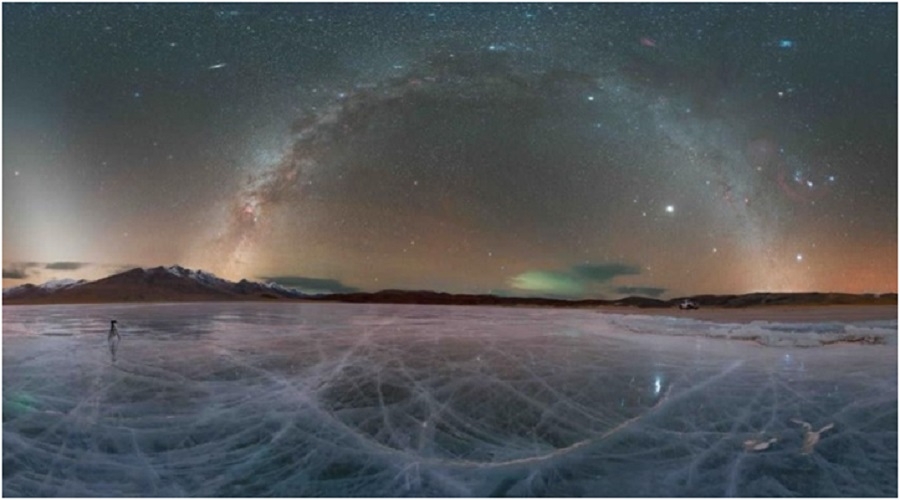
At nearly 5,000 metres above sea level, Chilling Tso is a remote high-altitude lake in Ladakh that transforms into a frozen, wind-scoured expanse each winter. Reached via a rough dirt track branching off the Hanle–Chumur road, even basic movement here is a challenge in sub-zero temperatures.
On January 10, a three-member team led by astrophotographer Dorje Angchuk—an Engineer-in-Charge at the Indian Astronomical Observatory, Hanle—braved these extreme conditions to photograph Jupiter at its brightest opposition. The expedition captured a rare celestial scene—Jupiter glowing over the frozen lake, accompanied by the faint zodiacal light in the same frame.
The result is a 360-degree panoramic image, stitched from multiple tracked exposures, revealing the pristine darkness of the Hanle Dark Sky Reserve—an extraordinary convergence of landscape and sky. Nearly 21 one-minute tracked panels were used to record the sky, while the frozen foreground was photographed with the tracker off to preserve depth and detail. Tracking was achieved using an iOptron SkyGuider Pro, stabilised on shifting ice amid strong winds.
"Our ancestors once learned from the stars—they were part of our everyday life. That's what I try to showcase in my recent work—true darkness, showing the land and the stars together without any artificial light," Dorje Angchuk says.
Extreme Conditions of Chilling Tso
In a conversation with ETV Bharat, Dorje Angchuk spoke in detail about the complexities and challenges of the expedition. "I'd been preparing for this trip for 15–20 days, thinking back to our previous visit on August 15, when two of our three vehicles got stuck even in summer. Attempting the same location in peak winter was far more intimidating, with extreme conditions making both reaching and returning a concern," Angchuk says. "I informed a colleague to send help if I didn't return by midnight, and he eventually joined me, which was reassuring."
"We arrived around 4:30 PM and began setting up. The shoot was far more challenging than expected—high altitude, intense cold, and strong winds made handling equipment extremely difficult. Even my tripod slipped on the ice, and aligning the tracker with the pole star demanded patience, as minor errors could ruin hours of work. Fingers went numb, and the shifting ice added to the difficulty," he adds.
"We travelled on a dirt track with the risk of getting stuck, and the frozen lake made conditions unpredictable. Fully prepared with extra clothes and sleeping bags, we spent nearly four hours shooting and packing up. Despite the harsh, chilling conditions, the effort was worth it," he further says, praising the modern and powerful equipment.
Expressing happiness over the final image, Angchuk calls it a "hard-earned success".
opposition and zodiac light alignment are rare and fleeting. Talking about the motivation to capture the moment, he says, "Jupiter's opposition had always been on my mind, but capturing the zodiacal light felt like icing on the cake—an unexpected bonus that made me truly happy. Earlier, some kids from Hanle village had visited the spot and shared images showing clear ice formations, which really encouraged me."
"Normally, most lakes in Ladakh freeze; their brackish water prevents the ice from becoming transparent. But this lake was different—the clarity clearly indicated clean water. Seeing that transparency convinced me it was worth attempting the shot, and that's what finally pushed me to go there," he adds.
about the dependence on technology, human judgment, and experience in unforgiving moments like these, he explains that while camera technology has improved significantly, reliable equipment and preparation are crucial in extreme conditions. Any failure in the cold can waste time and energy, so thorough practice beforehand is essential.
To stay prepared, Angchuk carries three cameras and tripods as backups. Owing to past challenges and earlier failures, only two setups were needed, while one remained unused. His main focus was capturing a 360° panorama, which required constant monitoring and attention.
Communicating Astronomy Through Images
about balancing scientific accuracy with artistic storytelling when creating images like this, Angchuk explains, "I enjoy connecting the landscape with the stars—that's my specialty and it gives me pure joy. While I can photograph deep-sky objects, they don't relate to the land in the same way. Ladakh has a stunning landscape, and the stars naturally complement it. I want to show both together, without heavy compositing or adding skies from elsewhere. Capturing the land and the stars in a single frame gives me great satisfaction. It also reminds people of what we're losing to light pollution."
Adding to this, Niruj Mohan Ramanujam, Head of Science Communication, Public Outreach and Education at the Indian Institute of Astrophysics (IIA), Bengaluru, emphasised the importance of visual storytelling in communicating complex astronomical research and highlighted the role of IIA in bridging science and society.
He said that traditional science education—textbooks and structured lab experiments—leaves little room for curiosity or play. To make people truly science-literate, science must be integrated into culture, like art, movies, or sports, using storytelling and, importantly, visual media. Striking photographs, like those of Dorje Angchuk, communicate complex astronomy far more effectively than words alone. Each image is carefully planned over days, with multiple elements crafted to appeal differently to viewers—astronomers notice celestial objects, artists see composition, and environmentalists may focus on ice and landscape.