Subsidy Challenge: Subsidy Bill Higher Than Combined Budget For Agriculture, Education, Health And Urban Development
Total Views |


Every year, the Union Government spends a considerable sum of the budget in providing relief to needy sections of the society, which includes farmers who require assistance for making fertilisers affordable, and other poor and downtrodden sections who need assistance for food and fuel.
This relief to the farmers for buying fertilisers at an affordable price is an indirect assistance, as financial support is given to fertiliser producers for selling urea and other fertilisers at an affordable price.
Similarly, fuel subsidy is also passed on through oil marketing companies, whereas food subsidy is given to nearly two-thirds of the country’s population either in the form of free food-grains or supplying food-grains at a heavily subsidised price.
The provision for this relief to the needy sections of society is described as a subsidy in the Union Budget. The Centre primarily gives subsidies under three heads – food, fuel and fertilisers. On average, financial assistance given to these three sectors alone accounts for nearly 8-9 per cent of the total budgeted expenditure of the Central government.
For example, the Union Government spent over Rs 3.85 lakh crores on food, fuel and fertiliser subsidies in the last financial year (FY 2024-25). It included over Rs 1.7 lakh crore on the fertiliser subsidy, Rs 2 lakh crores on giving subsidised food-grains and Rs 14,479 crores on fuel subsidy.
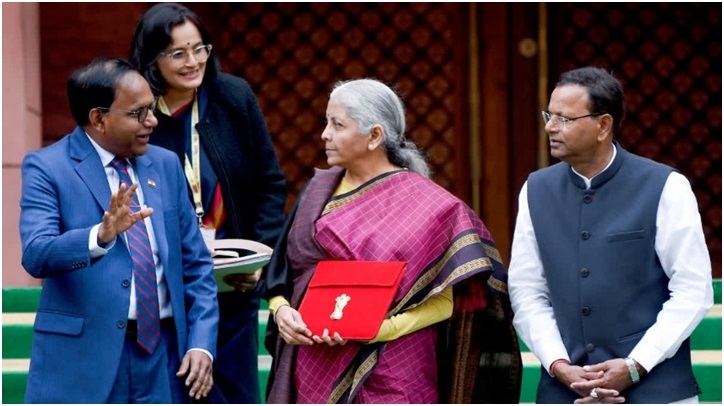
As per the revised estimates tabled by Finance Minister Nirmala Sitharaman on Sunday, the Centre’s subsidy bill for the current financial year ending in March is expected to rise to Rs 4.3 lakh crores, an increase of Rs 45,000 crores or 12 per cent over the subsidy bill for the last financial year.
This is mainly on account of higher provision for the food subsidy and fertiliser subsidy, which have been estimated at 2.28 lakh crores and over 1.86 lakh crores respectively.
Though the Finance Minister had estimated that the food subsidy bill would be in the range of Rs 2 lakh crores, almost at the same level as for the previous fiscal, it jumped to over 2.28 lakh crores, an increase of over 14 per cent.
Similarly, the fertiliser subsidy bill, which was estimated to be to the tune of Rs 1.68 lakh crores in the budget estimates for the current fiscal, jumped to over Rs 1.86 lakh crores as per the revised estimates tabled on Sunday, an increase of nearly 11 per cent. It was mainly on account of rupee depreciation against the US dollar and higher international prices for urea and other fertilisers.
The higher food subsidy bill has prompted the Finance Minister to make extra provision for the food subsidy for the next year, as she has allocated over Rs 2.27 lakh crore under this head, which is tad lower than the food subsidy bill for the current fiscal as per the revised estimates.
The food, fuel and fertiliser subsidy bill for the current fiscal (FY 2025-26) is estimated to be Rs 4.3 lakh crores, which is 8.66 per cent of the total budgeted expenditure for the current financial year ending in March.
The subsidy bill for the current fiscal (Rs 4.3 lakh crores) is higher than the cumulative expenditure of the Union Government on agriculture and allied activities (Rs 1,51,853 crores), education (1,21,949 crores), health (Rs 94,625 crores) and urban development (Rs 57,204 crores).
For the next fiscal (FY 2026-27), the subsidy bill is estimated to be over Rs 4.1 lakh crores, which will be higher than the combined allocation for agriculture and allied activities (Rs 1,62,671 crores), education (Rs 1,39,289 crores) and health (Rs 1,04,599 crores).