Bridging Communities: How A Muslim Woman’s Gajalakshmi 'Jhoti' Painting Lights Up Balasore Street
Total Views |


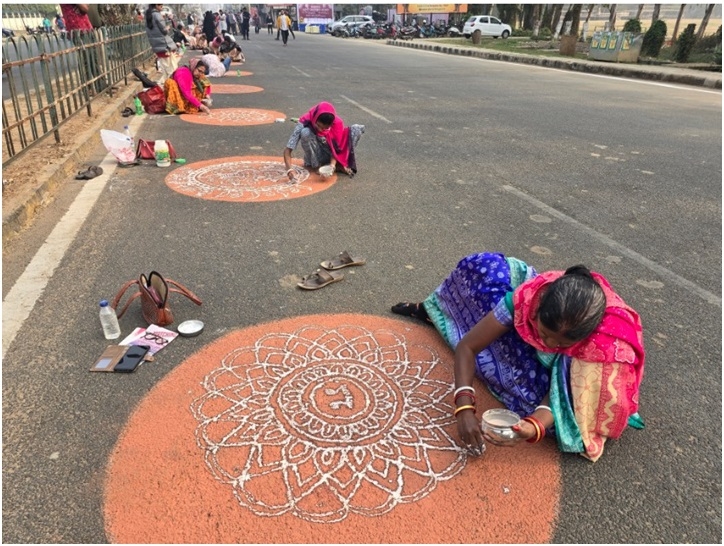
Sitting comfortably on the Old Trunk Road here under the open sky, Chandini Khatun, a young Muslim woman from Baripada, was dipping her fingers in white rice paste, carefully sketching the image of Maa Gajalakshmi with lotus, elephants and all characteristics associated with the goddess. Around her, there were many others who too were busy drawing their own art. But Chandini's art made passersby slow down and watch with awe. Even without realising that she was a Muslim, people praised her finesse and detailing in the art which typically is associated with Hindu Odias.
The moment captured more than artistic skill. It carried a message of communal harmony - that culture many times transcends religious identity.
Chandini and other women were participating in a jhoti competition, which is held annually in Balasore as a celebration of Odia art, culture and ritual. Jhoti, also called chita, is usually drawn by Odia women on walls and floors in houses in the month of Margashira to invoke and invite Goddess Laxmi besides during Makar Sankranti and other auspicious occasions. In recent years, however, the ritual has been sidelined due to the ease of pasting plastic stickers and modern décor.
Organised by the Utkaliya Jhoti Institute, nearly a kilometre of OT Road was transformed into a living canvas. Hundreds of young women and girls sat on the road reviving Odisha’s traditional Jhoti art using rice paste.
“I never tried drawing Jhoti at home. But I have been attracted to it since childhood after seeing it in a neighbour’s house. I started participating in competitions during school and college and gradually my interest in the art grew,” Chandini said.
Festival organiser Shilpi Keshu Das said the initiative is part of a long-term effort to give Jhoti national recognition as a floor art in India’s folk-art landscape.
Rangoli from Rajasthan and Kumkum from Kerala are nationally recognised. But Jhoti is not. You may take it as a movement that has been started to revive and protect it,” he said.
Among the many traditional and contemporary Jhoti designs on display, Chandini’s depiction of Gajalakshmi stood out, not because it was unusual, but because it reflected Odia iconography at its best. Her work earned her an award, which was presented by District Magistrate Suryavansi Mayur Vikas, drawing applause from both organisers and spectators.
“To keep jhoti art alive is everyone’s responsibility irrespective of whether Hindus, Muslims or Christians do it. Preserving tradition depends on all of us. Before religion, we are Indians first,” Chandini added.
Archana Nandi of the Utkal Jhoti Foundation, said around 100 contestants participated in the event, which featured both traditional and modern Jhoti competitions. “We see Jhoti slowly disappearing from homes. This competition is an effort to keep it alive,” she said.
Smita Panda, another participant echoed the sentiment. “Jhoti is ingrained in our culture and shows our respect for Maa Lakshmi. It is an integral part of our Laxmi Puja ritual. In fact, in every family, the art must pass down to generations,” she asserted.
Long after the awards ceremony, many feel, the rice paste art may fade with time from the road but Chandini’s Jhoti will remain imprint in public memory, reminding everyone that traditions survive not through boundaries, but harmony and a sense of belongingness.