Smarter Factories, Safer Workers: Tech Mahindra Showcases AI That Cuts Drudgery, Not Jobs
Total Views |


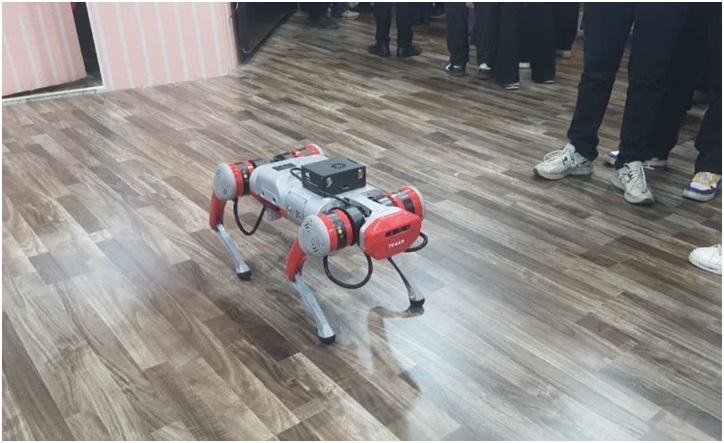
New Delhi : At a time when artificial intelligence is rapidly reshaping industries, the next frontier is no longer just digital, but physical. At the India AI Impact Summit, Tech Mahindra offered a glimpse into this transformation, where machines think, robots act, and factories evolve into intelligent, self-optimising systems.
Explaining this shift, Hemant from Tech Mahindra described what he called the convergence of two historically separate domains. “For many years, there were two parts of the world that were working separately. One was the brain, the other the body. While brain is AI, the body was always robotics,” he told ETV Bharat.
This integration of AI and robotics lies at the heart of what the company is showcasing at the Summit: A fully simulated, AI-driven factory floor where humans, machines, and robots work in seamless coordination.
One of the most critical innovations on display is simulation technology. Traditionally, factory setups have been prone to costly inefficiencies, from ordering wrong machinery to poor placement decisions.
“Most of the time, what happens is, when you start ordering machinery while land is being purchased, you end up ordering the wrong machinery, or more than what is needed,” Hemant explained. “It is only when it arrives that you realise the placement is incorrect. That’s why we do simulations.”
Using advanced computing power, Tech Mahindra is now enabling real-time, life-like simulations of entire shop floors. In one demonstration, a battery manufacturing unit was digitally recreated, allowing planners to test workflows, equipment placement, and production efficiency before physical deployment. “With all the compute power, your simulations are becoming real life and real time,” he added.
AI Meets Worker Safety
Beyond efficiency, safety emerged as a central theme. AI is now being utilised in hazardous industrial environments like battery manufacturing, to enforce compliance with safety measures that involve exposure to chemicals.
The example provided is where an employee damaging battery parts is being monitored via overhead cameras with machine learning capabilities. “If the worker is not wearing a glove, the machine won't move forward,” Hemant said, highlighting how AI can prevent long-term health risks.
The system also simplifies complex processes for workers with limited technical training. Step-by-step instructions displayed on screens guide them through standard operating procedures, ensuring consistency and reducing errors.
Reducing Physical Strain, Not Jobs
Contrary to fears of automation replacing human labour, Tech Mahindra emphasised augmentation rather than substitution.
In a typical warehouse, workers may walk up to 25-30 km a day transporting materials. Autonomous Mobile Robots (AMRs) now take over this physically exhausting task.