Between Markets and Power: India's Twin Trade Reset
Total Views |


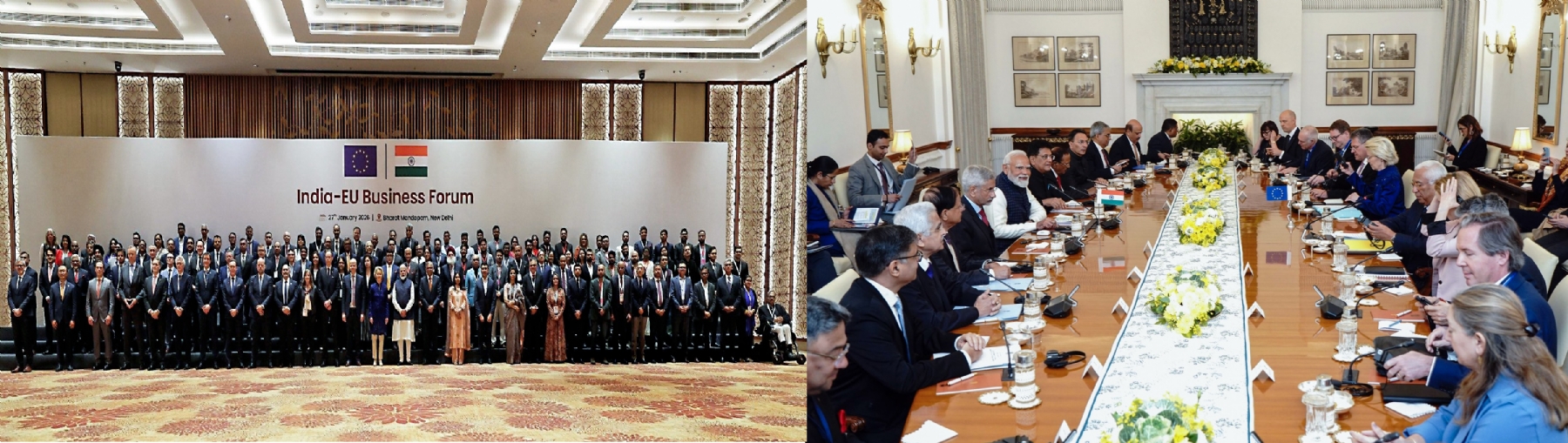
India struck two consequential trade deals within a matter of weeks, first with the European Union and then the much-awaited agreement with the United States. While both had been in the works for years, America’s shifting tariff policies have injected unprecedented urgency into global trade diplomacy, pushing states to pursue fresh agreements, diversify markets, and de-clutter supply-chain dependence on major economic hubs, especially the US and China.
For several years, US policy had encouraged a “China-plus-one” strategy, diversifying production away from exclusive reliance on China. With the return of Donald Trump, the calculus has shifted further: Washington is compelling partners not only to negotiate with it but also to broaden their trade engagements globally. Such re-strategising will yield uneven outcomes across countries, depending on economic scale, resilience, and openness.
In India’s case, the agreement with the EU, alongside ongoing negotiations with partners such as Canada and the Gulf Cooperation Council, appears to have nudged Washington toward finalising a bilateral trade deal with New Delhi. Both agreements are comparable in that they link India with the world’s largest and second-largest economic groupings. The EU arrangement connects India to a combined economic space estimated at roughly $24 trillion, benefiting close to two billion people.
The US deal, meanwhile, promises to unlock market opportunities worth hundreds of billions of dollars over time. A common thread across both agreements is their likely impact on India’s labour-intensive sectors such as textiles and apparel, marine products, leather and footwear, chemicals, plastics and rubber goods, sports equipment, toys, and gems and jewellery. Despite a period of domestic political contestation, the US agreement also holds the promise of easing economic frictions and restoring momentum to a relationship that had shown signs of strain.
The political and economic significance of these agreements reflects not only rapidly shifting global economic and strategic dynamics but also a critical juncture in India’s own growth story. China’s rise offers a useful reference point. When China initiated economic reforms in 1978, it ranked around 11th globally; when India liberalised in the early 1990s, it stood closer to 17th. These contrasts become even more striking when measured in per capita income terms. Such realities matter in a world order increasingly shaped by protectionist impulses and strategic competition.
Washington’s tariff activism has cut both ways for India, yet it has also nudged countries out of their comfort zones and toward deeper engagement with one another. Major economies such as Japan, Germany, and Brazil, as well as economic blocs like the EU, might not have felt the same urgency to conclude agreements with India absent these pressures.
India’s rise to become the world’s fourth-largest economy, and its trajectory toward third place, coincides with an unusually turbulent international environment. Just as India’s growth momentum was gathering pace, the world encountered a series of systemic disruptions: the COVID-19 pandemic, the Russia–Ukraine war, and the Palestine-Israel conflict, developments that have collectively unsettled the global order.
In contrast to China’s three decades of relatively unfettered growth within an open Western trading system, India’s rise is unfolding amid strategic rivalry and constrained economic openness. The world’s leading economic power is no longer inclined to extend unconditional market access, even to partners, while India’s relationship with China remains structurally constrained by an unresolved border dispute, making it a managed rather than transformative engagement.
India has long benefited from a broadly favourable relationship with the United States, reinforced by political convergence, a large diaspora, robust people-to-people ties, and shared interests in maintaining balance in the Indo-Pacific. Yet the terms of engagement are evolving as Washington’s approach to trade and economic partnerships becomes more transactional.
At the same time, recent years have demonstrated India’s capacity to absorb external economic pressure while sustaining growth momentum, an outcome partly rooted in the buffers created by its historically protected domestic economy.
With new agreements involving the European Union and the United States, alongside multiple free trade arrangements concluded in recent years and several more under negotiation, India is moving toward a markedly more open economic posture. This transition will inevitably entail adjustment costs, including greater competition and regulatory adaptation. For a large and ascending economy seeking deeper integration into global value chains, however, such trade-offs may represent a strategic price India is prepared to pay.