Modi Reaffirms ASEAN Centrality, Proposes New Initiatives On Maritime Security And Cybercrime
Total Views |


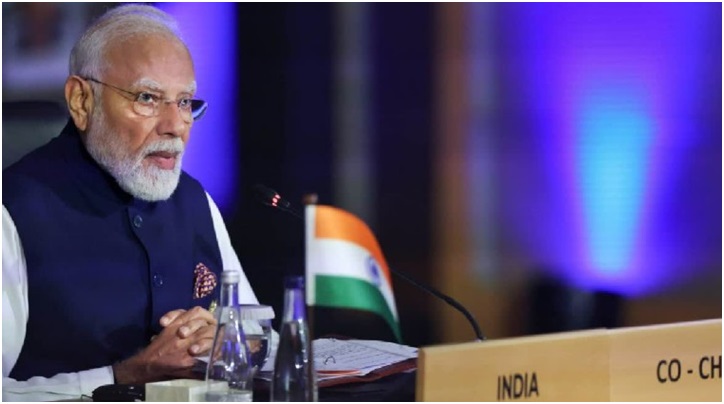
New Delhi: Prime Minister Narendra Modi has proposed a series of initiatives to expand India’s strategic engagement with Southeast Asia, focusing on maritime security, cybersecurity, artificial intelligence (AI), cultural heritage and higher education, while reaffirming ASEAN’s centrality in India’s Indo-Pacific vision.
Addressing the 21st East Asia Summit (EAS) in Manila on Tuesday, November 17, Modi said ASEAN (Association of Southeast Asian Nations) unity and centrality remained integral to India’s Act East Policy and reiterated New Delhi’s commitment to a free, open, inclusive and rules-based Indo-Pacific.
His address came amid growing geopolitical tensions, disruptions to international energy and food supplies, threats to commercial shipping and rising transnational cybercrime. Stressing that peace, stability and predictability were essential for economic prosperity, he called for greater regional cooperation to address emerging challenges.
Among the key announcements were a Seafarers’ Safety Initiative, an East Asia Summit Cyber Crime Conference at India’s National Forensic Sciences University, a Maritime Heritage Festival at Lothal in Gujarat, and a University Heads Conclave at Nalanda in Bihar in 2027.
The proposals reflect India’s intention to broaden its engagement with ASEAN beyond conventional diplomatic, economic and defence cooperation by combining its technological and institutional capabilities with longstanding historical and cultural connections.
ASEAN centrality at the heart of India’s Indo-Pacific vision
Modi’s emphasis on ASEAN centrality reiterates India’s position that the grouping must remain at the centre of the evolving regional architecture.
India’s engagement with ASEAN began with sectoral dialogue relations in 1992 and progressed to a full Dialogue Partnership in 1995, a Summit-level Partnership in 2002 and a Strategic Partnership in 2012. The relationship was elevated to a Comprehensive Strategic Partnership in 2022, reflecting growing convergence across economic, political and security domains.
ASEAN’s importance extends beyond trade. Its geographical position between the Indian and Pacific Oceans gives it considerable strategic significance, with several members located along vital international shipping routes. The region also offers access to major manufacturing centres, expanding consumer markets and integrated production networks.
For India, closer economic integration with Southeast Asia is important for connecting its northeastern states with regional markets and strengthening its Indo-Pacific presence. Consequently, the Act East Policy has evolved into a broader framework encompassing connectivity, defence, maritime security, investment, technology and people-to-people exchanges.
The emphasis on ASEAN centrality also reflects India’s approach to intensifying strategic competition, particularly between the US and China. Maritime disputes, military modernisation and competing security interests have heightened regional uncertainty.
New Delhi favours an inclusive regional order in which ASEAN-led institutions provide platforms for dialogue among major powers and facilitate peaceful management of differences.
The East Asia Summit, comprising ASEAN members and India, China, Japan, South Korea, Australia, New Zealand, the US and Russia, is an important forum for such engagement. India’s participation reflects its preference for regional cooperation based on international law, mutual respect and dialogue rather than exclusive geopolitical arrangements.
Referring to conflicts in Ukraine and West Asia, Modi highlighted the wider consequences of geopolitical instability, including disruptions to energy supplies, food security, fertiliser availability and international shipping. For India and ASEAN, whose economies depend heavily on global trade and maritime transportation, maintaining predictable economic and security conditions is a common priority.
Maritime security and seafarers’ safety
The proposed Seafarers’ Safety Initiative seeks to strengthen regional cooperation through joint training and improved emergency response mechanisms, addressing growing concerns over threats to commercial vessels and their crews.
Southeast Asia occupies a critical position in global maritime transportation. The Malacca Strait connects the Indian Ocean with the South China Sea and the wider Pacific, making it one of the world’s most important shipping corridors.
Disruptions caused by military confrontation, piracy, attacks on commercial vessels or restrictions on navigation can have serious consequences for international trade and regional supply chains. India has a direct interest in protecting these routes because of its dependence on maritime transportation for energy imports and overseas commerce. ASEAN countries share similar concerns.
The proposed initiative could facilitate cooperation in emergency preparedness, professional training, information-sharing and capacity-building, with particular attention to protecting seafarers. It complements India’s MAHASAGAR (Mutual and Holistic Advancement for Security and Growth Across Regions) vision, which seeks to strengthen maritime security and economic cooperation across the Indian Ocean and Indo-Pacific.
The initiative also gains relevance from the designation of 2026 as the ASEAN-India Year of Maritime Cooperation. India has been pursuing greater collaboration in maritime domain awareness, naval exchanges, disaster management, marine research and protection of shipping routes.
By focusing on the safety of maritime personnel, the new proposal adds a practical dimension to these efforts and reinforces the shared interest in keeping regional waterways secure for international commerce.
Cybercrime and AI emerge as new priorities
Modi also highlighted the growing threat of transnational cybercrime, particularly online financial fraud and scams, which have become serious challenges for governments, financial institutions and law enforcement agencies.
Expanding digital connectivity has created opportunities for commerce and financial inclusion but has also enabled criminal networks to exploit technological vulnerabilities and operate across national boundaries.
To address these threats, Modi proposed an East Asia Summit Cyber Crime Conference at India’s National Forensic Sciences University. It would bring together law enforcement agencies, forensic specialists and policymakers to exchange information, share investigative techniques and develop coordinated responses to cross-border cybercrime.
He also welcomed the joint statement adopted at the summit on combating online scams, underlining the need for collective regional action. On Artificial Intelligence (AI), Modi advocated human-centric, inclusive and safe applications of the technology. He drew attention to digital watermarking as a possible means of identifying manipulated content, deepfakes and misinformation.
As AI becomes increasingly influential in financial services, public administration and communications, cooperation in AI governance, cybersecurity, digital infrastructure and technology standards could emerge as an important component of India-ASEAN relations.
The proposed conference reflects India’s willingness to share its institutional and technological expertise with regional partners in tackling emerging security challenges.
Cultural heritage and academic cooperation
Beyond technology and security, Modi sought to strengthen the historical and cultural foundations of India’s relationship with Southeast Asia.
Centuries of maritime trade, religious interaction, migration and cultural exchanges connected the Indian subcontinent with Southeast Asian societies. These links continue to be reflected in the region’s architecture, languages, literature, religious traditions and artistic heritage.
To highlight this shared legacy, Modi announced an East Asia Summit Maritime Heritage Festival at Lothal in Gujarat, where India is developing the National Maritime Heritage Complex.
Lothal was an important trading centre of the Indus Valley Civilisation, and its archaeological remains provide evidence of ancient maritime commerce and overseas trading connections. The proposed festival will showcase the shared maritime traditions of India and Southeast Asia, including seafaring, trade and cultural interaction.
Higher education is another proposed area of cooperation. Modi announced that India would host an East Asia Summit University Heads Conclave at Nalanda in 2027.
Nalanda was among ancient Asia’s most influential centres of learning and attracted scholars and students from across the region. Cooperation in science, technology, AI, digital innovation and sustainable development offers considerable potential for strengthening academic links between India and Southeast Asian countries.
Treaty of Amity and Cooperation reinforces regional principles
Modi’s reference to the 50th anniversary of the Treaty of Amity and Cooperation (TAC) in Southeast Asia was significant amid intensifying geopolitical competition and regional tensions.
Signed in Indonesia in 1976, the Treaty established principles governing relations among Southeast Asian countries, including respect for sovereignty and territorial integrity, non-interference in internal affairs, peaceful settlement of disputes and rejection of the threat or use of force.
Over five decades, the TAC has become an important foundation of ASEAN’s diplomatic framework, with countries outside Southeast Asia also acceding to it. India joined the Treaty in 2003, reflecting its commitment to ASEAN’s principles and regional institutional engagement.
Expanding economic and strategic cooperation
The initiatives announced at the EAS formed part of a wider agenda outlined by Modi at the 23rd ASEAN-India Summit in Manila earlier in the day.