'India's Aviation Sector On Brink Of Major Transformation', Says Union Minister Dr Jitendra Singh
01 Dec 2025 15:49:07
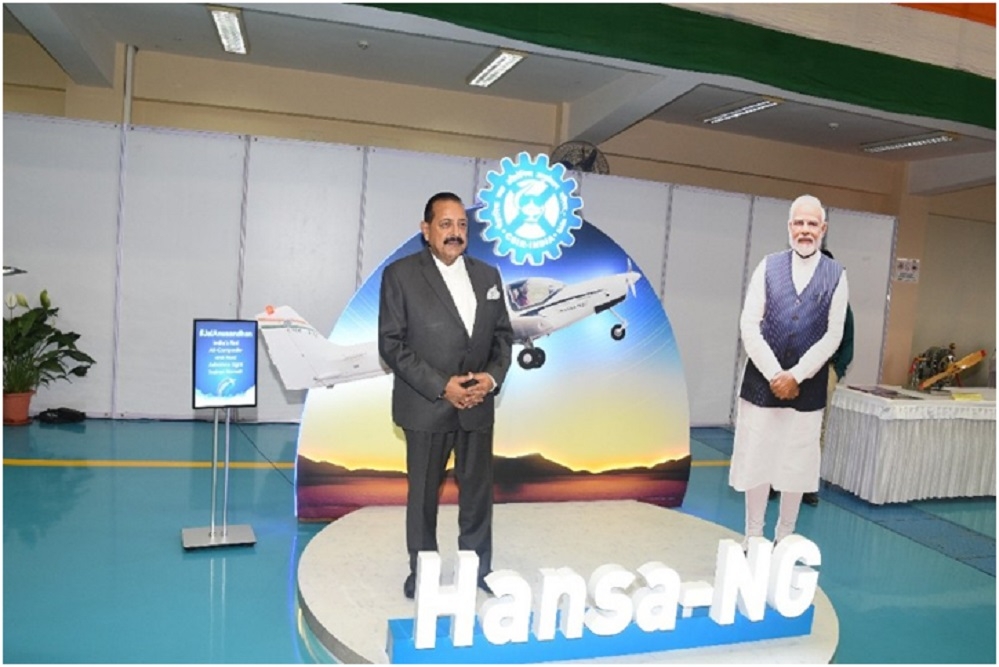
India’s aviation sector is on the brink of a major transformation, Union Minister of State for Science and Technology Dr Jitendra Singh said on Saturday as he unveiled the production version of the HANSA-3 NG aircraft and inaugurated the Saras Mk-2 Iron Bird Facility, the new High-Altitude UAV manufacturing line, and the NAviMet aviation meteorology system.
With recent reports indicating that the country will need nearly 30,000 pilots over the next 15–20 years—up from the current 6,000-7,000—the push for indigenous aircraft manufacturing has never been more critical.
In a significant boost to this vision, Pioneer Clean Amps Pvt. Ltd. (PCA) is setting up a state-of-the-art facility in Kuppam, Andhra Pradesh, to manufacture 70–100 aircraft annually, generating employment for about 250 people and advancing the ideals of Atmanirbhar Bharat.
Speaking after the virtual inauguration in Bengaluru, Dr Singh said the collaboration will accelerate India’s indigenous aircraft ecosystem and position the HANSA-NG on the global stage.
Lauding CSIR–NAL’s collaboration with industry partner Solar Defence & Aerospace Ltd, the minister noted that CSIR has launched a major project for the indigenous design, development, and testing of a 150 kg-class Loitering Munition (LM) UAV. The UAV will be powered by NAL’s indigenously developed Wankel engine, already certified by CEMILAC for aircraft integration and flight qualification.
India Aviation Sector
Dr Jitendra Singh with Dr Abhay A Pashilkar, Director, CSIR-NAL; Dr C M Ananda, Programme Director (Civil Aircraft Programmes) along with other Directors and staff members at CSIR-NAL program. (ETV Bharat)
He stated that the LM-UAV will match the performance of leading global systems in its class, offering a range of 900 km, endurance of 6–9 hours, and a service ceiling of 5 km. The platform will incorporate advanced features such as GPS-denied navigation, low radar cross section, and AI-enabled Detection, Recognition & Identification (DRI) capabilities.
The Minister emphasised that the collaboration with Solar Defence & Aerospace Ltd (SADL), Nagpur, initiated at the design and development stage, represents an exemplary Public–Private Partnership (PPP) aimed at delivering a Make-in-India solution for the armed forces. He expressed confidence that the joint efforts of CSIR and the Solar Group will significantly contribute to realising the Prime Minister’s vision of Atmanirbhar Bharat, strengthening India’s self-reliance in defence manufacturing.
The minister highlighted that India is poised to emerge among the world’s top three nations in domestic and international passenger traffic, backed by its strategic geographical location, a 300-million-strong middle class, and a rapidly expanding economy. In this context, he noted that CSIR–NAL is positioned to capture major opportunities in the aviation sector, having developed strong capabilities in the indigenous design and development of pressurised aircraft.
Highlighting ongoing advancements, the Minister said CSIR–NAL is currently developing the 19-seater LTA–SARAS Mk-2 aircraft, equipped with digital avionics, a glass cockpit, autopilot, command-by-wire flight controls, a pressurised cabin, and significant improvements in drag and weight reduction to meet IAF requirements.
The aircraft is being designed for both civil and military operations, with the Indian Air Force already issuing a Letter of Intent to procure 15 aircraft for troop transport.
Inaugurating the Iron Bird Facility for SARAS Mk-2, the Minister said the test platform will play a critical role in integrating and validating all major aircraft systems on the ground, helping identify design issues early, reduce risks and costs of flight testing, enhance safety, and significantly shorten development timelines.
The minister also inaugurated the dedicated manufacturing facility for High-Altitude Unmanned Aerial Vehicles (UAVs) capable of operating above 20 km in the stratosphere for military, civil, and scientific applications. He noted that only a few nations—such as the USA, UK, Germany, South Korea, New Zealand, and Japan—are pursuing similar programs.
With CSIR–NAL’s initiative, India now joins this elite group of advanced aerospace nations. CSIR–NAL’s subscale prototype has already reached 7.5 km altitude with 10 hours of endurance, and the first full-scale flight to 20 km is planned for March 2027. This facility will enable research into cost-effective alternatives to satellite technology, he added.
The minister further inaugurated the NAviMet (NAL Aviation Meteorological) System at HAL Airport, Bengaluru. He stated that this indigenous weather monitoring system measures critical aviation parameters such as visibility, temperature, humidity, wind speed and direction, pressure, and present weather.
The first NAviMet system was commissioned in 2022 at HAL’s Tumakuru Helicopter Manufacturing Facility, inaugurated by the Prime Minister. The Minister expressed pride in unveiling the second installation at HAL Airport today.
It is pertinent to mention that CSIR-National Aerospace Laboratories (NAL), a constituent of Council of Scientific and Industrial Research (CSIR), under the aegis Ministry of Science & Technology, Govt. of India has indigenously designed and developed HANSA-3(NG) trainer aircraft for commercial pilot licensing (CPL).
It has designed indigenous 19-seater Light Transport Aircraft (LTA) under development for connecting Tier-1 & Tier- 2 cities. High Altitude Platform (HAP) – India’s Initiative for a high altitude solar powered drone to undertake persistent surveillance. NAviMet (DRISHTI and AWOS) for Safe Landing & Take-off Operations at Airports and Collaborative project on 150 kg class Loitering Munition – UAV (LM-UAV) with industry partner M/S Solar Defence & Aerospace Ltd.
On the sidelines of the programme, ETV representative Dr Anubha Jain spoke with Dr Singh and asked about the Ministry’s strategy to position platforms like SARAS Mk II, HANSA 3 PS, and upcoming UAV systems in the global market. The Minister said that in recent years, India has rapidly expanded its airport network, creating an urgent need for more trained pilots.
The indigenous Hansa-3 (NG)—taken up for demonstration and commercialization in April this year—has now been unveiled within just six to seven months, marking a major milestone. With this, Indian pilots no longer need to travel abroad for basic flight training.
The minister noted that Prime Minister Narendra Modi’s proactive engagement with the private sector and supportive policies have enabled successful PPP-driven models, including this initiative. He added that the 19-seater SARAS Mk-II, designed for the middle-class traveller and ideal for regional and charter routes, also showcased its simulation model at the event.
He emphasized that technological advancements once considered the domain of foreign nations are now being developed in India, and the day is not far when aircraft manufactured in India will be exported to the world.
Responding to a question by Anubha on India’s next major technological leap—whether hybrid-electric propulsion, advanced composites, autonomous regional aircraft, or high-altitude pseudo-satellites—the minister said that India is already advancing on all these fronts. He noted that these systems are autonomous, indigenous, and increasingly reliant on clean energy. Highlighting ongoing progress, he pointed out that solar panels generating nearly 500 watts are already being used to power aircraft technologies.
“We are addressing multiple targets set by Prime Minister Modi,” he said, adding that the day is not far when India will operate at least a few aircraft powered entirely by clean energy.
When Anubha asked how the operationalization of the Iron Bird facility would reduce testing time compared to earlier practices that often required foreign collaboration, the minister said that the facility allows real-time testing during the aircraft development process. Any fault can be identified and corrected immediately, resulting in significant savings in time, cost, and effort, while ensuring faster and more efficient validation of systems.