CSIR Leaders Highlight Innovations In UAVs And Other Initiatives Aimed At Achieving Self-Reliance
01 Dec 2025 15:52:21
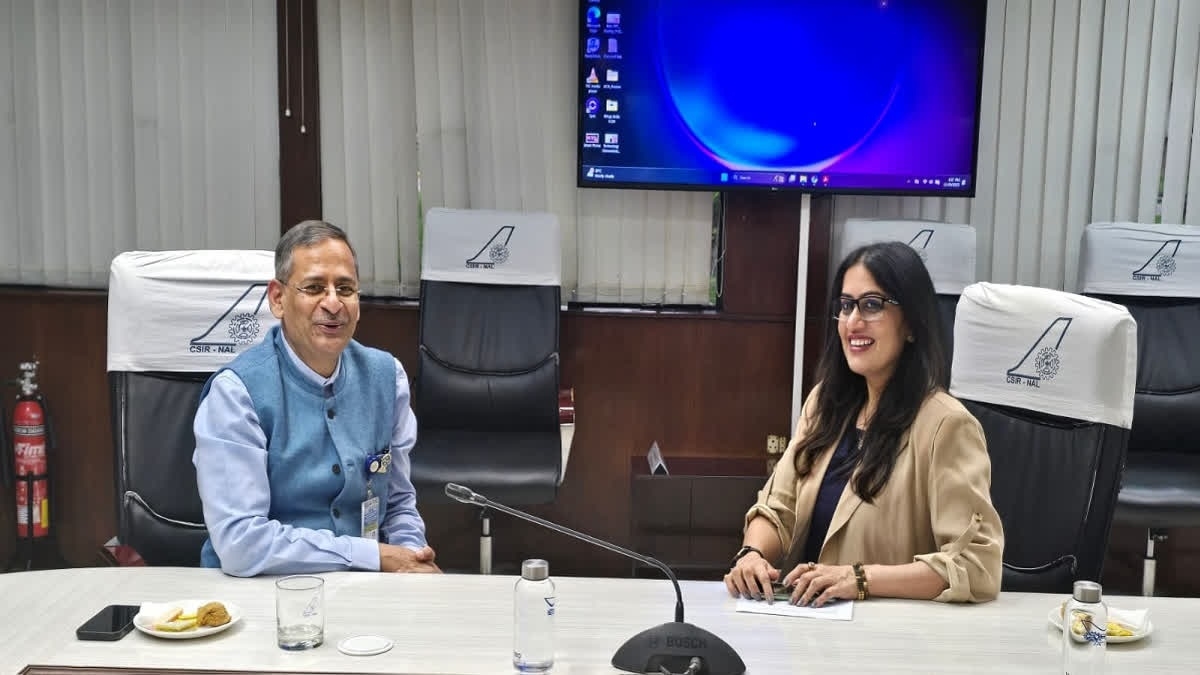
Bengaluru: On the occasion of unveiling the HANSA-3 NG aircraft, the Saras Mk-2 Iron Bird Facility, the High-Altitude UAV manufacturing line, and the NAviMet meteorology system on Saturday, CSIR leaders discussed India’s strides in indigenous aerospace and defence technologies. They highlighted innovations in UAVs, electric propulsion, semiconductors, and aviation infrastructure aimed at achieving self-reliance and advanced capabilities.
ETV Bharat's Dr Anubha Jain interacted with Dr Abhay A Pashilkar, Director, CSIR-NAL; Dr CM Ananda, Programme Director (Civil Aircraft Programmes); Dr Naresh Chandra Murmu, Director, CSIR-CMERI; Dr PC Panchariya, Director, CSIR-CEERI; Dr GK Patra, Director, CSIR-4PI at CSIR-NAL in Bengaluru on Saturday.
Responding to Anubha's question on the long-term roadmap for expanding India’s advanced aerospace testing infrastructure, Dr Pashilkar said traditionally NAL has been carrying out testing. "NAL works closely with ISRO, DRDO, and other strategic and atomic sectors in aerospace, mechanical engineering, and embedded systems," he said. Given the sensitivity of air-vehicle data, he emphasized that testing within the country is essential to protect critical performance information. He added that the Defence Ministry has recently initiated a major national effort to identify and develop all essential test facilities required to achieve true self-reliance. This includes infrastructure for electronics, structures, aerodynamics, engine test beds, airborne test platforms, and even capabilities to detect counterfeit electronics. A significant investment in these facilities is already in process, aimed at reducing foreign dependence and accelerating project timelines.
On the occasion of unveiling the HANSA-3 NG aircraft, the Saras Mk-2 Iron Bird Facility, the High-Altitude UAV manufacturing line, and the NAviMet meteorology system, CSIR leaders discussed India’s strides in indigenous aerospace and defence technologies. They highlighted innovations in UAVs, electric propulsion, semiconductors, and aviation infrastructure aimed at achieving self-reliance and advanced capabilities
When Anubha asked how government policy encourages deeper participation of private players and startups in aircraft development in UVA programmes, Dr Pashilkar said that from the CSIR perspective, "many of our laboratories have been collaborating with industry for decades, with the aim of transferring technology, generating new knowledge, and developing innovative products". He said, "The Loitering Munition UAV and the high-altitude solar-powered drone are prime examples of such efforts. Additionally, we develop smaller vertical takeoff drones and quadcopters, widely used in agriculture and other civil applications, supported by our laboratories working on precision agriculture".
Looking ahead, initiatives like the National Drone Mission and upcoming programs such as Drone Shakti will focus on both military and civilian applications, including schemes like Drone Didi, to build a robust drone ecosystem. Currently, India depends heavily on imported raw materials, components, and systems, with most players acting as integrators rather than engaging in end-to-end design and development. Recognizing the strategic importance of critical minerals, CSIR laboratories are actively working to enhance domestic self-reliance, optimize existing resources, and secure supply chains for sustainable growth, Dr Pashilkar said.
Anubha asked about the Ministry’s roadmap for modernizing India’s aviation navigation and meteorology infrastructure. Dr Ananda, explained that earlier, such systems were imported. CSIR and NAL have now designed and deployed a fully indigenous system, with nearly 175 units across 120 airfields in the country, serving both civilian and military operations. He highlighted the system’s critical role in visibility measurement for safe landings, which is mandatory for pilots before approach. The system, called NAviMet, integrates visibility and weather monitoring, providing real-time information to pilots through a nationwide network. It has been operational 24/7 for over a decade and is considered one of the most essential systems for aviation safety, especially during months with poor visibility such as November to February.
In heavily trafficked airports like Delhi, there are more than 13 installations with each runway requiring two installations, making it one of the most widely used and vital systems across India’s airfields.
Talking about electric propulsion, Dr Murmu, said most critical motors and electronics are currently imported, and this is where CSIR-CMERI aims to contribute. He highlighted ongoing projects addressing key challenges such as power-to-weight ratio, which is crucial for aircraft. “We have currently achieved up to 4 kW/kg, and our target is to reach a minimum of 8–9 kW/kg,” he said.
He also noted that efforts are underway in aluminium-nitride-based electronics for precise motor control and analysis, along with other advanced electronic systems required for efficient electric propulsion.
Continuing the discussion, Dr Panchariya, highlighted India’s growing focus on electronics and semiconductors. “The Government of India’s Semiconductor Mission, with an outlay of Rs 76,000 crore, reflects this priority. CSIR-CEERI, based in Rajasthan, has been working on electronics for over four decades, and India’s semiconductor journey started here,” he said. He added that the institute develops a wide range of sensors, including those currently imported, as well as LED lights and specialized solar panels. Work is also underway on advanced solar cells and other semiconductor components. “Through these initiatives, we are contributing significantly to India’s electronics and semiconductor ecosystem,” he concluded.
Concluding the discussion, Dr Patra, Director, CSIR-4PI, said that in the Loitering Munition (LM) UAV project, the institute is contributing in secure communications, particularly encryption and post-quantum algorithms to make communication quantum-proof.
He added that CSIR-4PI is also developing intelligent vehicular health monitoring systems, leveraging AI and ML to predict the remaining lifespan and performance of components. “We are still a young lab—just one and a half years old as a national laboratory, though our roots go back to 1988 as a unit within NAL. Our focus is on addressing national challenges using AI, ML, and data science applications,” he concluded.