Voice of Rhythm with Sandip Soparrkar Robots Take to the Dance Floor
‘India willing to help end Russia-Ukraine conflict’
Total Views |


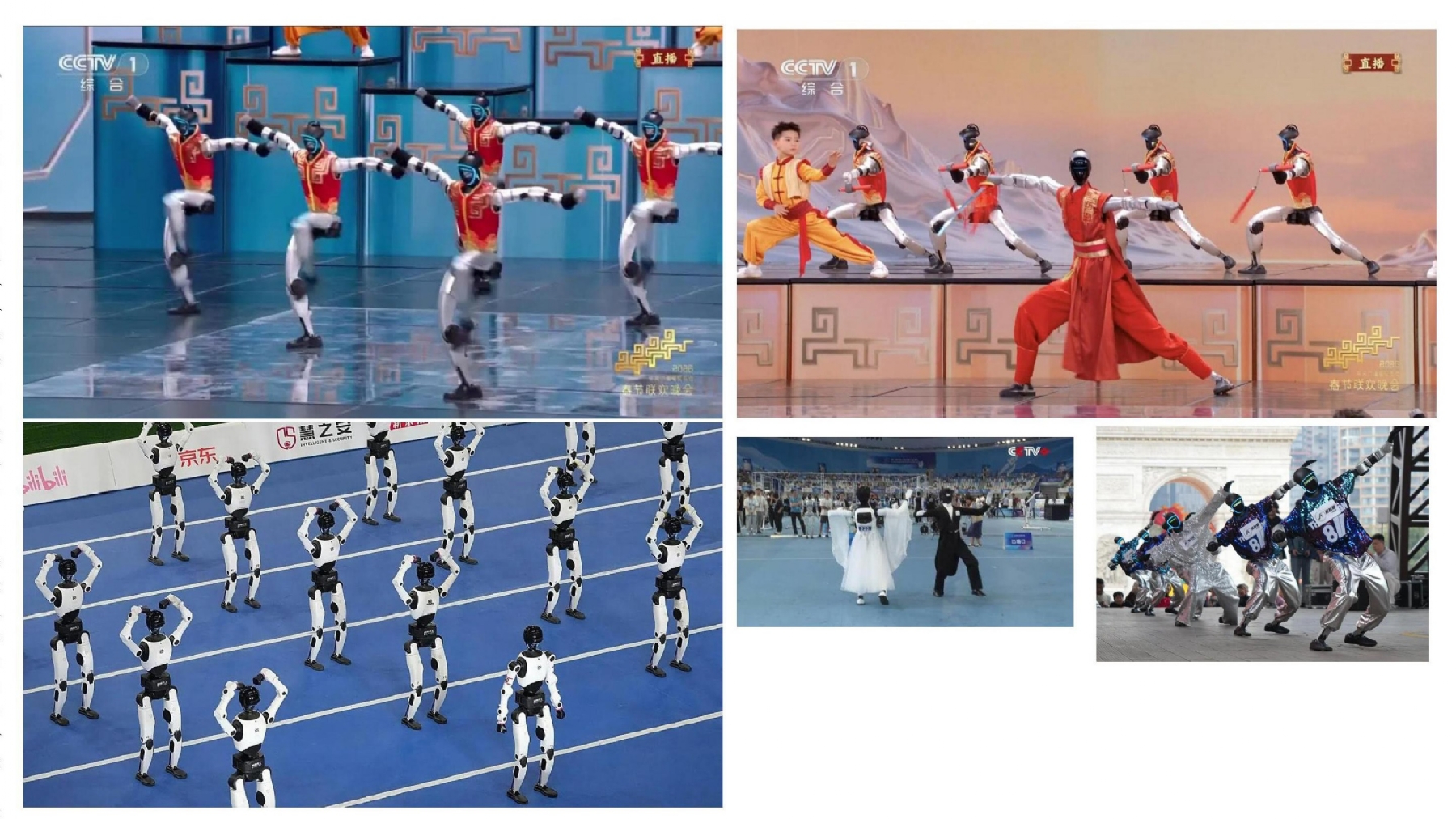
Recently on August 25, 2026, Beijing witnessed a performance that seemed to belong more to science fiction than to a sports arena: humanoid robots competing in dance.
As part of the 2nd World Humanoid Robot Games, held from August 22 to 26 at Beijing’s National Speed Skating Oval—popularly known as the “Ice Ribbon”—robots competed in an extraordinary range of sporting and practical challenges. More than 2,000 humanoid robots representing 666 teams from 16 countries took part in 51 events. Among the newest and most intriguing additions was dancesport, bringing together the worlds of technology, athleticism, music and choreography.
The inclusion of dance was significant. Dance is not simply about moving the body from one position to another. It requires rhythm, musicality, balance, coordination, expression, spatial awareness and, particularly in partner dancing, an almost intuitive understanding between two performers. Teaching a machine to reproduce these qualities presents a very different challenge from making a robot run or lift weights.
This year’s robot dance programme was divided into three categories: street dance, cheerleading and dancesport. The response was remarkable. The number of teams participating in dance-related events increased dramatically, from 29 in the previous edition to 108 teams this year.
The most distinctive new addition was dancesport, in which two humanoid robots performed as a pair. The robots competed in Waltz and Samba, two dances that demand very different qualities from a performer.
The Waltz requires elegance, controlled turns, rises and falls, flowing movement and an awareness of the partner. Samba, on the other hand, demands a much more energetic quality, rhythmic precision and complex body movement. For a humanoid robot, reproducing these contrasting movement vocabularies is an impressive technical challenge.
What made the competition even more extraordinary was that the two robots had to coordinate with each other autonomously. They were required to recognise each other’s positions, maintain appropriate distance and execute their movements together without remote human intervention. Advanced visual-perception and trajectory-coordination systems allowed the machines to continually adjust their movements in relation to their partners.
The August 25 final demonstrated just how far this technology has progressed. A pair performing the Waltz emerged victorious, impressing observers with synchronised turns, rises and falls and swinging movements.
For the dance world, this raises a fascinating question: Can a machine really dance?
Technically, a robot can be programmed to execute movement. But dance has traditionally been considered much more than movement. A dancer interprets music, communicates emotion, responds to another dancer and uses the body as an instrument of expression. In partner dancing, communication can occur through the smallest changes in weight, posture, timing and direction.
The robot competition attempted to translate some of these fundamental principles into the language of artificial intelligence and robotics. The judging system itself reflected this connection. Nine judges evaluated the performances, with the highest and lowest scores removed before the remaining scores were averaged. Performances were assessed across three broad areas: motion control, multi-robot coordination and artistic choreography.
The street-dance competition presented another challenge. Robots had to coordinate multiple joints—including wrists, ankles, waist and torso—to reproduce the detailed movements associated with human street dance. Cheerleading, meanwhile, focused heavily on group coordination, with several robots changing formations autonomously and performing together.
The significance of the event extends beyond entertainment. The Games were designed to demonstrate advances in humanoid robotics and explore how machines might eventually function alongside humans in real-world environments. The competition included not only sports such as football, table tennis, boxing and athletics, but also practical tasks involving industry, hospitality, household work and emergency response.
The dance floor, therefore, became another laboratory.
Watching a pair of robots glide through a Waltz may initially appear amusing or futuristic. Yet behind every turn and every carefully synchronised step lies a complicated combination of sensors, artificial intelligence, mechanical engineering, balance control and motion planning.
There is also something symbolically beautiful about the experiment. Dance has always evolved alongside technology. Music, costumes, lighting, stage machinery and digital media have continually expanded the possibilities of performance. Now robotics is entering that conversation.
The Beijing competition does not mean that robots have suddenly acquired the soul of a human dancer. Human dancers still possess something machines cannot easily reproduce: lived experience, emotion, intuition and the ability to transform a movement into a personal artistic statement.
But the sight of humanoid robots dancing together suggests that the boundary between technology and performance is becoming increasingly fluid.
Beijing’s dance floor was therefore more than a competition arena. It was a glimpse into a possible future—one in which choreography may involve both human and artificial performers, where technology becomes a new instrument of movement, and where the ancient language of dance finds itself being explored by one of humanity’s newest creations: the humanoid robot.