Pitru Paksha 2026: How Unresolved Family Patterns Show Up In Your Kundli
Total Views |


Pitru Paksha in 2026 starts on September 26 and ends on October 10. It opens with Purnima Shraddha and culminates with Sarva Pitru Amavasya. Some calendars start the count on September 26, while others place it on September 27. The difference comes down to how the tithi falls that particular year. It sounds like a small detail, but it matters. None of this was ever meant to run on a fixed date convenient for everyone. It runs on the moon.
“This year, there is a peculiar overlap on September 30, when two Shraddha tithis fall on the same day. So anyone observing an ancestor's death anniversary around then needs to check the Panchanga rather than just reaching for last year's calendar,” says Acharya Poonam Dutta (Satyamshakti), Vedic astrologer, certified hypnotherapist and spiritual counsellor. She is also the Founder and Chief Astrologer of Annant Drishti Aadhyatam Peetham in Mumbai.
Sixteen days, each one associated with a different category of ancestors. That's the actual structure underneath what most people simply call “shraddh season.” Acharya Dutta explains how unresolved patterns in your family show up in your birth chart.
What To Look For In The Chart
People hear the phrase “Pitru Dosha” and immediately picture something angry sitting in the family line, waiting to cause trouble. That's not really what it meant originally. It points more towards something left undone, a thread in the family history that was never properly tied off. Reading it in a chart isn't as simple as spotting one planet in one house and declaring a verdict. It requires a wider look: the Sun, the ninth house and its ruler, the fourth house, the Moon and the fifth house, all considered together and interpreted in the context of whatever stage of life a person happens to be in.
Teen devotees offering Tarpan
"Start with the Sun, since that's usually where the paternal thread lives, along with a person's sense of authority and self-worth. The Sun sitting close to Rahu, or coming under Saturn's influence, doesn't automatically spell disaster. It can instead be a prompt to look more closely at the father's story. A lot of people with such combinations may have grown up with fathers who checked out early," says Acharya Dutta.
Others may have had fathers who were buckling under pressures nobody talked about, or who were still carrying something unresolved from their own childhood. Right next to this sits the ninth house, associated with dharma and inherited fortune, as well as the ethical and philosophical weight a family carries forward. When it is under strain, people sometimes describe a particular kind of frustration: the timing never quite lines up, opportunities seem to collapse just before they are supposed to work out, or life repeatedly feels as though it is getting in its own way. It can feel almost as if something further back in the chain has not yet been settled.
The fourth house tells another part of the story. It represents home, roots and whatever sense of safety was built in early life. Mars or Saturn strongly influencing this house can be seen in families that have experienced property disputes, forced relocations or homes that looked perfectly fine from the outside but carried considerable tension behind closed doors.
Moon Brings In Emotional Residue
The Moon, particularly when associated with Ketu, brings in the emotional residue: families where grief happened but nobody spoke about it, where silence became the default response. None of these should be treated as a diagnosis. They are starting points; invitations to have conversations that many families may have been avoiding for a generation or two. This is where actual research begins to matter, as something that offers a parallel way of understanding what tradition has been describing for centuries.
Research into intergenerational trauma suggests that children of people who have experienced severe hardship can develop altered stress responses, shaped by upbringing, family dynamics and the stories passed down through generations. Some studies have also explored biological changes associated with how stress is regulated in the body. That isn't proof that karma sits inside a single strand of DNA. But it does echo something Jyotish vidya has assumed for centuries in its own language: pain that remains unresolved in one generation can shape the next generation's nervous system, choices and relationships, whether or not anyone ever names it.
What Actually Helps During Pitru Paksha
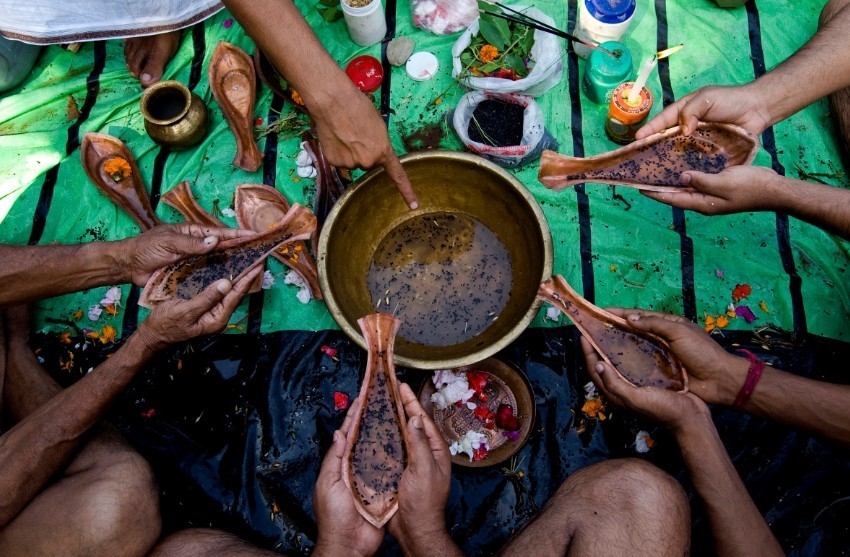
It works best on two levels at once. There is the ritual piece: performing Tarpan properly, offering water and black sesame with attention rather than rushing through it like a chore, observing Shraddha on the correct tithi when the family knows it, or observing Sarva Pitru Amavasya when the specific tithi is unknown. Then there is the part people conveniently skip: the behavioural piece. A family caught in a cycle of property disputes needs the paperwork sorted out today, not another round of offerings. A family with a history of sidelining its women needs to practise fairness and respect towards the women who are still alive, not only perform rituals in the memory of those who have passed.
One thing worth trying this fortnight is to sit down and actually map out three generations. Write down the early deaths and the silences nobody ever explained. The debts that were written off and never mentioned again. The ambitions someone abandoned because the family needed them to. The land disputes that were buried rather than resolved. The relationships that broke without anyone ever explaining why. Most people who sit with this exercise long enough may begin to notice that some patterns were not as random as they first appeared. Seen this way, Pitru Paksha stops being only about appeasing something from the past. It becomes an opportunity to look at that past clearly enough to understand it, and finally, to stop repeating it.