India-CELAC Partnership Gains Momentum Amid Shifting Global Geopolitics
Total Views |


New Delhi : At a time when geopolitical rivalries, fragmented supply chains and competing visions of the global order are reshaping international relations, India is looking increasingly beyond its traditional diplomatic theatres to build partnerships across the Global South.
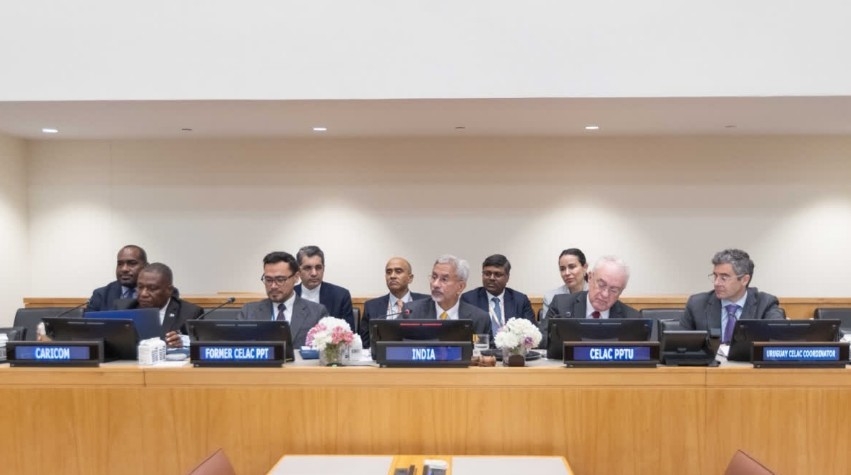
The India-CELAC Expanded Troika Foreign Ministers’ Meeting in New York on September 22, with participation from 30 of the 33 members of the Community of Latin American and Caribbean States (CELAC), underlines the growing strategic relevance of Latin America and the Caribbean in India’s foreign-policy calculus.
According to a statement issued by the Ministry of External Affairs on Wednesday, External Affairs Minister S Jaishankar co-chaired the India-CELAC Expanded Troika Meeting along with Mario Lubetkin, Minister of Foreign Affairs of Uruguay, on the sidelines of the 81st session of the United Nations General Assembly (UNGA) in New York. The Foreign Minister of Saint Lucia Alva Baptiste also outlined his roles within the Troika.
"The India-CELAC Foreign Ministers’ Meet (FMM) saw strong participation where 30 out of 33 CELAC members participated in the FMM, including 16 Foreign Ministers and five Vice Ministers level participation," the Ministry statement reads.
"Foreign Ministers of Uruguay, St Lucia, Antigua and Barbuda, Barbados, Bolivia, Costa Rica, Cuba, Guyana, Haiti, Jamaica, Nicaragua, Saint Kitts and Nevis, Saint Vincent and Grenadians, Trinidad & Tobago and Venezuela participated in the meeting among others."
In a post on his X handle, Jaishankar stated: “Attended by 30 CELAC members, the largest ever, CELAC agreed on the following: appreciation for new Indian Embassies in Uruguay, Ecuador and Bolivia, as well as growing CELAC Embassies in India; cooperation on health and pharma, food and agriculture, energy and resources, SMEs and digital; expansion of ITEC (Indian Technical and Economic Cooperation) slots for CELAC participants; Support for Indian-led initiatives including International Solar Alliance, Coalition for Disaster Resilient Infrastructure, International Big Cat Alliance, Global Biofuels Alliance and Mission Life; annual India-CELAC Ministerial; and establishment of a permanent Commission and an India-CELAC cooperation roadmap.”
According to the Ministry statement, the participants welcomed the landmark achievement of India–CELAC bilateral trade reaching $50 billion in 2025–26, while emphasising the immense potential for further growth.
"The discussions further focused on strengthening India-CELAC cooperation, enhancing trade and development partnerships, and addressing global challenges through multilateralism,” the Ministry stated. “Both sides emphasized the importance of deepening political dialogue, economic collaboration, and people-to-people exchanges. They also agreed to work on establishing an institutional mechanism for reviewing the engagements periodically."
It further stated that the CELAC members expressed appreciation for India’s swift humanitarian response to Jamaica, Venezuela and Colombia following earthquakes in 2025 and 2026.
"India reaffirmed its commitment to deepening its partnership with CELAC countries across a broad range of areas, including trade, climate action, renewable energy, digital transformation, health, food security, critical minerals, infrastructure building, space cooperation, agriculture, HADR and Capacity building,” it added.
CELAC is an intergovernmental bloc of 33 sovereign nations representing approximately 600 to 650 million people across Latin America and the Caribbean. It was formed as a regional political dialogue mechanism and an alternative to the Organisation of American States (OAS) that excludes the US and Canada. Its core goals are strengthening political, social, and cultural integration, stimulating economic growth, promoting regional well-being, and serving as a unified voice in global multilateral negotiations.
According to Aprajita Kashyap, Associate Professor, Latin America Studies Programme, at the Centre for the Study of the Americas, School of International Studies, Jawaharlal Nehru University, the CELAC regional grouping gives India a unified diplomatic platform to collaborate with more than 30 sovereign nations, improving efficiency compared with bilateral negotiations.
"It also offers strategic diversification beyond India’s traditional export goods and partnerships with the US, Europe, and neighbouring countries," Kashyap told ETV Bharat. “India is known as a developing democracy with a broader commitment to strategic autonomy and non-alignment."
She pointed out to the fact that CELAC is important as a trade and resource partner and as a platform for Global South diplomacy.
“Within the commitment to South-South cooperation, this tie elevates India’s role as a key representative of the Global South,” she explained. “These ties also align with efforts to reform multilateral institutions such as the UN Security Council, the IMF, and the World Bank."
The first India-CELAC Expanded Troika Foreign Ministers’ Meeting in New York on September 22 thus comes at a point when India is seeking to translate its ‘Voice of the Global South’ diplomacy into sustained partnerships with developing regions. CELAC provides India with a broad multilateral interlocutor representing a geographically diverse and resource-rich part of the Global South.
The significance of the engagement can be viewed through five interconnected dimensions: economic diversification, critical minerals and energy security, food and climate cooperation, strategic autonomy and multilateral diplomacy.
The most immediate indicator of the expanding relationship is trade. As the Ministry pointed out, India-CELAC bilateral trade reached $50 billion in 2025-26, a substantial milestone that gives the relationship an increasingly important economic foundation.
This is not an entirely new trajectory. India-Latin America trade had already risen to almost $50 billion in 2022-23, according to the Ministry’s annual report for that year. The report also noted growing institutional engagement through the India-LAC Business Conclave and cooperation with regional groupings such as CELAC, CARICOM (Caribbean Community) and SICA (Central American Integration System).
India’s economic relationship with Latin America has traditionally involved areas such as pharmaceuticals, automobiles, machinery, information technology, chemicals and agricultural commodities, while Indian companies have shown interest in energy and mineral resources. The opportunity now is to move towards more integrated value chains involving manufacturing, digital services, technology, renewable energy, logistics and infrastructure.
Perhaps the most strategically important area identified in the New York meeting is critical minerals.
Latin America and the Caribbean possess substantial mineral resources that are becoming increasingly important to the global energy transition and advanced manufacturing. The International Energy Agency’s (IEA) 2026 assessment says the region is a major supplier of critical minerals and has significant resources of lithium, copper, silver and graphite, as well as important reserves of molybdenum and tin and production of minerals such as niobium and rhenium.