India Reinforces Defence Partnership With Sri Lanka During Defence Minister Rajnath Singh's Visit
Total Views |


New Delhi : At a time when geopolitical competition is intensifying across the Indian Ocean, and external powers are seeking greater strategic space in India’s maritime neighbourhood, New Delhi is moving to reinforce its security partnerships with Sri Lanka.
Defence Minister Rajnath Singh’s visit to Colombo and the three memorandums of understanding (MoUs) signed with Sri Lanka on Wednesday represent an important step in that effort.
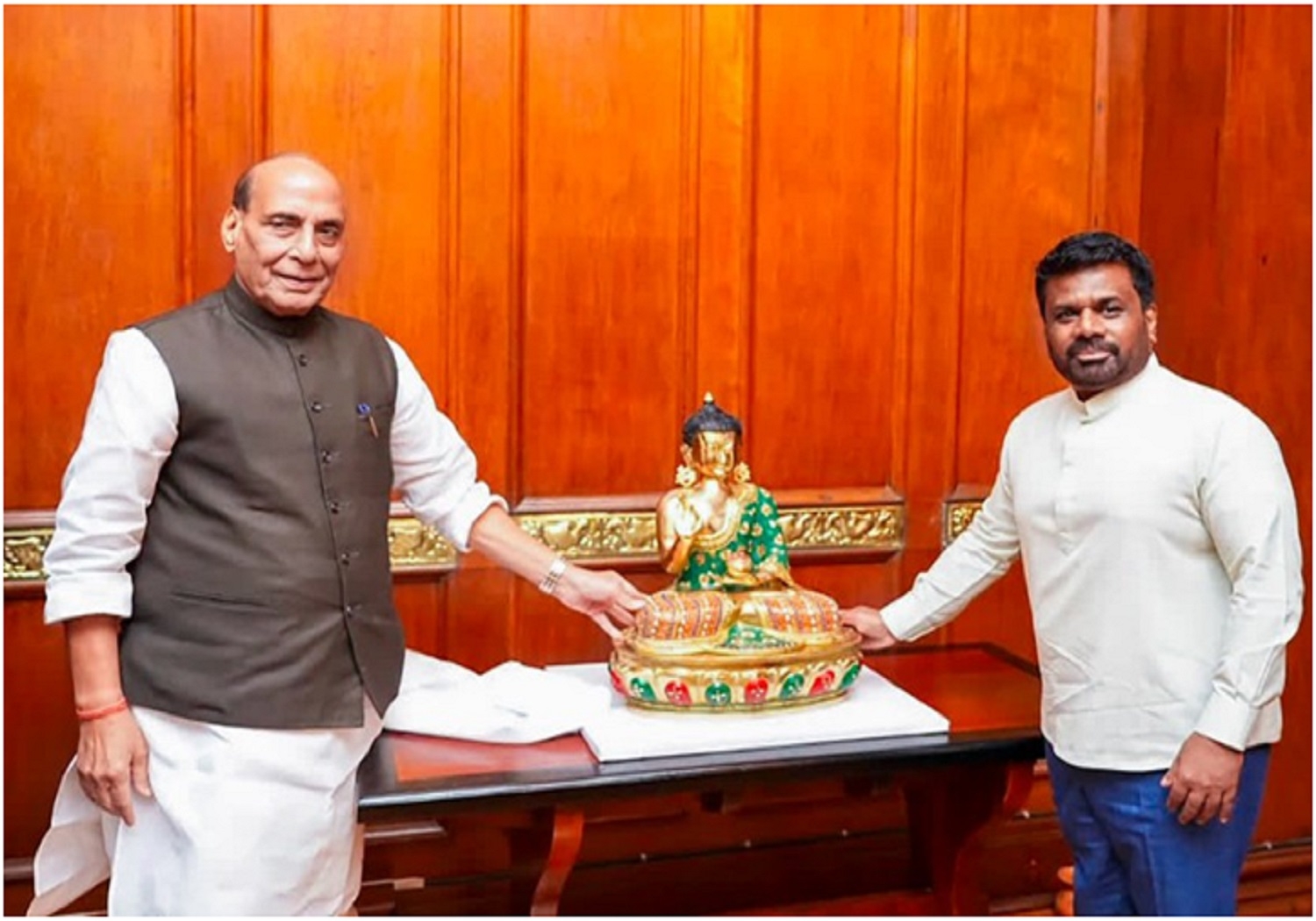
According to a statement from the Ministry of Defence, Singh called on Sri Lankan President Anura Kumara Dissanayake and held substantive discussions on the multi-faceted partnership between the two nations, characterised by traditionally warm relations and mutual trust.
“Both leaders virtually inaugurated three Bailey Bridges constructed by the Indian defence forces,” the Ministry stated.
“The two sides also exchanged MoUs on upgradation of L70 Guns for the Sri Lankan Air Force, and cooperation between National Cadet Corps (NCC) and National Defence Colleges (NDC) of both the countries."
According to the Ministry, India will upgrade L70 Guns, earlier provided by India to the Sri Lankan Air Force, through an Indian government grant. While the other agreements on military education and youth exchanges will deepen institutional and people-to-people links, the Indian-funded upgradation of six L70 guns for the Sri Lankan Air Force has a more direct security dimension, strengthening Colombo’s ability to protect critical assets while deepening India’s role in Sri Lanka’s defence architecture.
The L70 is a 40-mm air-defence gun originally developed by Sweden’s Bofors and used worldwide for short-range defence.
Although the basic weapon dates back several decades, modernised L70 systems can be integrated with contemporary fire-control systems, electro-optical sights and radars, substantially improving their effectiveness.
According to the Defence Ministry statement, the upgraded guns will strengthen the air-defence architecture protecting Sri Lanka's critical assets.
The fact that the guns were earlier supplied by India and are now being modernised with Indian assistance creates a longer-term equipment relationship between the two countries.
This matters strategically.
Defence relationships tend to become deeper when one country operates platforms supplied, upgraded or maintained by another. Equipment cooperation inevitably generates requirements for training, maintenance, technical support, spare parts and doctrinal interaction. India has previously provided Sri Lanka with a Dornier aircraft for maritime surveillance and supported the establishment of a Maritime Rescue Coordination Centre (MRCC). During Prime Minister Narendra Modi’s April 2025 visit to Sri Lanka, the two countries also signed an MoU on defence cooperation.
Their joint statement envisaged greater cooperation in maritime surveillance, hydrography, joint exercises, defence exchanges, intelligence sharing and the provision of defence platforms and assets.
Wednesday’s agreements can therefore be seen as implementation of a security architecture that India and Sri Lanka have been constructing gradually over several years.