Chinese Humanoid Robot Sets New 100-Metre Sprint Record in Beijing
Total Views |


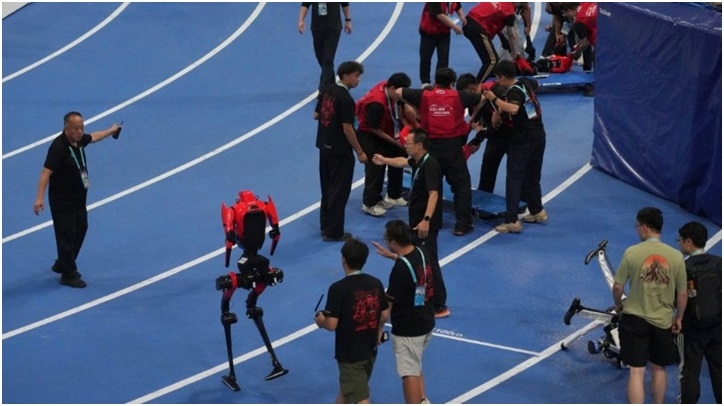
BEIJING: A Chinese humanoid robot has set a new 100-metre sprint record, completing the distance in just 8.86 seconds at the World Humanoid Robot Games in Beijing on Tuesday. The performance surpassed the previous robot record of 9.39 seconds, which had been established only three days earlier.
The latest achievement has attracted international attention because the robot’s time was also faster than the fastest officially recorded human 100-metre sprint. Jamaica’s Usain Bolt holds the men’s world record of 9.58 seconds, set in Berlin in 2009.
The race was part of China’s World Humanoid Robot Games, an Olympic-style event that is being held for the second consecutive year. Beyond being a sporting competition, the Games are serving as a major showcase of China’s rapidly developing robotics industry amid an increasingly intense technology competition between China and the United States.
Experts say the significance of the achievement goes beyond the headline-making time. Dennis Hong, professor of mechanical and aerospace engineering at the University of California, Los Angeles, described the performance as a significant milestone, noting that making a bipedal robot run at such speed presents enormous engineering challenges.
As robots move faster, maintaining balance and controlling their movements becomes increasingly difficult. The machines must withstand repeated impacts while their motors, actuators and mechanical components operate under considerable stress. Engineers therefore face challenges involving stability, control systems, mechanical strength and energy management.
The record-breaking performance also demonstrated that speed alone is not enough to measure the usefulness of humanoid robots. After completing the race, the robot collided with a padded barrier at the end of the track and fell, with sparks reportedly coming from its waist. Officials subsequently extinguished the sparks and the robot was carried away from the track.
The incident raised important questions about the next stage of humanoid robotics. Experts say robots will eventually need to demonstrate not only speed, but also the ability to stop safely, identify unexpected obstacles, recover from mistakes and continue operating after accidents.
The World Humanoid Robot Games feature more than 1,300 competitions involving over 2,000 robots across 51 events. The programme includes traditional sporting activities such as running, long jump and table tennis, along with unusual competitions such as ballroom dancing.
Unlike conventional sporting events, however, the Games also test robots in practical team-based situations. These include household activities, hotel services and emergency-response scenarios, allowing developers to evaluate how effectively robots can operate in environments that resemble everyday human life.
China’s official *People’s Daily* has highlighted the difficulties involved in developing robots capable of performing household and caregiving duties. Such machines remain largely in pilot and validation stages, but researchers view these challenges as important opportunities for further technological development.
The sprint record illustrates the rapid progress being made in humanoid robotics. Yet the fall at the finish line also highlights the distance still to be covered. Building a machine that can run extremely fast is one achievement; creating a robot that can safely navigate unpredictable real-world environments, interact with people and reliably perform complex tasks is a far greater challenge.
As robotics companies and research institutions continue to improve artificial intelligence, sensors, motors and mechanical systems, competitions such as the Beijing Games are becoming important testing grounds. The combination of athletic performance and practical tasks could provide a glimpse into how humanoid robots may eventually be used in homes, workplaces, hospitals, hotels and emergency situations.
The 8.86-second sprint therefore represents more than a new record. It is another indication of how quickly humanoid robotics is advancing—and a reminder that the future of machines may depend as much on safe, intelligent movement as it does on raw speed.