The Greatest Guru Still Teaches in Silence:Let Us Learn from Nature, One Plant at a Time
Total Views |


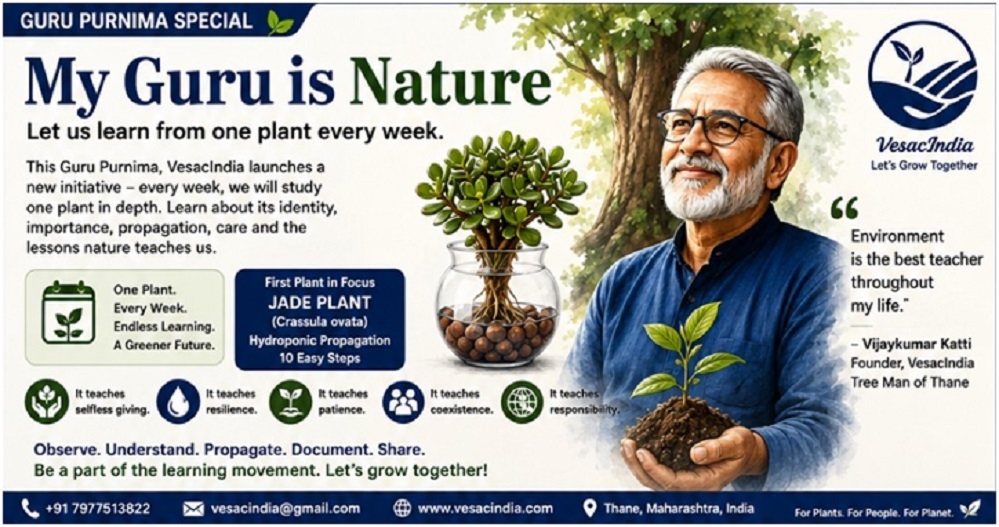
There are moments in life when we realise that our greatest teachers were never confined to classrooms, textbooks or institutions. On the auspicious occasion of Guru Purnima, a festival dedicated to honouring those who illuminate our minds and shape our character, I find myself bowing in gratitude before a Guru who has remained constant throughout my life. This Guru has never spoken a single word, never sought recognition, never demanded followers, and yet has patiently imparted lessons every single day. That Guru is the Environment.
This conviction did not emerge overnight. It was not born from a single experience or a particular achievement. It evolved gradually through years of observing trees, nurturing plants, engaging with communities, working in environmental conservation, and witnessing the remarkable intelligence with which nature sustains life. Every sunrise, every fallen leaf, every flowering branch and every seed searching for a place to germinate became a lesson. Over time, I realised that the environment is not merely our surroundings; it is humanity's oldest university, where every living organism becomes both a teacher and a student in the continuous journey of life.
Nature teaches without discrimination. A tree does not ask who deserves its shade. A flower does not choose who may enjoy its fragrance. Rivers do not decide whose thirst they will quench. The sun rises for everyone alike. These simple observations reveal profound truths that modern society often overlooks. The environment demonstrates generosity without expectation, resilience without complaint, patience without urgency, coexistence without conflict and responsibility without external enforcement. These are not merely ecological characteristics; they are timeless principles for building compassionate individuals, resilient communities and sustainable nations.
As I reflected upon these lessons during this year's Guru Purnima, one question continued to occupy my thoughts. If nature has been teaching humanity for millions of years, why have we gradually stopped listening? We proudly speak about technological advancement, artificial intelligence and scientific innovation, yet many children today can recognise hundreds of digital applications while struggling to identify the trees growing outside their own homes. Families readily discuss the latest electronic devices, yet seldom discuss the plants that purify the air they breathe every day. This widening gap between human progress and ecological understanding is perhaps one of the greatest challenges of our generation.
Environmental conservation cannot succeed through regulations alone. Sustainable living cannot be achieved merely by organising plantation drives or celebrating environmental days once a year. Real transformation begins when knowledge becomes a habit, observation becomes curiosity and curiosity develops into responsible action. Every meaningful environmental movement begins with a simple question: What can I learn from the living world around me today?
It is with this belief that VesacIndia is honoured to announce a new public knowledge initiative beginning on this sacred occasion of Guru Purnima. Every week, we shall select one plant and study it in depth—not merely as a botanical specimen, but as a living teacher. Each weekly edition will explore the plant's identity, ecological role, environmental significance, cultural relevance, propagation techniques, care requirements, scientific characteristics and practical applications for homes, schools, institutions and urban communities. Our objective is not simply to help people grow plants. Our mission is to help people grow their understanding of life through plants.
The first series will focus on hydroponic propagation, beginning with the Jade Plant (Crassula ovata), a species admired not only for its ornamental beauty but also for its remarkable ability to adapt and thrive. Through a carefully illustrated ten-step scientific guide, participants will learn how to select healthy propagation material, prepare stem cuttings, encourage root development, monitor plant health and understand the biological processes that enable new life to emerge from a single stem. The exercise is far more than a gardening activity. It is a practical lesson in observation, patience, adaptation and scientific thinking.
When we observe a cutting patiently developing its first roots in water, we begin to appreciate the extraordinary resilience built into every living organism. When we record changes in leaf colour, stem growth and root formation, we develop scientific observation rather than casual assumption. When families participate together, children begin asking questions that textbooks alone cannot inspire. Why do roots grow downward? Why do leaves remain firm? How does light influence growth? Every answer strengthens environmental literacy and nurtures scientific curiosity.
This initiative is therefore not designed exclusively for gardeners. It is intended for students eager to explore science beyond classrooms, teachers seeking meaningful experiential learning, parents wishing to cultivate environmental values at home, senior citizens sharing their life experiences, researchers documenting urban biodiversity, housing societies developing greener neighbourhoods and every citizen who believes that learning should continue throughout life. Every plant has a story waiting to be discovered. Every species offers lessons in adaptation, resilience and coexistence. Together, they form an extraordinary living library that belongs to all humanity.
Our approach follows a simple philosophy: observe, understand, propagate, document and share. Participants will not only receive practical guidance but will also be encouraged to maintain observation records, photograph plant development, compare growth patterns, understand environmental influences and contribute their findings to a growing community of learners. Over time, these individual observations can collectively become valuable knowledge supporting urban biodiversity awareness, citizen science and responsible environmental stewardship.
In an age where information travels instantly but wisdom often travels slowly, this weekly series seeks to restore the joy of patient learning. Environmental education should not remain confined to academic institutions or specialised research laboratories. It should become part of everyday family conversations. A child proudly showing the first roots emerging from a propagated plant is not merely growing a succulent; that child is developing observation, responsibility and hope. A family nurturing a single healthy plant is quietly strengthening its relationship with nature. A community exchanging knowledge about plant care is simultaneously cultivating trust, cooperation and environmental responsibility.
Guru Purnima reminds us that true learning is a lifelong journey. Every Guru reveals a different dimension of truth. Some teach through words. Some teach through action. Nature teaches through existence itself. Every changing season reminds us that transformation is inevitable. Every seed demonstrates that extraordinary potential often begins in the smallest form. Every forest proves that strength is created through diversity rather than uniformity. Every ecosystem teaches that survival depends not upon competition alone but upon cooperation and balance. These lessons have never become outdated because they are woven into the very fabric of life.
As we begin this new weekly knowledge movement, I extend a heartfelt invitation to every reader. Join us in rediscovering the wisdom that surrounds us every day. Subscribe to receive our weekly plant study, participate in the propagation exercises, observe with curiosity, document with sincerity and share your experiences with others. Whether you nurture one plant or one hundred, your journey contributes to a larger culture of environmental awareness and responsible coexistence.
On this auspicious Guru Purnima, let us express our gratitude not only to the teachers who shaped our minds but also to the silent Guru who has sustained humanity since the beginning of civilisation. Let us honour the Environment not merely through words, but through continuous learning and responsible action. If every week we learn deeply from just one plant, then over time those plants will quietly transform the way we understand our homes, our cities, our forests and ultimately ourselves.
The greatest Guru has never stopped teaching. The only question that remains is whether we are prepared to become attentive students once again.
To receive the complete weekly illustrated plant study, hydroponic propagation guide, scientific observations and regular environmental knowledge updates, please connect with VesacIndia.
- Vijaykumar Katti