Why A Hug Before Dinner May Be One Of Evolution's Oldest Survival Tricks
Total Views |


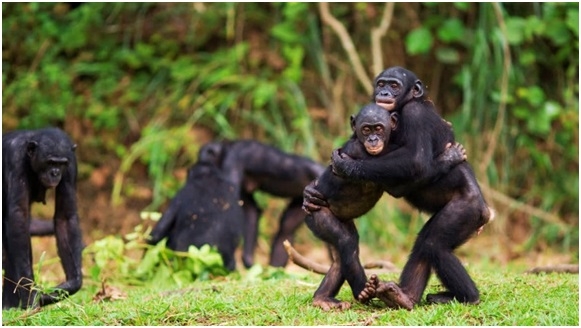
Human beings like to think we've invented diplomacy. We hold peace talks, sign treaties, shake hands after cricket matches and occasionally send awkward thumbs-up emojis to defuse arguments. But it turns out our closest relatives had worked out a rather elegant solution millions of years before we arrived: have a cuddle before the food comes out.
According to a new study led by researchers at Durham University in England, physical touch whether it's an embrace, a gentle pat, a kiss or even reassuring contact helps bonobos and chimpanzees reduce social tension before competing for food. In other words, if you're about to fight over the last slice of pizza, a hug might improve your odds of sharing it peacefully.
Social Touch Has Ancient Roots In Bringing Peace
Published in the Proceedings of the Royal Society B: Biological Sciences, the study suggests that touch isn't merely a pleasant social custom. It may be one of evolution's oldest conflict-resolution strategies.
To investigate this surprisingly heartwarming idea, researchers observed five semi-wild groups of bonobos and chimpanzees living in African sanctuaries. A total of 116 apes were filmed during the five minutes before food was released into a shared space. The scientists then did something that deserves admiration bordering on sainthood. They painstakingly recorded every reassuring touch: who hugged whom, who kissed whom, who reached out with a comforting hand, and then measured how peacefully everyone behaved once lunch officially began.
What Was The Result?
The results were remarkably clear. Apes that exchanged more reassuring physical contact before feeding spent significantly more time eating side by side afterwards. There was less social friction and greater willingness to share space, even when valuable food was involved. Considering that humans have been known to argue over the last samosa at family gatherings, this is no small achievement.
Juvenile male Tschibo offers a comforting embrace to another bonobo Oshwe
Juvenile male Tschibo offers a comforting embrace to another bonobo Oshwe following an aggression where Oshwe was threatened (Courtesy Zana Clay/ Lola Ya Bonobo Sanctuary)
The story becomes even more interesting when you realise that the two species have rather different personalities. Bonobos are famous for solving many of life's problems through cooperation and affection. Chimpanzees, meanwhile, have a reputation for being considerably more assertive, occasionally reminding us that they possess strong muscles. Yet both species relied on reassuring touch before potentially tense situations. The difference lay in who comforted whom. Female bonobos were especially likely to strengthen bonds with other females, reflecting the female-centred nature of bonobo society. Among chimpanzees, males showed the strongest pattern, mirroring the importance of male alliances in their social world.
Extreme Trust
Then there were the chimpanzees who took trust to extraordinary levels.
Lead researcher, Dr Jake Brooker, who was based at Durham University’s Department of Psychology at the time of the study, said: “Comparing bonobos and chimpanzees who are our two closest relatives offers fascinating insight into the evolutionary roots of social behaviour and how they, and we, manage tension, competition and cooperation. Social touch is a powerful communicative tool, present long before language and likely one of the earliest channels through which social bonds form. Its use in these contexts seems to be something we share with our closest relatives."
"The riskier mouth-to-body contacts among chimpanzees, such as placing fingers or hands in another’s mouth, were particularly striking. Chimpanzees are often associated with aggression, but these behaviours reveal a deep level of trust and a willingness to be vulnerable in order to navigate tense moments. We were partly inspired to conduct this study by an observation from our most tolerant chimpanzee group: one male embracing another from behind, then a second joining in, then a third, one by one, until the whole chain settled — what my colleagues and I started calling a 'reassurance train'.”
Research senior author, Professor Zanna Clay, based in Durham University’s Department of Psychology adds: “Our study highlights the ancient and powerful role that touch plays in regulating our social relationships, particularly during tense times when emotions run high. Although much attention has been placed on the role of aggression and competition in human evolution, our study shows that our lineage has also evolved rich and flexible behavioural tool-kits to manage social tension to protect social relationships and promote social harmony."
"It is striking that many of the reassurance behaviours that we observed in our closest ape cousins mirror those we also see in humans today. This highlights how much we still depend on preserved behavioural tools that hark back millions of years to navigate our social worlds, particularly in the most challenging of moments," she concludes. It is a comforting thought that one of humanity's oldest technologies wasn't the wheel or fire. It was kindness delivered through touch.