Quad-ASEAN Convergence: A New Pillar For Peace And Security In The Indo-Pacific
Total Views |


New Delhi: The reaffirmation by the Quad countries of their commitment to ASEAN unity and centrality in Manila on Wednesday comes at a time when the Indo-Pacific is facing growing strategic competition, maritime tensions and a proliferation of non-traditional security challenges.
As geopolitical rivalry intensifies and the region’s maritime domain becomes increasingly contested, closer cooperation between the Quad and the Association of Southeast Asian Nations (ASEAN) could emerge as a critical pillar of a stable, inclusive and rules-based regional order.
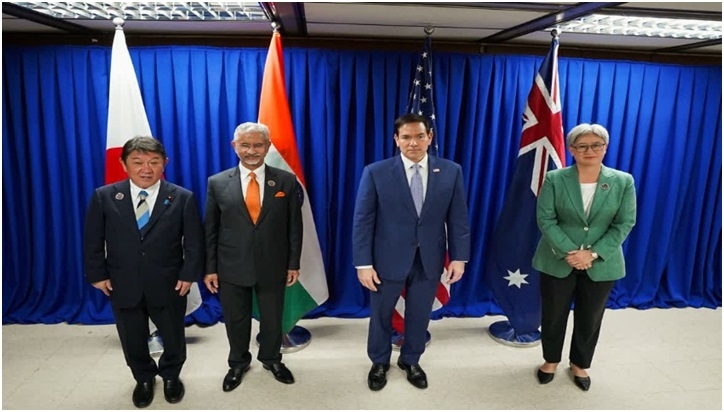
Following a meeting between External Affairs Minister S Jaishankar, Australian Foreign Minister Penny Wong, Japanese Foreign Minister Toshimitsu Motegi and US Secretary of State Marco Rubio on the sidelines of the ASEAN Foreign Ministers-level meeting, the Quad issued a joint statement reaffirming the group’s commitment to strengthening a free and open Indo-Pacific and unwavering support for ASEAN unity and centrality.
“We are deeply invested in the region’s success and in cooperating with ASEAN and its member states,” the statement reads. “We discussed regional challenges and opportunities to strengthen our support for the practical implementation of the ASEAN Outlook on the Indo-Pacific (AOIP) through our shared priorities of maritime and transnational security, economic prosperity and security, critical and emerging technologies, and humanitarian assistance and emergency response. We are united in our conviction that peace and stability in the Indo-Pacific maritime domain underpin the security and prosperity of the region.”
The reaffirmation by the Quad of its commitment to a free and open Indo-Pacific, ASEAN unity and ASEAN centrality underlines an increasingly important reality: the region’s long-term peace and stability will depend not only on the capabilities of major powers, but also on their ability to work with ASEAN and strengthen an inclusive, rules-based regional order.
The timing of the meeting is significant. ASEAN’s foreign ministers are confronting simultaneous pressures from the intensifying strategic rivalry between the US and China, continuing tensions in the South China Sea, the prolonged crisis in Myanmar and disruptions to global energy and trade routes arising from conflict in West Asia.
The Manila meetings are therefore taking place against a backdrop in which security in the Indo-Pacific can no longer be viewed narrowly through the prism of conventional military threats. Maritime coercion, grey-zone activities, cyber threats, supply-chain vulnerabilities, critical-technology competition, humanitarian crises and natural disasters are all becoming interconnected dimensions of regional security.
The most important strategic value of closer Quad-ASEAN cooperation lies in the complementary strengths of the two groupings.
ASEAN provides regional legitimacy, inclusiveness and diplomatic convening power, while the Quad brings together four major Indo-Pacific powers with substantial economic, technological, maritime and military capabilities. ASEAN’s Indo-Pacific framework is explicitly open and inclusive and seeks to strengthen cooperation through ASEAN-led mechanisms rather than create an exclusive security bloc. This makes the AOIP an important bridge between ASEAN’s preference for strategic autonomy and the Quad’s objective of maintaining a free and open regional order.
Maritime security is likely to remain the central pillar of Quad-ASEAN cooperation. The South China Sea is the most visible arena where freedom of navigation, international law and the sovereignty and maritime rights of smaller states are being tested. Recent tensions involving China and the Philippines have once again highlighted the risk that confrontations involving coast guards and other maritime forces could escalate even without a conventional military conflict. At the same time, ASEAN continues to seek progress on a long-discussed Code of Conduct for the South China Sea.
The Quad’s May 2026 launch of the Indo-Pacific Maritime Surveillance Collaboration (IPMSC), designed to improve maritime surveillance and information sharing, particularly in the Indian Ocean Region, demonstrates the type of practical capability that could eventually complement ASEAN’s own maritime security requirements. Greater interoperability and information exchange could help Southeast Asian countries monitor their waters more effectively and respond to maritime incidents before they escalate.
Amit Dasgupta, former Indian Ambassador to the Philippines, views Wednesday’s Quad statement, which offers unwavering support for ASEAN unity and centrality, as a very positive development.
“The background of ASEAN was regional security and regional economic collaboration with the sole purpose of improving the economic welfare of its own population,” Dasgupta told ETV Bharat. “They were never a confrontationist organisation. They wanted peace and harmony as the core objective to be able to achieve economic success.”
Quad, on the other hand, he explained, was seen by the ASEAN as doing two things.
“Number one is that it was encroaching on what ASEAN considered to be its domain and its backyard,” he said. “So, the Quad started looking at areas that ASEAN said, look, this is something that I am looking at. Why are you looking at it? Second, the Quad’s approach to the region appeared in the minds of many people to be confrontational and combative vis-a-vis China.”
Dasgupta said that the Quad is now recognising that it cannot actually look at the same region without a collaborative approach.
“Therefore, this statement in Manila is a very positive development,” he stated. “Now, if there is a Quad and ASEAN synergy, then what will happen is that you will be able to look at different aspects, whether it is critical technologies, whether it is artificial intelligence, robotics; the whole range of issues can then be aligned together so that people work together. And as far as India is concerned, this is a strong, yet another strong pillar in the Indo-Pacific architecture that New Delhi is invested in.”
inclusion of critical and emerging technologies in the Quad-ASEAN agenda reflects another major shift. Artificial intelligence, quantum computing, cyber capabilities, autonomous systems and space-based technologies are rapidly changing the character of security.
The challenge is to ensure that Southeast Asia does not become merely an arena in which major powers compete for technological influence. Instead, cooperation should focus on building regional capacity, protecting critical digital infrastructure and establishing responsible technology standards.
For India, deeper Quad-ASEAN cooperation fits naturally with its Act East Policy and Indo-Pacific vision. India has consistently supported ASEAN centrality and views Southeast Asia as a critical link between its eastern and western maritime neighbourhoods.