House Republicans Adopt $95 Billion Package For The Iran War And Trump's Priorities
Total Views |


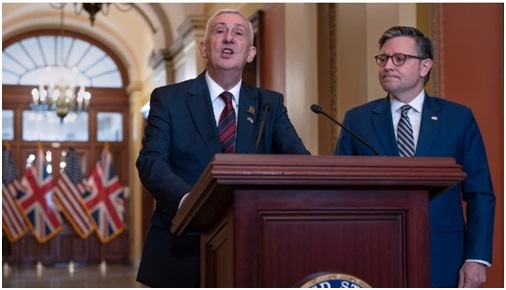
Washington: The House adopted a Republican-only $95 billion budget proposal Wednesday, a long-shot effort to fund the Iran war and other White House priorities over objections from Democrats and a few GOP holdouts in a final push before the midterm elections.
House Republicans were divided over the plan, with conservatives wary because there are no offsetting budget cuts. But Speaker Mike Johnson plunged ahead, viewing the go-it-alone process as the best chance to usher President Donald Trump's priorities through the split Congress, despite skepticism in the Senate.
The vote tally was 216-214, with two Republicans and one independent joining Democrats in opposition.
"Just bullets and bombs to finish the job," said Rep. Jodey Arrington, R-Texas, the chairman of the Budget Committee.
Democrats argued the money should be spent at home, particularly on efforts to lower costs for Americans.
"Republicans plan to spend tens of billions of dollars on Trump's failed war in Iran," said Rep. Pete Aguilar of California, chairman of the House Democratic caucus, this week. "Think about what we could spend with these resources instead."
Congress is at a standstill over the U.S. war against Iran — unable to stop Trump's military strikes, but not having authorized the use of American military force — and politically torn over having to provide billions of taxpayer dollars to pay for it. Most Americans disapprove of Trump's Iran strategy, according to a recent AP-NORC poll.
The budget battle comes as Trump attended the dignified transfer of four service members killed in the Middle East, bringing the military death toll to 18. Defense Secretary Pete Hegseth told senators at a fiery hearing this week that the Pentagon is running short of cash, despite a massive $150 billion one-time allotment in last year's big budget bill.
Even as the House action advanced the resolution, Johnson's strategy faces uncertainty in the Senate.
The package has $60 billion for the Pentagon and $13 billion for other national security needs, $12 billion for farmers struggling under Trump's tariffs and $10 billion for voting law changes aligned with the SAVE America Act and proof-of-citizenship requirements that are Trump's top priority.
A once rare budget tool is now the norm in split Congress
Republicans are relying on the budget reconciliation process, which enables approval on a majority vote in Congress, bypassing the Senate's ability to filibuster the measure t o stall or kill it.
Once rare, the reconciliation process is now Johnson's preferred strategy for pushing proposals through Congress. It's the way Republicans approved Trump's big tax breaks and spending cuts bill last summer and funded Homeland Security this year over Democrats' refusal to fund Trump's mass deportation agenda.
"No matter how you feel about current events, these funds are necessary to ensure our fighting forces remain ready, our troops are paid and our nation is safe," said Rep. Mike Rogers of Alabama, the Republican chairman of the Armed Services Committee.
But House Democratic Leader Hakeem Jeffries said, "Republicans have literally ripped food from the mouths of hungry children, seniors and veterans to sustain the Trump war machine."
Among those opposed was Rep. Kevin Kiley of California, a former Republican turned independent, who said he felt any war funding bill should be bipartisan. He also wanted to ensure Congress had a "much higher level of involvement" in bringing the war to an end, and he said this proposal did not set that process in motion.
Republicans Rep. Thomas Massie of Kentucky and Rep. Warren Davidson of Ohio also voted against.