PM Modi, Indonesian Prez Subianto Visit 'Majestic' Prambanan Temple
Total Views |


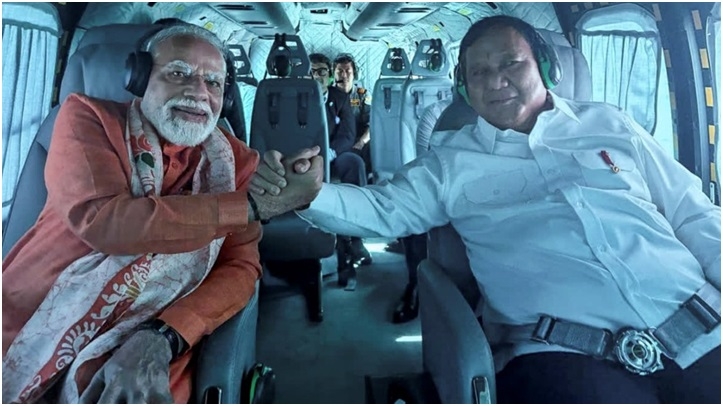
Jakarta : Prime Minister Narendra Modi and Indonesian President Prabowo Subianto on Wednesday visited the centuries-old Prambanan Temple, the largest Hindu temple complex in the Southeast Asian nation.
India and Indonesia, a day ago, exchanged a Letter of Intent to start a project on the conservation and restoration of the temple complex with assistance from India. Modi arrived in Jakarta on Monday on the first leg of his three-nation tour, which will also cover Australia and New Zealand.
Prime Minister Modi and President Subianto visited the heritage site and inaugurated the Prambanan Temple restoration project in Yogyakarta. "On the way to the Prambanan Temple from Yogyakarta with President Prabowo Subianto," PM Modi posted on X ahead of their visit and shared a photo of the two leaders holding hands warmly in an aircraft.
"The majestic Prambanan Temple!" the post said. Situated on the island of Java, the Prambanan Temple Complex stands as the largest Hindu temple site in Indonesia and the second-largest across Southeast Asia, behind Cambodia's Angkor Wat.
Rising above the centre of the last of these concentric squares are three temples decorated with reliefs illustrating the epic of the Ramayana, dedicated to the three great Hindu divinities and three temples dedicated to the animals who serve them, according to the UNESCO website.
At the epicentre of the complex stand three towering structures dedicated to the Hindu Trimurti: Lord Shiva, Lord Vishnu, and Lord Brahma. Constructed from volcanic stone, the central Shiva Temple dominates the landscape at an approximate height of 47 metres, exhibiting classical Hindu architectural design through its soaring spires, symmetrical layouts, and ornate gateways.
The exterior walls showcase exceptionally detailed reliefs depicting narrative sequences from the Ramayana and other major Hindu epics. These carvings mirror the extensive religious and cultural exchange that flowed across Southeast Asia centuries ago via maritime trade channels, scholarly networks, and ancient commercial routes.
The complex was eventually abandoned in the 10th century, a shift historians attribute to political realignments in Java and catastrophic volcanic eruptions from nearby Mount Merapi. Over subsequent generations, intense seismic activity reduced a significant portion of the structures to ruins.
Preliminary salvage work began under Dutch colonial oversight in the 19th century, followed by systematic archaeological reconstruction between 1913 and 1953, which restored the principal shrines.
Acknowledging its profound historical legacy, UNESCO inscribed Prambanan as a World Heritage Site in 1991. The site now stands as one of Indonesia's premier cultural destinations, offering an evocative window into the archipelago's diverse religious history.
The fresh preservation pact highlights the enduring civilisational ties between New Delhi and Jakarta. By deploying specialised expertise to safeguard one of Asia's most crucial Hindu monuments, the joint initiative breathes new life into centuries-old historical connections while expanding modern strategic, economic, and people-to-people cooperation between the two nations.