100 Days Of Balendra Shah Government In Nepal Signals Shifts And Overhauls
Total Views |


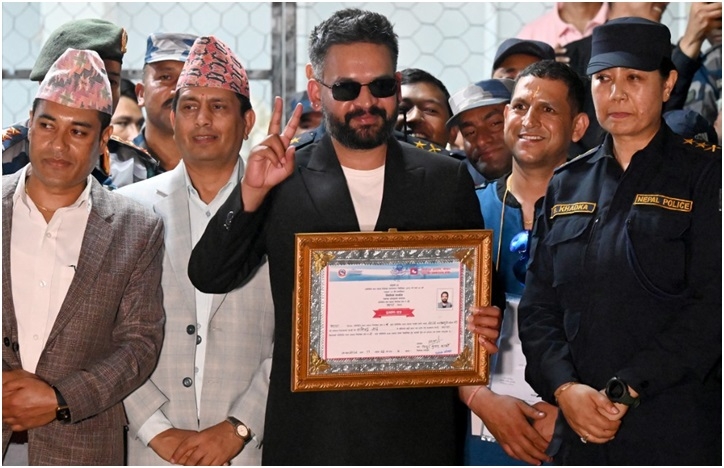
Kathmandu : The initial 100 days of Nepal’s Balendra Shah-led government have signalled that it won’t be business-as-usual on governance matters, as well as on Nepal’s international relations, including those with powerful giant neighbours, China and India.
Inside Nepal, the government’s new approach to ensure speedy service delivery and reforms has drawn mixed reactions. Moves to end political appointments have earned accolades, yet a hasty campaign to dislocate and rehabilitate the country’s lakhs of landless and urban poor, combined together with Shah’s continuing hesitation to face Parliament or journalists, has drawn criticism.
Nepal-watchers and diplomats in Delhi, Beijing and Washington seemed alarmed after the new government, formed in late March following a landslide victory of the four-year-old Rastriya Swatantra Party (RSP), indicated that it would adopt an unconventional and strictly protocol-driven foreign policy.
That meant that, as in the past when the old guard ruled Nepal, no foreign ambassador or senior official would enjoy direct access to the Prime Minister, and that the new Prime Minister would not be immediately looking to visit Delhi and Beijing as Nepal’s past prime ministers had often been doing.
The March election followed the abrupt ouster of the KP Sharma Oli-led government – a strange coalition of the Communist Party of Nepal – Unified Marxist Leninist (CPN-UML) and the Nepali Congress - at the height of what is popularly known as Nepal’s Gen Z Revolt on September 9, 2025.
An interim administration led by Sushila Karki held a general election in March, which saw older parties nearly routed, and the new party RSP – of which Shah, the former Kathmandu mayor, is the co-leader - emerge as the largest, commanding almost a two-thirds majority.
Matters came to a head in May when Indian Foreign Secretary Vikram Misri’s planned visit to Kathmandu was abruptly cancelled, reportedly because of Prime Minister Shah’s refusal to meet him. It happened against the backdrop of the Nepal-India border dispute over the Lipulekh-Kalapani area, from where India and China had just agreed to resume the Kailash Mansarovar Yatra.
Earlier, Shah had declined to meet the Indian ambassador to Nepal. Even senior US diplomats couldn’t enjoy their past privileges of having a brief meeting with Nepal’s chief executive. Instead, signalling a break from conventional diplomacy, Shah has opted to meet Kathmandu-based foreign diplomats in groups.
He has not gone on a single foreign trip. His social media posts portray him as the leader building “the country”. Despite initiation confusions vis-à-vis Nepal relations with the southern neighbour, India, with which Nepal shares an open border plus civilizational ties, or with the northern neighbour, China, foreign policy pundits in Kathmandu hope that things now seem poised to be back on track.
Nepal’s Foreign Minister Shishir Khanal’s recent visits to Delhi and Beijing, they say, have laid the groundwork for further engagements, including high-level visits, plus boosting pre-existing bilateral exchanges, as well as pushing bilateral cooperation and development projects aimed at Nepal’s infrastructure and socio-economic development.
Before Khanal, Chairperson of the RSP, Rabi Lamichhane visited Delhi. Formally invited by the ruling Bharatiya Janata Party (BJP), Lamichhane held talks with Prime Minister Narendra Modi and senior leaders. In Delhi, he made it clear that his party is looking to pursue “development diplomacy” with all friendly countries, including India.
Often very reserved but social media-savvy, Prime Minister Shah too has indicated that his government will maintain cordial relations with all friendly countries, including next-door neighbours, India and China. In May, he told the lower house of Parliament that his government would pursue diplomatic dialogue to resolve border disputes.
It was a fact also underlined by Foreign Minister Shishir Khanal during his visit to Delhi in June. Amid concerns over a possible third party – in this case British and Chinese – involvement on the issue of Nepal-India border dispute, Khanal ruled out any such possibility.
There, he told journalists, “We want to solve our disputes through diplomatic processes. We just want to see if we can access some of the documents that might be in libraries or museums in the UK. Our position was not that we were asking for mediation.”
Despite recent developments, foreign policy pundits in Kathmandu stress that Nepal-India relations need to improve further. More so, because a younger generation of leaders, often inexperienced and immature, has taken charge.
“Nepal-India relations are very deep and multifaceted,” said Nilambar Acharya, Nepal’s former ambassador to India. “Recent visits are a good start. We hope that there will be more official visits from both sides. Some of the issues, like the border dispute, trade imbalance and big infrastructure projects that both sides agreed to develop for mutual benefits long ago need to be addressed, or expedited, at the highest political level.”
“So the sooner the prime ministers of Nepal and India can visit each other and meet each other, the better it will be to resolve contentious issues and expedite development cooperation projects.”