World Music Day: Rajasthani Culture Expert Calls For Connecting Youth With Folk Music And Instruments
Total Views |


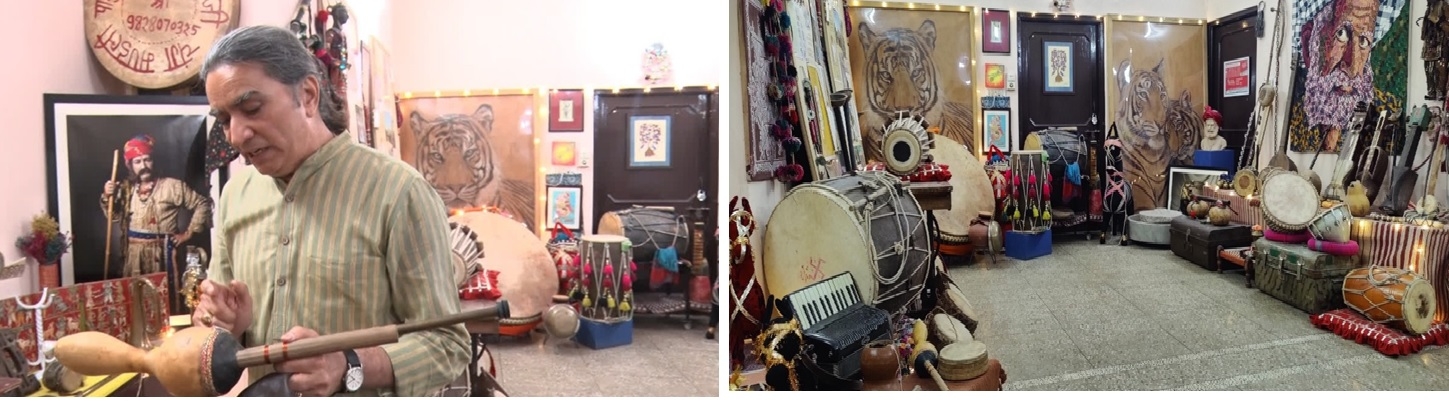
Jaipur : At a time when music is increasingly confined to digital platforms and electronic instruments, there are individuals dedicated to preserving centuries-old folk traditions. One of these personalities is Vinod Joshi of Jaipur who hails from Shekhawati region of Rajasthan. His Jajam Foundation is not only preserving folk music but also working tirelessly to gain recognition and financial strength for folk artists.
In an exclusive chat with ETV Bharat on the occasion of World Music Day that falls on June 21, Joshi while talking about the rare and traditional musical instruments of Rajasthan at his foundation explained that these instruments are living documents of Rajasthan's folk life, culture, tradition and social structure.
“For centuries, they have been associated with specific castes and communities who craft them themselves and pass on the art from generation to generation,” he said while adding that these instruments have the capacity to move their listeners the moment artists take the stage with them. Their sound brings out melodies along with the depth of history, tradition and folk life.
At a time when music is increasingly confined to digital platforms and electronic instruments, there are individuals dedicated to preserving centuries-old folk traditions. One of these personalities is Vinod Joshi of Jaipur who hails from Shekhawati region of Rajasthan. His Jajam Foundation is not only preserving folk music but also working tirelessly to gain recognition and financial strength for folk artists.
According to Joshi, “Every musical instrument in Rajasthan has its own social and cultural significance. Apart from music, they are associated with special occasions, rituals and religious ceremonies. For example, the ‘Dhoom Dhadaaka’ instrument played by the Sahariya community which is on the verge of losing its original identity was once a key part of the community's identity and celebrations.”|
He believes that these instruments contain the essence of folk life. If they are not preserved, future generations will be deprived of this precious cultural heritage.
He claims that his collection is not a ‘museum’ but a ‘folk journey’. It is a journey of living tradition that continues from the past to the present and on to the future. He says that to keep Rajasthan's culture, history and music alive, it is essential to explain the importance of these musical instruments to the society and connect the new generation with them.
At a time when music is increasingly confined to digital platforms and electronic instruments, there are individuals dedicated to preserving centuries-old folk traditions. One of these personalities is Vinod Joshi of Jaipur who hails from Shekhawati region of Rajasthan. His Jajam Foundation is not only preserving folk music but also working tirelessly to gain recognition and financial strength for folk artists.
Citing the example of the Bhopa community's ‘Masak’ instrument, he explained that this instrument is made entirely from goat skin and its structure reflects the goat's body shape. “Developed 500 to 700 years ago, this instrument is blown into from one side while a flute-like pipe is attached to the other. The sound produced by the balance of the two is extremely melodious and unique,” he explained while pointing out that since modern chemicals or adhesives were not available at that time, the artisans used natural gum extracted from trees for this instrument.
“This demonstrates that artisans of that era were not only skilled but also possessed a scientific approach,” he underlined.
Rajasthan boasts of several musical instruments that are a hallmark of specific communities. For example, the Bhopas and Bhopis who recite the story of Pabuji play the ‘Ravan Hattha’ while the Kalbelia community uses the ‘Pungi’, a traditional instrument crafted from gourd and wood.
Similarly, divisions are evident within the Langa community. While the Sindhi Langas play the ‘Sarangi’ and sing, the Surnaiya Langas specialize solely in the ‘Surinda’. This diversity further enriches Rajasthan's folk music.
Joshi feels that while technology and science have completely transformed the world of music, no new musical instruments have been developed to establish folk music in the last 500 years. “This means that our traditions have already been so rich and complete that there has been no need to change them,” he said.
He underlined that in order to preserve folk music and traditional musical instruments, it is essential to connect with the new generation by including them in the school and college cultural programmes.
He said that a society’s identity remains intact only as long as it remains connected to its roots. “Folk music is not just a means of entertainment but a reflection of our culture, history and lifestyle. It is our responsibility to preserve it,” said Joshi.