An Invitation With A Message: What Iran’s Outreach To Modi Means
Total Views |


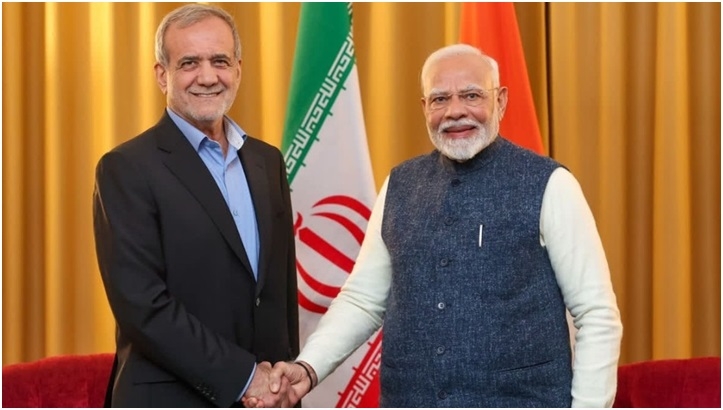
New Delhi : The reported invitation from Iranian President Masoud Pezeshkian to Prime Minister Narendra Modi to attend the burial ceremonies of Ayatollah Ali Khamenei carries significance that extends well beyond diplomatic protocol.
“Iranian President Masoud Pezeshkian is learnt to have invited Prime Minister Narendra Modi to the burial ceremonies for the late Supreme Leader Ayatollah Ali Khamenei,” PTI news agency reported Wednesday citing diplomatic sources. “The funeral ceremonies will be held from July 5 to 9.”
The report comes two days after National Security Adviser (NSA) Ajit Doval’s meeting with Ghadir Nezamipour, Deputy Secretary for Defence Affairs of the Supreme National Security Council (SNSC) of Iran, ahead of the 16th BRICS NSAs Meeting held in New Delhi on June 23.
It remains to be seen whether Modi can make a trip to Iran given that he will be embarking for Indonesia on July 6 on the first leg of his three-nation visit to Southeast Asia and Oceania.
However, the reported invitation would be far more than a gesture of diplomatic courtesy. Coming barely four months after the US and Israel launched a military campaign that led to the death of Iran’s long-serving Supreme Leader and reshaped the strategic landscape of West Asia, the outreach appears to underscore Tehran’s view of India as an important regional actor capable of maintaining engagement across rival geopolitical camps. Whether or not Modi is able to attend, the invitation itself sends a message about Iran’s expectations of India’s role in the region’s emerging post-war order.
Women attend a condolence meeting organised in memory of deceased Supreme Leader of Iran Ayatollah Ali Khamenei and his companions, who were killed in the ongoing military action by Israel and USA in Iran, at the India Islamic Cultural Centre in New Delhi on Saturday, March 07, 2026 (IANS)
India today enjoys close strategic partnerships with both the US and Israel. Washington is India’s largest strategic partner in defence and technology cooperation, while Israel has emerged as one of India’s principal suppliers of advanced military equipment and intelligence cooperation.
Despite these ties, Tehran appears to view New Delhi as a country capable of pursuing an independent foreign policy rather than acting as part of any anti-Iran coalition. Inviting Modi to ceremonies surrounding Iran’s most important political and religious figure would amount to an acknowledgement of India’s strategic autonomy.
For New Delhi, participation would reinforce India’s longstanding position that it maintains issue-based partnerships rather than alliance commitments.
Khamenei’s death and the subsequent war marked the most serious upheaval in Iran since the 1979 Islamic Revolution. In such moments, countries often use state funerals and transition ceremonies to identify which international partners they regard as important for the country’s future.
An invitation to Modi would indicate that Iran views India as a long-term partner despite New Delhi’s expanding relations with Israel, the US and Gulf Arab states.
For India, the gesture would provide reassurance that bilateral relations remain resilient despite years of disruptions caused by sanctions and regional instability. Before US-imposed sanctions sharply reduced imports, Iran was among India’s major crude oil suppliers.
The post-war environment may eventually lead to new diplomatic arrangements involving sanctions relief, energy agreements or reconstruction initiatives. Maintaining political goodwill with Tehran would preserve India’s options should Iranian oil re-enter global markets in a significant way.
From India’s perspective, preserving channels of communication with all major energy producers in West Asia remains a strategic necessity rather than a diplomatic luxury. One of India’s principal interests in Iran remains the Chabahar Port project and the broader connectivity corridor linking India with Afghanistan, Central Asia and Eurasia. India’s involvement in the development and operation of the Chabahar Port has entered one of its most uncertain yet strategically important phases since New Delhi joined the project nearly a decade ago. A combination of renewed US sanctions, the US-Israel war against Iran, changing regional geopolitics and evolving connectivity priorities has transformed Chabahar from a relatively straightforward infrastructure project into a major test of India’s strategic autonomy and regional ambitions.
The most important recent milestone was the signing in May 2024 of a 10-year contract between India Ports Global Limited and Iran’s Ports and Maritime Organisation of Iran for the operation of the Shahid Beheshti Terminal. The agreement was intended to provide long-term stability after years of short-term operating arrangements and represented India’s strongest institutional commitment to Chabahar to date.
India has also already fulfilled its principal financial obligations under the agreement. New Delhi disbursed ₹400 crore during FY 2025-26 and completed its committed contribution of approximately $120 million for procurement of port equipment by August 2025. As a result, no new allocation was made in the Union Budget for 2026-27.
biggest challenge to India’s role emerged after Washington allowed the sanctions waiver granted to Chabahar under the 2018 exemption regime to lapse in 2025. The waiver had originally been provided because Chabahar was considered essential for Afghanistan’s economic development and humanitarian access. The exemption was temporarily extended until April 2026 before renewed uncertainty emerged over the project’s future.
Despite the uncertainties, Tehran has repeatedly emphasised that it wants India to remain involved in Chabahar. Iran’s Ambassador to India Mohammad Fathali publicly stated earlier this year that his country remained open to continued Indian participation and viewed Chabahar as a symbol of bilateral cooperation and regional connectivity.
During a regular media briefing here on Tuesday, when asked specifically whether the issue of Chabahar Port had figured during the meeting between Doval and Nezamipour, External Affairs Ministry spokesperson Randhir Jaiswal neither confirmed it nor denied it.
“Both sides reviewed the ongoing situation in West Asia,” Jaiswal said. “They discussed various aspects of the developments that are happening there. They also discussed cooperation under BRICS platform as also various aspects of India-Iran bilateral ties.”
Energy security and Chabahar Port apart, the 2026 war is likely to accelerate the emergence of a new Middle Eastern security architecture involving shifting alliances, reconstruction needs and fresh diplomatic arrangements.
Iran’s outreach to India suggests Tehran may see New Delhi as a useful bridge to the wider international community and potentially as an important economic partner during the country’s recovery phase. For India, maintaining influence in the post-war regional order is essential given the country’s stakes in energy imports, trade routes, diaspora welfare and maritime security in the Indian Ocean.
People gather to mourn the death of Iran's Supreme Leader Ayatollah Ali Khamenei in Tehran, Iran, March 1, 2026. Iran's state media confirmed Sunday that its Supreme Leader Ayatollah Ali Khamenei was killed in a joint U.S.-Israeli attack on Saturday, prompting Iranian missile strikes on Israel and U.S. targets across the region (IANS)
According to former Indian diplomat Talmiz Ahmad, who widely served in West Asia, since Modi already has a prior engagement, New Delhi would not need to give any explanation for his absence at Khamenei’s burial rites.“It is very likely that the Prime Minister may nominate either the Vice President or the External Affairs Minister to represent India,” Ahmad told ETV Bharat. “To my mind, it appears to be a golden opportunity for us to restructure the relationship with Iran. We need to go back to the situation that prevailed before this uncalled-for conflict. That is where we need to now go back to, even the period earlier to 2018, when Iran was a very major supplier of petroleum to India.” He said that he was using the word “restructure” instead of “repair” because from the Iranian side, there is no indication that the relationship needs repair. “They have been very, very helpful to India,” Ahmad said. “From their side, there has not been ever any indication of dissatisfaction or unhappiness.”
He explained that the Iranians are deep strategic thinkers with a very profound understanding of international affairs and they rarely do anything which is impulsive or thoughtless. As for Chabahar, Ahmad expressed the view that India should be reengaging with Iran on the port project “almost immediately”.
In diplomatic terms, invitations to funerals of transformative national leaders often reveal as much about future partnerships as they do about past relationships. Iran’s reported outreach to Modi appears to fall squarely within that category.