In Bishkek, Rajnath Singh Turns SCO Spotlight On Double Standards Over Cross-Border Terror
Total Views |


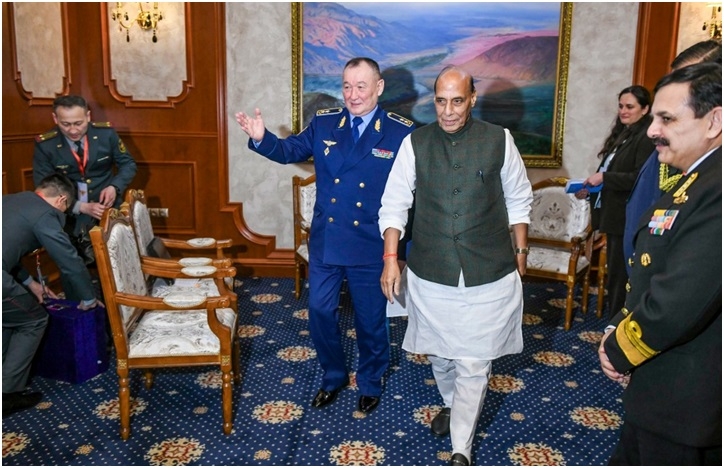
New Delhi : When Defence Minister Rajnath Singh addressed the Shanghai Cooperation Organisation (SCO) Defence Ministers’ Meeting in Bishkek on Tuesday, his reference to Operation Sindoor was more than a rhetorical flourish.
It was a deliberate signal that India’s evolving counter-terror doctrine - targeting terror epicentres beyond its borders - now forms a central pillar of its multilateral messaging, especially in forums where questions of sovereignty and non-interference are deeply sensitive.
Singh used the SCO platform to press a pointed argument: the credibility of the SCO will ultimately be judged by how consistently its members act against terrorism, without political exceptions or double standards. The SCO is a Eurasian political, economic and international security organisation of 10 member states. It focuses on political, economic, security and counter-terrorism cooperation.
It is the world’s largest regional organisation in terms of geographic scope and population, covering at least 24 per cent of the world’s total area (65 per cent of Eurasia) and 42 per cent of the world's population. As of 2024, its combined nominal GDP accounts for around 23 per cent, while its GDP based on purchasing power parity (PPP) comprises approximately 36 per cent of the world's total.
The SCO is the successor to the Shanghai Five, formed in 1996 between China, Kazakhstan, Kyrgyzstan, Russia, and Tajikistan. In June 2001, the leaders of these nations and Uzbekistan met in Shanghai to announce the SCO, a new organisation with deeper political and economic cooperation. In June 2017, it expanded to eight states, with India and Pakistan. Iran joined the group in July 2023, and Belarus in July 2024. Its most recent meeting was held in September 2025 in Tianjin, China.
By invoking last year’s Tianjin Declaration and the work of the SCO’s Regional Anti-Terrorist Structure (RATS), Singh framed counter-terrorism as the litmus test of the grouping’s relevance. His speech in Bishkek suggested that for India, the SCO is no longer just a Eurasian dialogue forum but a stage to demand accountability on terror safe havens.
“The real test of collective credibility remains in consistency,” Singh said. “We must not forget that terrorism has no nationality and no theology. Nations must take a firm and collective stance against terrorism.”
The Tianjin Declaration solidified a collective stance on security, counter-terrorism, and a multipolar world order, emphasising non-interference and cooperation in artificial intelligence (AI), technology, and economic development. The declaration condemned terrorism, separatism, and extremism, specifically citing the April 2025 Pahalgam attack in India, while emphasising the rejection of “double standards” in combating cross-border terrorism.
Singh’s reference to Operation Sindoor was highly significant. By stating that terror epicentres are “no longer immune to justifiable punishment”, he internationalised India’s evolving counter-terror doctrine: cross-border terror will invite direct consequences.
Placed in the SCO context, where members include countries historically sensitive about sovereignty and non-interference, the remark served as a justification narrative: actions against terror infrastructure are framed as legitimate self-defence rather than escalation. It subtly challenges members to acknowledge the distinction between sovereignty and the misuse of territory for terrorism.
“Do we need a new world order or a world which is more orderly?” Singh questioned. “We need an order where every citizen of this world is treated with dignity and respect. We need an order where differences do not become disputes and disputes don’t precede disasters. The real crisis today is not of a non-existent order but a tendency to question the established rule-based world order. We must focus on a global consensus where co-existence, co-habitation and compassion take precedence over chaos, competition and conflict.”
Without naming any country, Singh’s remarks on state-sponsored cross-border terrorism and no place for double standards were clearly aimed at long-standing regional fault lines. The SCO includes both India and Pakistan, as well as China, making the forum diplomatically delicate. His phrasing allowed India to put its concerns on record in a multilateral setting without derailing proceedings through direct accusations.
This is significant because India used the SCO stage to legitimise its security concerns in front of Eurasian powers, not just Western partners.
Singh’s philosophical reflections on whether the world needs a “new order or a more orderly world” linked terrorism to a broader erosion of respect for the rules-based international system. By invoking Mahatma Gandhi and the idea of restraint, dialogue, and dignity, he positioned India as a responsible security actor – one that balances firmness against terror with commitment to peace.
This dual messaging is crucial: India projects strength through punitive capability while retaining moral high ground through calls for diplomacy and coexistence.
Singh also highlighted the joint statement of the heads of state on ‘Countering Radicalisation leading to Terrorism, Separatism and Extremism’ issued during India’s chairmanship of the SCO in 2023 that symbolises shared commitment in this regard. He further stated that, in view of the present global uncertainties, SCO holds a pivotal role as today's world view appears fractured and countries are becoming increasingly inward-looking.
By recalling India’s chairmanship and the joint statement on countering radicalisation, Singh reminded members that India has shaped the SCO’s recent counter-terror discourse. This reinforces India’s stake and leadership credentials within a grouping often perceived as dominated by China and Russia.
In the year marking the SCO’s 25th anniversary, India used the occasion to underline that the organisation’s relevance depends on how seriously it treats threats like terrorism and radicalisation. According to MS Prathibha, Associate Fellow at the East Asia Centre in the Manohar Parrikar Institute of Defence Studies and Analyses, Singh’s statement was well-intentioned messaging from India.
“The SCO was formed to counter terrorism,” Prathibha told ETV Bharat. “The RATS is one of the foremost mechanisms to combat terrorism.” She said that the SCO is the perfect platform for India to talk about countering terrorism.
“India has been talking about countering terrorism on the SCO platform for years,” Prathibha said. “All SCO members have accepted the three pillars of the organisation: countering terrorism, separatism, and extremism. The idea came from China. SCO members are bound to fight these three evils.”
According to her, what India basically said is that the SCO can’t have an exception (meaning Pakistan). “But China will see cross-border terrorism from Pakistan in India as a bilateral issue,” Prathibha said. “But India has made it clear that it stands for the core principles of the SCO. India is saying why Operation Sindoor is justified.”
To sum up, Singh’s address in Bishkek was not merely a routine intervention. It internationalised India’s post-Operation Sindoor counter-terror posture, pressured SCO members to confront inconsistencies on terrorism, and positioned India as both a hard security actor and a moral advocate of peace.”