Hosting BRICS Foreign Ministers Amid Crises, India Steps Up As A Bridge In A Divided World
Total Views |


New
Delhi : As wars rage in both Europe and West Asia, India’s decision to host the
BRICS Foreign Ministers’ Meeting on May 14–15 has acquired unusual geopolitical
weight.
Announced
by External Affairs Ministry spokesperson Randhir Jaiswal here on Thursday, the
gathering comes at a time when the BRICS grouping finds itself at the
crossroads of two major global crises — the Russia-Ukraine War and the
escalating US-Israel war against Iran.
“India
will host the BRICS Foreign Ministers’ meeting on May 14 and 15, 2026,”
Jaishankar said during a regular media briefing.
“The meeting will be chaired
by External Affairs Minister S Jaishankar. BRICS foreign ministers and heads of
delegations from member and partner countries will participate in the meeting.
They will also call on Prime Minister Narendra Modi. During the meeting, the
Foreign Ministers of BRICS member countries will exchange views on global and
regional issues of mutual interest.”
According
to a statement issued by the Ministry, on May 15, BRICS member and partner
countries will participate in a session themed ‘BRICS@20: Building for
Resilience, Innovation, Cooperation and Sustainability’. “This will be followed
by a session on the ‘Reforms of Global Governance and Multilateral System’,”
the statement further reads.
For
New Delhi, which holds the BRICS chair this year, the meeting is set to become
a platform where the Global South’s leading voices deliberate on wars that are
reshaping energy markets, trade routes, and the global balance of power.
BRICS
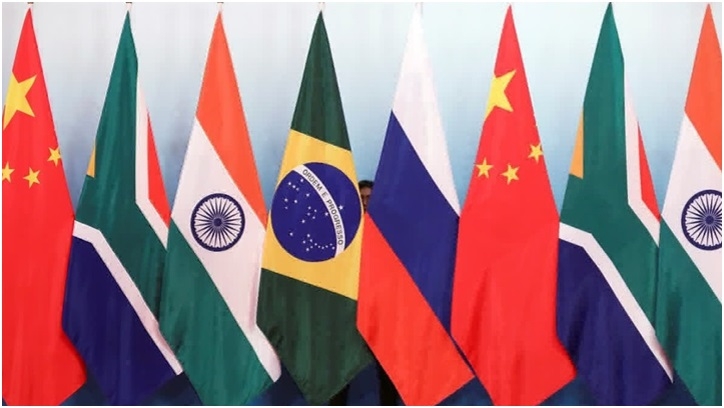
is a major intergovernmental organisation comprising 11 emerging economies -
Brazil, Russia, India, China, South Africa, Egypt, Ethiopia, Iran, Saudi
Arabia, the United Arab Emirates (UAE) and Indonesia – that represent over 40
percent of the world’s population and 37.3 percent of the global GDP.
It
promotes economic cooperation, geopolitical influence, and global governance
reform.
Originally
formed as BRIC (Brazil, Russia, India, China) in 2006, it became BRICS with
South Africa coming into the fold in 2010, and expanded in 2024-2025 to include
Egypt, Ethiopia, Iran, Saudi Arabia, the UAE, and Indonesia.
The
BRICS Foreign Ministers’ meeting comes at a time when international system is
witnessing sharp polarisation. The US is deeply involved in both the European
and West Asian theatres. Russia remains locked in Ukraine and under extensive
sanctions. West Asia is destabilised by the confrontation involving Iran,
Israel, and US forces. Energy markets, shipping lanes, and food supply chains
are under stress.
The
BRICS countries collectively represent a large share of the world’s population,
energy demand, commodity production, and emerging market growth. By hosting the
Foreign Ministers’ meeting, India is enabling BRICS to position itself as a
stabilising diplomatic forum outside Western alliance structures. New Delhi is
offering a platform for coordinated Global South responses to war-driven
economic shocks. It is also expected to act as a counterweight to narratives
shaped primarily in NATO or G7 spaces.
The
West Asian escalation has direct implications for BRICS members. Iran is
central to energy flows and regional stability.
The Strait of Hormuz and Red
Sea routes are critical for global trade. Oil prices and shipping insurance
costs are surging.
India,
China, and South Africa are heavily dependent on West Asian energy. Brazil is a
major commodity exporter affected by shipping disruptions.
By
convening BRICS Foreign Ministers now, India is creating space to discuss
collective diplomatic messaging urging de-escalation, address maritime security
in the Indian Ocean and adjoining waters, coordinate positions on energy supply
stability and price volatility, and reinforce the principle that regional wars
should not destabilise global trade.
On
the other hand, the Russia–Ukraine conflict has divided the world into
sanctioning and non-sanctioning blocs. Within BRICS, Russia is a principal
member and a party to the conflict. China and India have avoided condemning
Moscow while advocating dialogue. Brazil and South Africa have taken neutral,
negotiation-oriented positions.
Hosting
this meeting allows India to reinforce BRICS’s collective stance in favour of
dialogue over escalation. India uniquely maintains working relations with all
principal actors. New Delhi has a strong strategic partnership with the US. It
also has long-standing defence and energy ties with Russia. It maintains deep
engagement with Israel, civilisational and energy links with Iran, and holds
leadership credentials in the Global South.
This
gives India credibility to host difficult conversations without appearing
partisan. The meeting allows New Delhi to demonstrate its capacity to convene
rivals at the same table, its aspiration to act as a bridge power in a
fractured world, and emerge as a diplomatic hub of the Global South.
Originally
seen as an economic grouping, BRICS is increasingly becoming a geopolitical
forum. By hosting this meeting at a time of war in two theatres, India is
underscoring that BRICS is now a forum for political coordination on global
crises. It is also signalling that the Global South will not remain a passive
observer of great-power conflicts.
According
to Ruchika Sharma, Research Associate at the Udaipur-based Usanas Foundation
think tank, the upcoming BRICS Foreign Ministers’ meeting in India marks a
critical moment amid the geopolitical churnings in West Asia.
“The
Iran-US war continues to create ripple effects across global economies and is
widely shaping the geopolitical alignments,” Sharma told ETV Bharat. “Amidst
these developments, BRICS remains a significant platform for cooperation and
India attaches great importance to it.
The theme, ‘Building Resilience,
Innovation, Cooperation, and Sustainability’, assumes even greater significance
in deepening partnerships with the Global South, offering India an opportunity
to project BRICS as a platform capable of sustaining dialogue, cooperation, and
unity, which are the core fundamentals of multilateral engagement.”
To
sum up, India hosting the BRICS Foreign Ministers’ meeting is geopolitically
consequential. In a world increasingly divided by war and blocs, New Delhi is
positioning BRICS as a space for dialogue, balance, and strategic moderation –
and itself as the convening power capable of steering that conversation.