1 Cent Per Litre: Stanford Develops Durable Hydrogel That Harvests Drinking Water From Air
Total Views |


Atmospheric water generators use hydrogels, made of salt
and absorbent polymers, to draw moisture from the atmosphere and convert it
into drinking water. However, these materials degrade too quickly, reducing
their cost-effectiveness. Now, researchers from Stanford University have
developed a way to harvest water from air using solar power and a new hydrogel
that lasts for eight months or more.
Carlos Diaz-Marin, an assistant professor of energy
science and engineering in the Stanford Doerr School of Sustainability and
co-lead author of the research, believes that their work could potentially
provide a way to access additional water resources to help people who don't
have access to water or have to walk hundreds of hours per year to procure
water.
The professor also highlights the increased importance
of atmospheric water generation technology as industries like semiconductor
manufacturing and data centres continue to put more pressure on water systems.
Published in Nature Communications, the research claims
that the new hydrogels can produce potable water in really extreme conditions
as well. Building upon their earlier work, the researchers investigated how the
hydrogel breaks down and found that problems arise from the gel's contact with
a metal surface, which releases ions that form radicals in the hydrogel and
attack the polymer's long chains, even though the metal casing is key to
powering the water-harvesting process with heat from the sun. The gel's contact
with the metal turned it into goo as bits of polymer leached into the water.
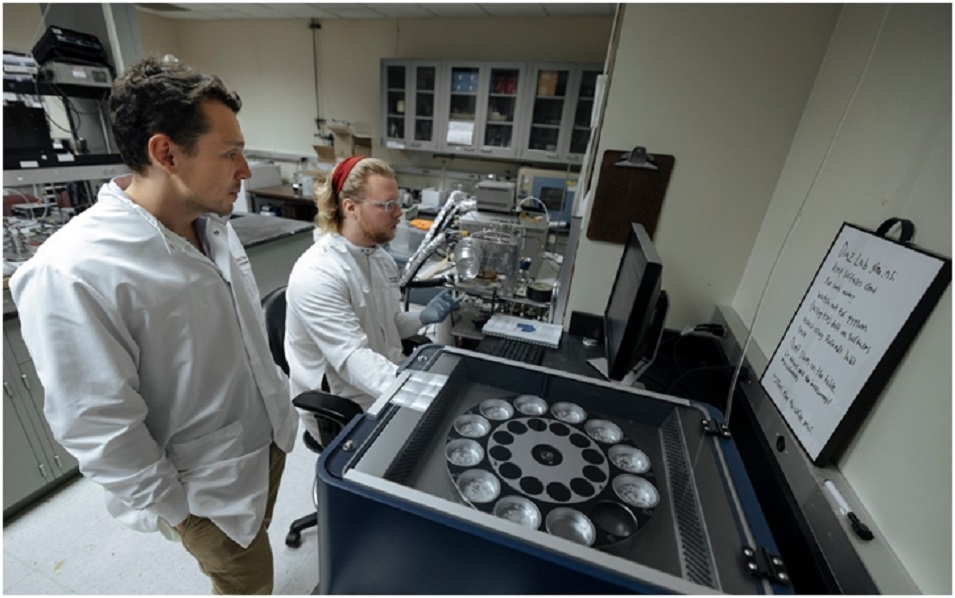
Researchers are developing low-cost hydrogels that can
harvest drinking water from the air. Here, energy science and engineering
Assistant Professor Carlos Diaz-Marin (left) and graduate student Garin Gross
(right) use a machine to measure how well various salts capture water, a key
step in the process
“The radicals are very efficient at eating the polymer
away,” said Diaz-Marin.
“To our knowledge, nobody had thought of durability and
degradation of these materials, despite it being a critical parameter for water
production.”
The researchers tested interventions to block the metal
ions, and an anti-corrosion coating on the metal solved the problem, extending
the hydrogel’s lifespan dramatically. In one test, the hydrogel remained stable
for more than eight months while kept at 167 degrees Fahrenheit, a temperature
meant to stress-test the material under extreme conditions. The researchers
also found the hydrogel on coated metal remained stable for more than 190
water-harvesting cycles.
Diaz-Marin said that this level of durability advanced
the hydrogel toward producing water at a competitive cost and could lead to a
point where water is produced at around one cent per litre. "This would be
about 1 per cent of the cost of bottled water and about 10 times the rate US
households pay for tap water. We see a path to this technology to perhaps even
being competitive with tap water," he said.