Why Partnering With South Korea Gives India A Scientific Edge In The Arctic
Total Views |


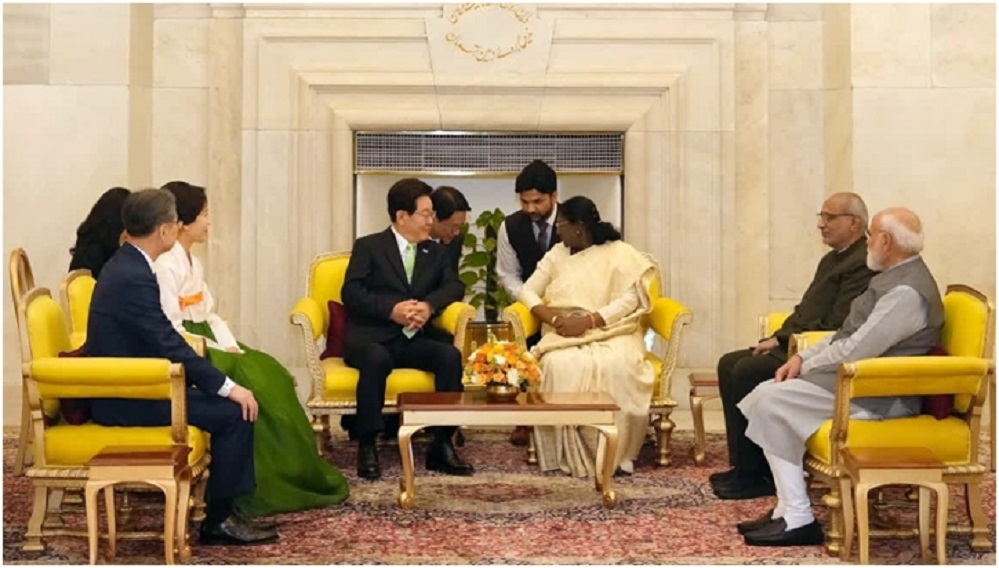
New Delhi : When India and South Korea agreed to deepen cooperation in Arctic science and shipping, the decision reflected more than symbolic climate diplomacy.
For India, the Arctic is a laboratory that shapes monsoon behaviour, sea-level rise, and long-range weather prediction. Partnering a technologically advanced polar nation gives New Delhi a practical pathway to upgrade its scientific access and capabilities in a region that is rapidly gaining global strategic weight.
According to a Joint Statement on Cooperation in the field of Sustainability issued following a bilateral summit between Prime Minister Narendra Modi and South Korean President Lee Jae Myung here on Monday, the two sides noted their growing engagement in Arctic research and scientific cooperation.
“The two sides recognised the Arctic as an important region for advancing understanding of climate change and agreed to expand cooperation in the Arctic, including Arctic science and Arctic shipping,” the statement reads. “The two sides will promote closer collaboration between their respective Arctic research institutions and explore opportunities for joint research initiatives, scientific exchanges, and participation in international polar research programmes.”
Addressing a special media briefing following Monday’s summit, P Kumaran, Secretary (East) in the Ministry of External Affairs, said that India and South Korea signed a memorandum of understanding (MoU) under Article 6.2 of the Paris Agreement.
Article 6.2 of the Paris Agreement enables countries to voluntarily cooperate to meet their Nationally Determined Contributions (NDCs) by trading emission reductions, known as Internationally Transferred Mitigation Outcomes (ITMOs). This framework allows for bilateral or multilateral transfers of carbon credits, facilitating cost-effective, high-ambition climate actions while requiring robust accounting to prevent double-counting.
“On sustainability, we are launching a dialogue on important themes such as climate, Arctic, and maritime cooperation,” Kumaran said.
India’s decision to deepen Arctic research cooperation with South Korea is strategically significant for science, climate policy, maritime planning, and geopolitics. For India, partnering a technologically advanced polar player accelerates capability-building in a region that is increasingly central to climate dynamics and future sea lanes.
Although geographically distant, the Arctic directly affects India. Arctic warming alters jet streams and polar vortices that influence the Indian monsoon. Melting Arctic ice contributes to global sea-level changes, affecting India’s long coastline. Arctic data improves the accuracy of long-range weather and climate forecasts for South Asia. Melting ice is also opening new shipping corridors that could reshape Eurasian trade flows.
India formalised its interest through its Arctic Policy, released in March 2022, which prioritises climate research, scientific presence, and responsible engagement. There are six central pillars of India’s Arctic Policy: science and research; environmental protection; economic and human development; transportation and connectivity; governance and international cooperation; and national capacity building.
South Korea is among Asia’s most capable Arctic research nations. It operates the Dasan Arctic Station in Svalbard since 2002 and runs a modern icebreaking research vessel, RV Araon. South Korea possesses world-class polar shipbuilding and maritime engineering expertise. It maintains strong participation in international polar research programmes.
This makes South Korea an ideal operational and technological partner for India, which maintains its own Arctic base, the Himadri Research Station, but lacks comparable polar logistics depth. Partnering with South Korea will give India access to polar logistics and platforms. Joint expeditions aboard RV Araon can give Indian scientists greater seasonal access to Arctic waters without waiting for limited European berths.
Shared datasets on sea-ice dynamics, aerosols, and ocean circulation can improve India’s monsoon prediction models and extreme weather forecasting. This collaboration will expose Indian institutions to Korean expertise in ice-class ship design, polar sensors and autonomous instruments, and cold-region engineering and survival systems.
As Arctic Sea routes such as the Northern Sea Route become seasonally viable, Korea's experience in polar shipping will help India assess future trade and maritime strategy implications.
Also, as mentioned in the statement, the two sides will promote closer collaboration between their respective Arctic research institutions. This means cooperation will likely intensify between India’s National Centre for Polar and Ocean Research (which runs Himadri), and South Korea’s Korea Polar Research Institute (which runs Dasan and RV Araon).
“In 2013, India and South Korea were among five Asian countries to become observer nations in the Arctic Council,” Uttam Kumar Sinha, Senior Fellow at the Manohar Parrikar Institute of Defence Studies and Analyses (MP-IDSA) and an expert on climate change issues, told ETV Bharat. “The other three were China, Singapore and Japan. All these Asian countries have research stations in the Arctic.”
The Arctic Council is a high-level intergovernmental forum that addresses issues faced by the Arctic governments and the indigenous people of the Arctic region. It has seven member countries – the US, Canada, Iceland, Norway, Sweden, Finland, Denmark and Russia. Finland is the current chair of the Council.