Pope Criticizes Colonization Of Africa's Minerals As He Arrives In Equatorial Guinea
Total Views |


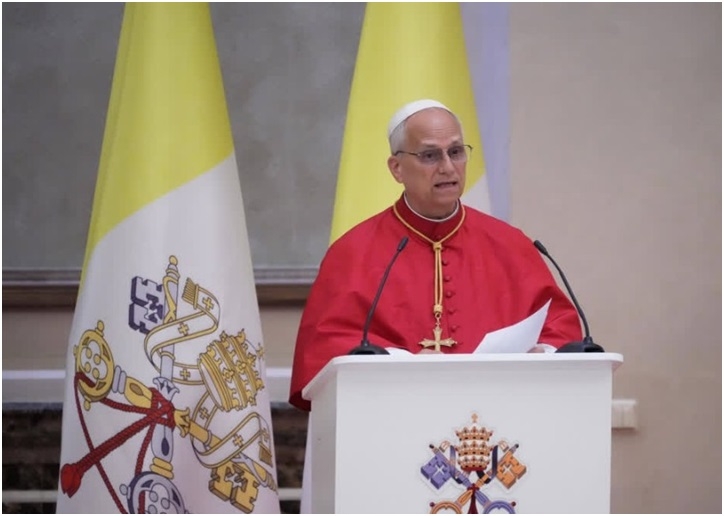
Malabo, Equatorial Guinea: Pope Leo XIV arrived in Equatorial Guinea on Tuesday on the fourth and final leg of his Africa journey, and denounced the "colonization" of Africa's minerals and the "lust for power" in a country whose repressive leader has been in office since 1979.
Adoring crowds in the largely Catholic country lined the road from the airport into the capital, Malabo, cheering the first pope to visit since St. John Paul II in 1982. Wearing his formal red mozzetta cape, Leo thrilled the flag-waving masses by arriving at the presidential palace in his open-sided popemobile.
"There is a lot of joy today because we waited 44 years for the pope to come," said Diosdado Marques, a senior Catholic official in the country. "It's a blessing for the country, we hope many things will change and we will deepen our faith."
The former Spanish colony on Africa's western coast is run by the continent's longest-serving president, Teodoro Obiang Nguema Mbasogo, who has been accused of widespread corruption and authoritarianism.
The discovery of offshore oil in the mid-1990s transformed Equatorial Guinea's economy virtually overnight, with oil now accounting for almost half of its GDP and more than 90% of exports, according to the African Development Bank.
Yet more than half of the country's nearly 2 million people live in poverty. And rights groups including Human Rights Watch — as well as court cases in France and Spain — have documented how revenues have enriched the ruling Obiang family rather than the broader population.
Leo, who arrived from Angola, met with Obiang at the presidential palace and then addressed government authorities, diplomats and civil service representatives. Noting that the encounter occurred on the first anniversary of Pope Francis' death, Leo quoted the late pope in denouncing income inequalities that he said had been exacerbated by a global economy focused on the pursuit of profit at all cost.
"Such an economy kills," Leo said. "In fact, it is even more evident today than in years past that the proliferation of armed conflicts is often driven by the colonization of oil and mineral deposits, occurring with no regard for international law or the self-determination of peoples."
The Trump administration, which has announced plans to create a minerals trading bloc with its allies, has been racing to get access to Africa's regions rich in critical minerals and to beat competition from China in a region where Beijing has long dominated.
Last year, as the administration emerged as a key broker for a peace deal to end the fighting in Congo's mineral-rich but conflict-battered eastern region, it was also signing a partnership with Congo that would allow American companies access to those conflict minerals.
The U.S. is also investing funds in the Lobito Corridor, a major rail project in Africa that would facilitate export of minerals from mineral-rich regions in Zambia and Congo through Lobito in Angola. At the same time, the U.S. has also backed a South Africa project aimed at extracting rare earth minerals from industrial waste. The project developer has said it can extract key metals used in electronics and defense systems.
Two models of cities The pope's meetings took place in the old presidential palace. The government has built a new capital on the mainland, named Ciudad de la Paz, or City of Peace, but the transfer of government buildings hasn't been completed yet.
Authorities have said the decision to build the new capital was strategic, given the potential for expansion of the city carved out in the middle of a tropical forest. But critics said the relocation of the capital would exacerbate existing inequalities and give further opportunities for the presidential circle to enrich themselves
Leo referred to the new capital by citing to the famous work of St. Augustine, "City of God," in which the 5th-century philosopher interpreted humanity through two models: The "earthly city" where people live temporarily, and the eternal "city of God," characterized by God's unconditional love and love of one another, especially the poor. Leo didn't call out the corruption associated with the Obiang family or the criticism of the new capital. But he suggested Equatorial Guinea should look to the "City of God" as a model.