Maldives Local Elections Reveal Political Balance That Matters To India
Total Views |


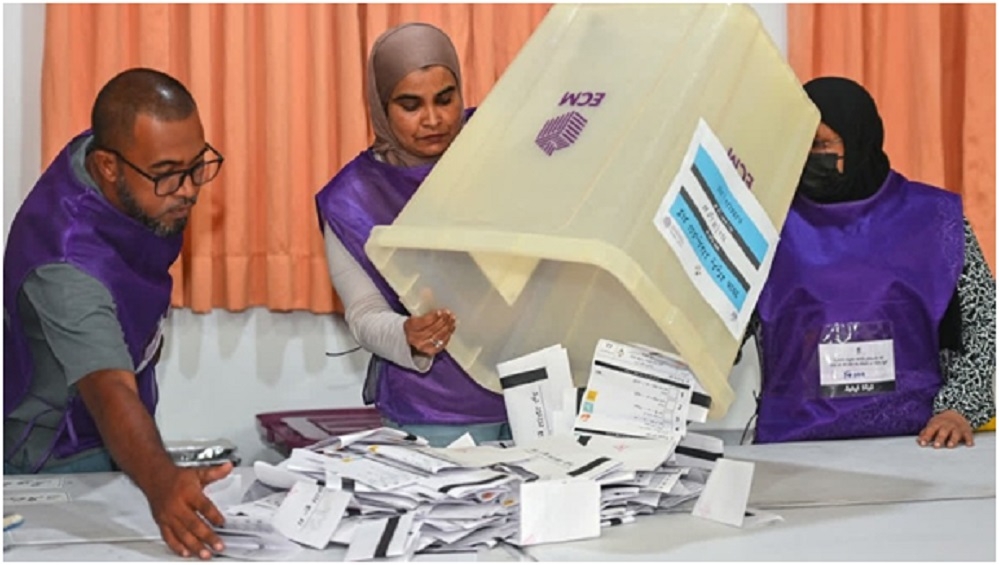
New Delhi : The results of the local council elections in the Maldives have resonated far beyond municipal politics. The sweeping victories of the Maldivian Democratic Party (MDP) across all five major city mayoralties and its lead in council seats amount to a subtle but unmistakable political signal midway through President Mohamed Muizzu’s term. For South Asia — and especially for India, watching developments in its maritime neighbourhood — the verdict underscores how local democratic currents can shape the region’s strategic landscape.
Maldivians went to the polls on Saturday to vote in local council elections, Women’s Development Committee (WDC) elections, and a nationwide referendum on whether presidential and parliamentary elections should be held together.
Preliminary results indicate that the main opposition MDP swept all five city mayoral races — Male, Addu City, Fuvahmulah City, Thinadhoo City, and Kulhudhuffushi City — with incumbent MDP mayors retaining their posts. The party also secured a majority of seats across local councils and WDCs.
At the same time, most voters rejected the government-backed proposal to merge presidential and parliamentary elections, delivering a significant setback to the administration. In the wake of the results, former Maldives President and MDP leader Ibrahim Mohamed Solih has called on the government to alter its current course and ensure its policies reflect the will of the people.The Sun Online news website cited Solih as congratulating the winning MDP candidates and thanking the voters for their support in a post on his X handle made in Dwivehi.
According to the Sun Online report, the former President stated that the election outcome signals public dissatisfaction with the government’s policies, describing the results as a clear indication that the administration must adjust its direction. Solih urged authorities to heed public sentiment promptly and implement the changes demanded by citizens.
Meanwhile, President Muizzu, who belongs to the People’s National Congress (PNC), whose candidates lost in the elections, said in a post on X that he accepts the results of the local council and WDC elections, as well as the public referendum, with full respect.
“He (Muizzu) further noted that, with the grace of Almighty Allah, the government will undertake the necessary efforts to address areas requiring improvement, in alignment with the will and sentiments of the people,” a report in the Raajje news website stated.
Although these were local elections, Maldivian voters can be seen as clearly using them as a proxy referendum on national politics. The ruling PNC was unable to dislodge MDP incumbents in the most visible urban centres. The MDP’s hold over Male, Addu, Fuvahmulah, Kulhudhuffushi and Thinadhoo shows that urban, politically aware voters remain aligned with the party that governed the Maldives from 2018 to 2023.
In effect, Maldivian voters separated local governance trust from national political rhetoric and chose continuity in city leadership under the MDP.