West Asia Turmoil Puts India-Russia Nuclear Energy Cooperation In Strategic Spotlight
Total Views |


New Delhi : At a time when the US-Israel attack on Iran has triggered fresh instability across West Asia, External Affairs Minister S Jaishankar’s assertion that Russia remains India’s foremost partner in civil nuclear energy carries significant strategic weight.
"Russia is our foremost partner in civil nuclear energy and the Kudankulam Nuclear Project is a stellar example," Jaishankar said while virtually addressing the 'India and Russia: Towards a New Bilateral Agenda' conference held in Moscow on Monday. "As India aims to increase its nuclear energy generation capacity to 100 gigawatts by 2047, I am confident that it will find a trusted and reliable partner in Russia for peaceful uses of nuclear energy."
Jaishankar's statement came even as Prime Minister Narendra Modi said in the Lok Sabha on Monday that India is promoting nuclear energy production.
"The government has also promoted nuclear energy production through the Amrit Kaal Energy Transition initiatives," Modi said while updating the Lower House of Parliament on India’s position in the ongoing conflict in West Asia.
Jaishankar’s remarks during the conference in Moscow underline how New Delhi is increasingly turning to long-term, stable energy partnerships to hedge against the volatility of hydrocarbon supplies from a conflict-prone region. His emphasis on Russia as India’s key civil nuclear partner highlights a strategic pivot towards reliable, non-fossil fuel energy sources that can insulate the country from external shocks.
The ongoing conflict has disrupted key supply routes, particularly the Strait of Hormuz, through which a substantial portion of India’s oil imports pass. India imports nearly 85 percent of its crude oil, making it acutely vulnerable to such disruptions.
In this volatile context, nuclear energy – developed with Russian assistance – offers India a stable, uninterrupted baseload power source, reduced dependence on imported hydrocarbons, and protection from price volatility caused by war or sanctions.
India-Russia nuclear cooperation is one of the cornerstones of their strategic partnership, anchored by the construction of Russian water-water energy reactors (VVERs) at the Kudankulam Nuclear Power Plant (KKNPP). The project is the centre of cooperation, involving six units (VVER-1000 reactors), with units 1-2 operating and 3-6 under construction. Russia guarantees the uninterrupted supply of nuclear fuel for the lifetime of the Kudankulam plant.
Discussions are ongoing for constructing a second Russian-designed nuclear power plant at a new site in India. The two countries are exploring cooperation in small modular reactors (SMRs) and floating nuclear power stations to meet India’s clean energy needs.
Unlike Western counterparts, Russia has accepted India’s civil liability regulations for nuclear damage.
The West Asian crisis has highlighted the risks of overdependence on fossil fuel regions. Nuclear cooperation with Russia provides India with a long-term hedge against geopolitical instability.
Unlike oil and gas, nuclear fuel supply chains are more predictable and governed by long-term agreements. Energy production is less vulnerable to maritime chokepoints or regional conflicts. It enables diversification of India’s energy basket As India targets 100 GW of nuclear capacity by 2047, Russian collaboration ensures scalability and continuity in achieving this goal.
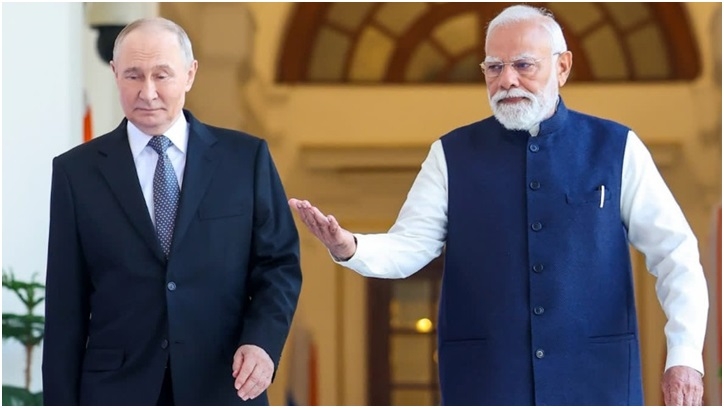
During Russian President Vladimir Putin’s visit to India in December last year, both sides reaffirmed their commitment to strengthening cooperation in civil nuclear energy and the broader energy sector, emphasising the enduring strategic value of their Special and Privileged Strategic Partnership.
"The sides confirmed their intention to broaden cooperation in nuclear energy, including fuel cycle, life cycle support for operating Kudankulam Nuclear Power Plant and non-power applications, as well as to elaborate new agenda of interaction in the field of peaceful use of atomic energy and related high technologies," a joint statement issued following the bilateral summit between Putin and Modi read.
The two sides noted the importance of the cooperation in the peaceful uses of nuclear energy as a significant component of the strategic partnership taking into account the plans of the Government of India to increase India’s nuclear energy capacity to 100 GW by 2047.
India, much like China, has developed its own indigenous programme for building nuclear power plants based on domestic technology and design. At the same time, it continues to actively collaborate with Russia in expanding its nuclear energy capacity. While India remains open to engaging multiple international partners, it has also explored opportunities with other developers.
One notable example is the proposed Jaitapur Nuclear Power Project, for which India has been in discussions with France since 2009. The project envisions six reactors with a combined capacity of 9.6 GW. Although Electricite de France (EDF) submitted a detailed feasibility study in 2021, a final investment decision on the project is still pending.
Over the years, India has also held discussions with the US, South Korea, Japan and several other countries regarding nuclear power development. However, most of these proposals have not progressed beyond the preliminary stages of negotiation.
Consequently, despite India’s willingness to diversify its partnerships in the civil nuclear sector, other countries have struggled to match the scale, financing, and execution assurances offered by Russia. As a result, Russia is likely to remain India’s principal – and effectively the only – foreign partner in nuclear power plant construction for the foreseeable future. The ongoing geopolitical tensions, including those linked to the West Asian and Ukraine conflicts, are unlikely to significantly disrupt India’s civil nuclear cooperation with Russia.
It is also worth mentioning here that India passed the Sustainable Harnessing and Advancement of Nuclear Energy for Transforming India (SHANTI) Act last year. This Act overhauls India’s nuclear energy framework, replacing the Atomic Energy Act, 1962, and Civil Liability for Nuclear Damage (CLND) Act, 2010, to allow limited private and foreign participation in nuclear power generation, operation, and equipment manufacturing, while strengthening state control over strategic aspects and creating a clearer liability regime with capped operator liability and supplier immunity, aiming to boost clean energy and investment.