From Brussels To The Gulf: Why India-EU Ties Matter In A Time Of Energy Turmoil
Total Views |


New Delhi : As the conflict between the US–Israel coalition and Iran intensifies in West Asia, India’s energy security calculus is undergoing a significant shift.
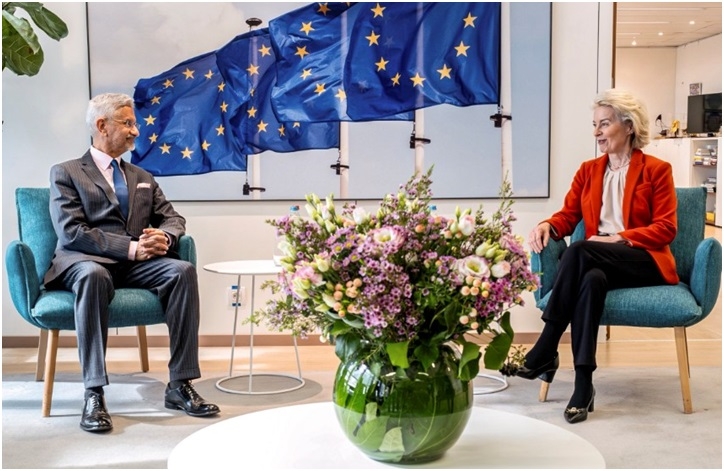
External Affairs Minister S Jaishankar’s consultations with the European Union (EU) during his visit to Brussels on March 15-16 highlight a growing recognition in New Delhi that safeguarding fuel supplies will increasingly depend on deeper coordination with like-minded partners beyond the Gulf.
The energy disruption risks triggered by the February 28 conflict in West Asia have reinforced India’s long-standing vulnerability to external energy shocks, prompting a renewed push for diversification and resilience. Against this backdrop, Jaishankar’s engagement with the EU assumes added significance, signalling an effort to align India’s energy security strategy with Europe’s evolving approach to supply diversification, clean energy transition, and crisis management.
According to a statement issued by the External Affairs Ministry on Tuesday, Jaishankar participated in an interaction with the EU Foreign Affairs Council, chaired by High Representative and Vice President (HRVP) Kaja Kallas and comprising foreign ministers of EU member states. It stated that Jaishankar highlighted the strong momentum following the India-EU Summit in January 2026, “calling to unlock the full potential of the FTA, deepen defence industrial collaboration and maritime cooperation under the security and defence partnership, transform the Trade and Technology Council into a more outcome driven forum integrated with industry, advance sustainable development and green and clean energy collaboration, and strengthen mobility frameworks”.
“EAM (Jaishankar) urged EU foreign ministers to realise synergies between India’s relations with the European Union and with member states – a sentiment that was fully reciprocated by his EU counterparts,” the statement further reads. “The ministers also exchanged views on pressing global challenges, particularly the situation in West Asia, including its effects on energy security and underlined the need for dialogue and diplomacy. They also discussed the situation in Ukraine and the Indo-Pacific. EAM stressed the growing convergence between India and the EU in maintaining a stable international order and strengthening multilateralism.”
During an interministerial media briefing here on Tuesday regarding the situation in West Asia, External Affairs Ministry spokesperson Randhir Jaiswal said that Jaishankar and the foreign ministers of the various countries of the EU “discussed the global effect on energy security”.
“The ministers also underlined the need for dialogue and diplomacy to be adopted to bring an early end to this particular conflict,” Jaiswal added.
Energy cooperation between India and the EU has moved from being a supplementary aspect of bilateral ties to a strategic necessity, shaped by geopolitics, market volatility, and the global energy transition. For India – one of the world’s fastest-growing energy consumers – engagement with the EU offers both immediate safeguards and long-term structural advantages. India imports more than 80 per cent of its crude oil, with a significant dependence on West Asia. Events such as the ongoing conflict in West Asia and the Russia-Ukraine war have demonstrated how quickly supply chains can be disrupted. India’s long-term energy security depends not just on securing fossil fuels but on reducing dependence on them. This is where the EU becomes a critical partner.
The EU is a global leader in renewable energy technologies (solar, wind, offshore wind), green hydrogen development, carbon markets and emissions regulation.
At the centre of India–EU energy and climate engagement is the Clean Energy and Climate Partnership (CECP), established in 2016, with Phase III adopted in November 2024, reflecting the growing scope of bilateral cooperation. The EU has been a partner of the International Solar Alliance since 2018, supporting solar energy deployment, while the European Investment Bank finances sustainable transport and urban mobility projects, including urban rail and metro systems in select Indian cities.
India-EU cooperation also covers offshore wind energy, gas infrastructure development, methane emissions reduction, investments, and technology transfer, and the EU’s joining of the Coalition for Disaster Resilient Infrastructure (CDRI) in March 2021 underscores shared priorities on climate-resilient infrastructure. In advanced scientific domains, India and the EU signed an R&D agreement on peaceful uses of nuclear energy with EURATOM in July 2020, and India has been an associate member of CERN since 2017.
According to a joint statement issued following the signing of the Free Trade Agreement (FTA) between India and the EU in January this year, both sides agreed to strengthen cooperation under the CECP, including through energy technologies, smart grids, storage, electricity sector regulation, and energy and climate diplomacy.