Google's Nuclear Power Deal In US Could Be A Pointer To India's Data Centre Ambitions
Total Views |


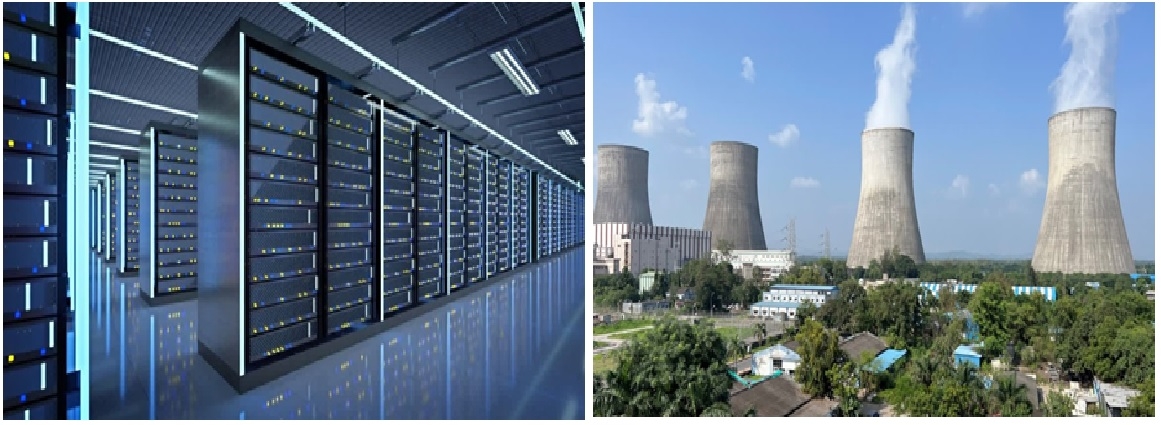
New Delhi: Google's parent Alphabet's 20-year deal for 890 megawatts worth of nuclear power from US nuclear power producer Constellation Energy could provide a fillip to India's data centre ambitions, as well as create new customers for its nuclear power plans.
The 20-year power purchase agreement will enable investments in new equipment and technology at 11 Constellation-owned nuclear units in Illinois, Pennsylvania, and New Jersey, the two companies said in a joint announcement on October 6. "The agreement represents more than $4.3 billion of new investment by Constellation," the statement added. However, the two parties did not disclose the deal value.
Constellation is the largest nuclear power operator in the US. It also has a strong presence in other "greener" energy sources such as renewables and natural gas. As a “merchant generator”, it sells in wholesale markets and to big customers through long-term contracts.
Google joins a list of other tech giants who have already inked deals with Constellation -- and other power producers -- to power their data centres. Data centres are giant consumers of electricity. So much so that data centre capacities are measured by the power they consume -- in megawatts or gigawatts -- rather than their actual compute capacity. The Google deal is the latest in a series of similar agreements that Constellation has already entered into with Microsoft, Meta, and Amazon.
Tech firms have another problem. For decades, they have been pitching themselves as low-carbon, green businesses. And they don't want to let go of that, hence the search for "green" power. While many data centres have been linked with renewable power sources, these don't offer reliable, 24x7 power availability. One of the secrets of many such "green" data centres is that, especially at night time, power is drawn from base load stations, most of which are high-emission thermal plants.
This is where nuclear power comes in, which offers reliable and round-the-clock availability of power without CO2 emissions. In fact, nuclear energy is classified in the "clean" power category, since it has no emissions other than steam from its cooling towers, and the radioactive waste generated is entirely contained.
In the US, tech companies are at the forefront of nuclear power revival. Last year, Google did a deal with NextEra Energy to support plans to restart a shuttered reactor in Iowa. It did another deal with Southern Co. to fund upgrades at two nuclear plants, according to media reports. Likewise, Microsoft has done a deal to buy power from the Three Mile Island plant -- shut after a meltdown scare. The reactor is expected to restart next year.
All this holds considerable interest for India, which sees data centre investments powering growth as well as its own AI ambitions. The stumbling block is the availability of sufficient power. Google's $15 billion data centre investment in Visakhapatnam, for instance, has $2 billion committed to renewable power, while the rest will be sourced from multiple sources.
Given surging oil prices and with the key oil-producing regions in the Gulf continuing to be conflict areas, nuclear is back on the table. While land acquisition and historical sanctions continue to be a problem, the government has passed the new Sustainable Harnessing and Advancement of Nuclear Energy for Transforming India (SHANTI) Act, which aims to remove legacy roadblocks and ramp up nuclear power.
That extra power will dovetail neatly with tech giants' need for power for their data centres. India could take a pointer or two from recent nuclear power deals that tech companies have done in the US, where they front-end a part of the investment required, which will also address the capital requirement issue.