Mars Dust Could Kill Astronauts! Here's What NASA Is Doing About It
Total Views |


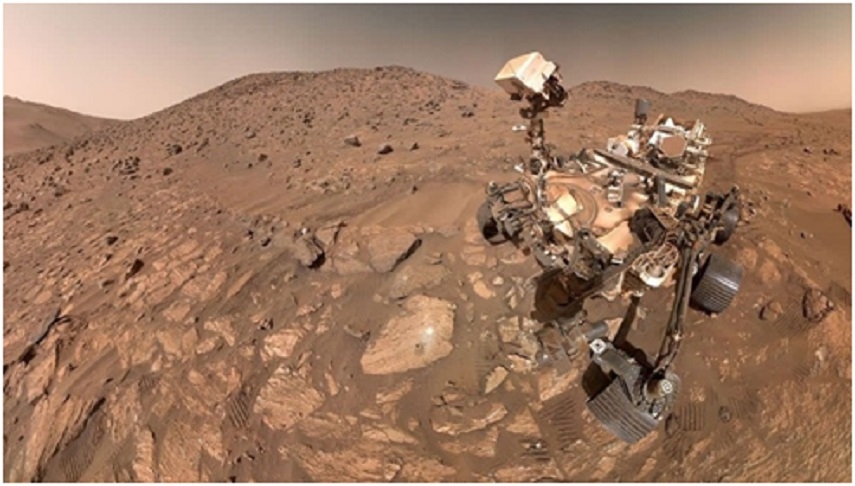
Mars looks like a dusty red desert from space. But up close, that dust could be one of the biggest dangers facing future astronauts. The National Aeronautics and Space Administration's (NASA) Perseverance rover has spent more than 1,645 Martian days studying it, and the results are alarming and important.
What did the Perseverance rover find?
The rover measured tiny particles of Martian dust that had settled onto samples of spacesuit materials carried onboard. These particles are extremely small — far smaller than a human hair, which is about 70 micrometres wide.
Scientists found two types of worrying particles. The first are fine particles, measuring less than 2.5 micrometres. The second are ultrafine particles, around 100 nanometres — roughly 700 times thinner than a human hair.
Both sizes are small enough to pass deep into the lungs. The very smallest can even enter the bloodstream. This makes them a serious health threat for anyone spending time on the Martian surface.
NASA says dust causes problems in space. During the Apollo Moon missions, lunar dust scratched helmet visors, damaged spacesuit seals, and wore away protective outer layers. Some astronauts came back with symptoms similar to hay fever.
Martian dust is less sharp and scratchy than Moon dust, because wind on Mars smooths the grains over time. However, it contains higher levels of sulphur, chlorine, and iron, and more silica than lunar dust. It also gets swept up into regional and global dust storms, meaning it circulates through the atmosphere regularly and settles on everything.
How did the rover collect this data?
Perseverance rover carries five sample square patches of spacesuit material, each about 20 millimetres wide. These swatches are made from materials used in real spacesuits, including Vectran and Teflon. They were sent to Mars to see how spacesuit materials hold up in Martian conditions.
The measuring of the dust particles was done by two onboard instruments: PIXL and SHERLOC.
PIXL, short for Planetary Instrument for X-ray Lithochemistry, detected the chemical make-up of dust that settled on a Teflon sample. As Teflon contains no elements that PIXL can detect on its own, any readings it picked up came purely from the dust resting on top.
SHERLOC, short for Scanning Habitable Environments with Raman and Luminescence for Organics and Chemicals, analysed the Vectran swatch.
Together, these tools provided scientists the most detailed picture yet of the size and composition of Martian dust particles.
Why does this matter?
The findings published in the Proceedings of the National Academy of Sciences directly shape how NASA prepares for human missions to Mars. Engineers and flight surgeons can now use this data to improve spacesuit designs, develop better dust removal methods, and set safe health limits for crews on the surface. As NASA's Lindsay Hays put it, dust has been a challenge since the Apollo era. Now, for the first time, scientists have precise measurements to work with — gathered from the surface of Mars itself, long before the first astronauts arrive.