At UNGA, India Intensifies Its Global South Outreach And Creates Issue Based Coalitions
Total Views |


New Delhi : The 81st UN General Assembly (UNGA) Session has revealed a new aspect of India's Global South diplomacy: creating issue-based coalitions rather than a rigid geopolitical bloc.
This has provided India with a strong platform to advance one of the central propositions of New Delhi’s contemporary foreign policy: that the Global South should move from being an object of global policy to an active participant in shaping it.
In meeting after meeting in New York, External Affairs Minister S Jaishankar has connected the demand for UN reform with issues ranging from climate change and development finance to technology, energy security and supply-chain resilience.
And he has emphasised that developing countries should not be forced into binary geopolitical choices.
On Friday, after participating in a discussion on ‘Ruptures and Ramparts: Building Bridges for a Changing World’ on the sidelines of the ongoing session, Jaishankar said that while the UN remains indispensable, the voice of the Global South will continue to matter.
“We agreed that the UN remains indispensable, while recognising the need for reform to reflect the aspirations and realities of the Global South,” Jaishankar posted on his X.
This was after discussions with Jamaica Foreign Minister Kamina Johnson Smith, Ghana Foreign Minister Samuel Okudzeto Ablakwa, Suriname Foreign Minister Melvin Bouva and President of the East West Centre Celeste Connors.
“The voice of the Global South will continue to matter amidst geopolitical fragmentation, conflicts, climate change, economic uncertainty and technological disruption,” he stated.
“The world will not be defined by binary choices. Countries will continue to make their choices based on interests, values and trust.”
Jaishankar used a series of ministerial meetings and plurilateral forums in New York to advance a broad argument: countries of the Global South are disproportionately affected by conflicts, energy and food insecurity, climate shocks, disrupted supply chains, debt pressures and technological disruption, yet remain under-represented in the institutions that shape responses to these challenges.
At the High-Level Ministerial Meeting of Like-Minded Global South Countries and Friends on September 22, Jaishankar argued that developing countries were increasingly bearing the consequences of global crises while having limited influence over the decisions that produce or address them.
The meeting, chaired by Jaishankar under the theme ‘Navigating Together Towards a Brighter Future – the Compelling Case for an Empowered Global South’, brought together countries facing common pressures ranging from conflicts and food and energy insecurity to climate events, volatile trade and investment flows and inadequate development finance.
Participants also called for comprehensive reform of the UN and greater coordination among Global South countries in multilateral forums.
Jaishankar's message was, therefore, not confined to a general call for solidarity. He outlined a practical agenda for developing countries: removing vulnerabilities in supply chains, finance and connectivity; protecting energy security; ensuring reliable access to food, grains and fertilisers; preserving the right to industrialise; securing maritime commons; making artificial intelligence more inclusive; and increasing the representation of the Global South in international decision-making.
The strongest institutional component of Jaishankar’s outreach has been the renewed push for reform of the UN Security Council.
On September 23, he co-chaired the L.69 Consultative Ministerial Interaction on UNSC reform with Saint Lucia Foreign Minister Alva Baptiste. The L.69 grouping consists largely of developing countries from Africa, Latin America and the Caribbean, Asia and the Pacific that favour comprehensive reform of the Security Council.
Jaishankar argued that the inability of the Security Council to adequately address ongoing conflicts and threats to international peace underlined the urgency of reform. India also coordinated with the African Union’s Committee of Ten, or C-10, in pressing the reform agenda.
This is important to India’s Global South strategy because UNSC reform is where the principle of greater representation becomes a question of institutional power. India’s argument is that the composition of the Council should better reflect contemporary geopolitical and economic realities rather than the distribution of power at the time the UN system was established.
India has simultaneously sought support from countries outside the traditional developing country groups. At the first Visegrad Group-plus-India ministerial meeting on September 21, the four V4 countries – Poland, Hungary, Slovakia and Czechia - expressed support for India’s permanent membership of the Security Council. Slovakia specifically described India as a leading country of the Global South that should have a place at the UN’s top decision-making body.
Latin America and the Caribbean have been another important component of the outreach. Jaishankar co-chaired the India-CELAC Foreign Ministers’ Meeting on September 22, with participation from 30 of the 33 CELAC countries – the largest participation recorded for the forum. He described the Community of Latin American and Caribbean States (CELAC) not simply as a regional grouping but as an important partner in shaping a more representative, balanced and inclusive international order.
The India-CELAC engagement has an important economic dimension. India is pursuing closer trade arrangements with the region, including negotiations relating to Chile and Peru and expansion of the preferential trade arrangement with the South American customs union and economic bloc
MERCOSUR. India-CELAC trade has crossed $50 billion annually. But the relationship is also being positioned around complementary development capabilities. India brings pharmaceuticals, digital technologies, skilled manpower and technology, while Latin America and the Caribbean offer opportunities in critical minerals, sustainable energy, agriculture and food resources.
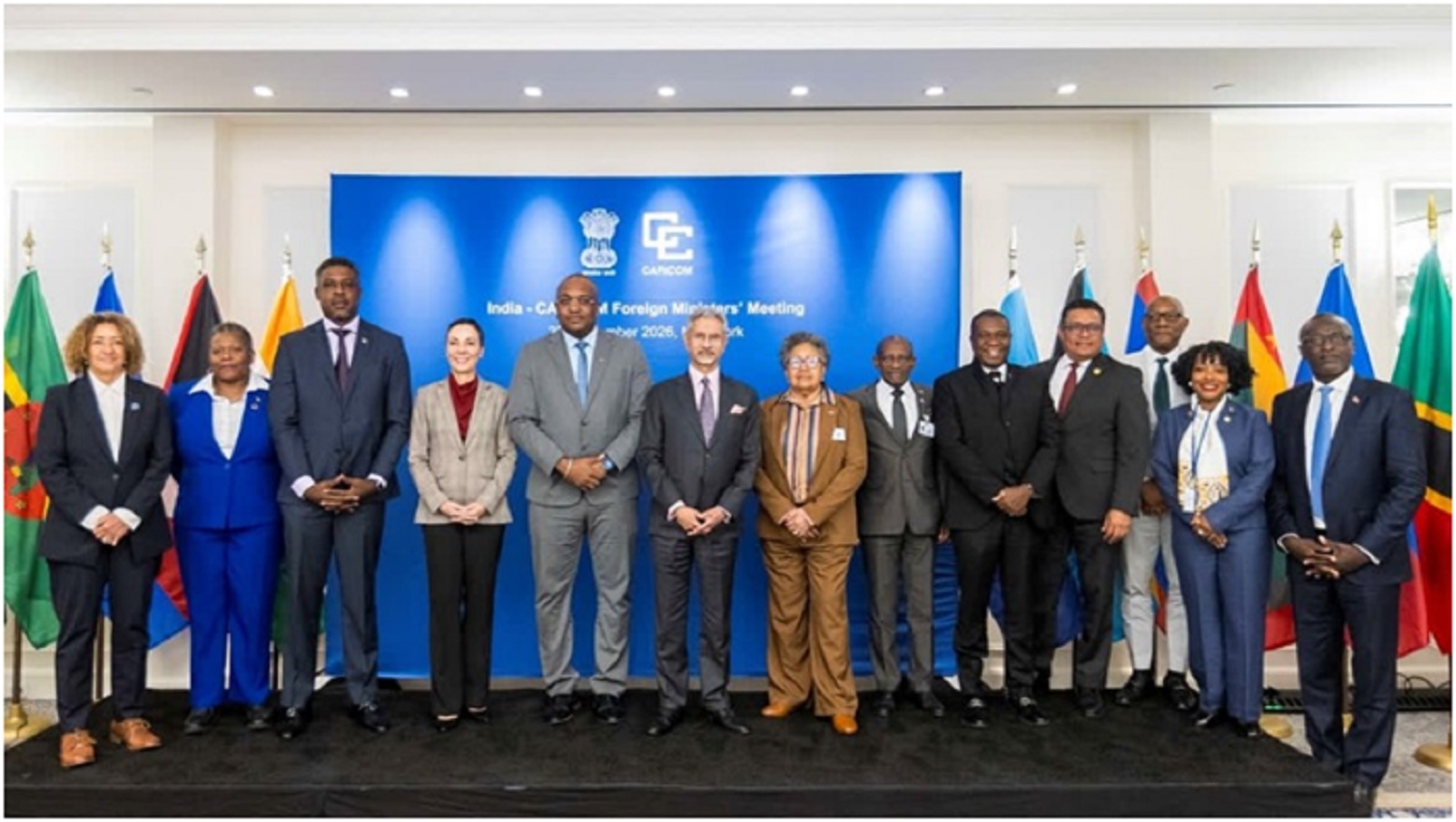
The Caribbean has received particular attention during the current UNGA week. At the India-CARICOM Foreign Ministers’ Meeting on September 23, Jaishankar called for deeper cooperation in economic, digital and mobility-related areas. He highlighted Indian initiatives involving solarisation, small and medium enterprises and Quick Impact Projects.
India has also provided practical assistance to Caribbean partners, including limb-fitment camps, haemodialysis units and BHISHM Cube medical units, while offering training opportunities and customised capacity-building programmes. Jaishankar encouraged Caribbean Community (CARICOM) countries to participate more actively in initiatives such as the International Solar Alliance and Global Biofuels Alliance.
The Pacific has been another major focus. Jaishankar chaired the second India-Pacific Islands Cooperation (FIPIC) Foreign Ministers’ Meeting on September 23, with participation from a wide range of Pacific Island countries. Discussions focused on renewable energy, climate action, disaster resilience, healthcare, education and capacity building.
India has emphasised that its approach to the Pacific is demand-driven, development-oriented and people-centric, while supporting the priorities of the Pacific Islands Forum’s 2050 Strategy for the Blue Pacific Continent. New Delhi has also encouraged Pacific partners to participate in the International Solar Alliance and the Coalition for Disaster Resilient Infrastructure.
According to Ruchita Beri, Senior Fellow at the Vivekananda International Foundation think tank, India is engaging with all the developing nations, because New Delhi has repeatedly said that it supports the ambitions of the Global South, whether they are in Africa, Asia, Latin America or the Caribbean.
“These countries participate in group forms within the UN General Assembly,” Beri told ETV Bharat. “For example, the L.69 is a group with which India has a certain understanding regarding UN Security Council reforms. Similarly, the C-10 is also looking for UN Security Council reforms.”
She said that Jaishankar is meeting these groups separately to discuss the issue of better global governance. “He is pushing like-minded countries on the larger issue of global governance reforms and also the discussion on how to represent the voices of the Global South in various international organisations and multilateral forums,” Beri added.
Jaishankar’s Global South message is closely linked to India’s broader call for what it describes as reformed multilateralism. At the inaugural ‘Partners for Multilateralism, International Law, Peace & Prosperity’ summit on September 21, co-chaired with European Council President Antonio Costa, Jaishankar argued that the global order was under stress because of geopolitical competition, conflicts and technological change.
He called for more participatory deliberations and transparent decision-making, while identifying peace and security, climate justice, emerging technologies, development finance, counter-terrorism, supply chains, disaster resilience and pandemic preparedness as areas requiring greater international cooperation.