Three-day festival promotes cultural exchange under the theme ‘Shared Stories, Shared Futures’
Total Views |


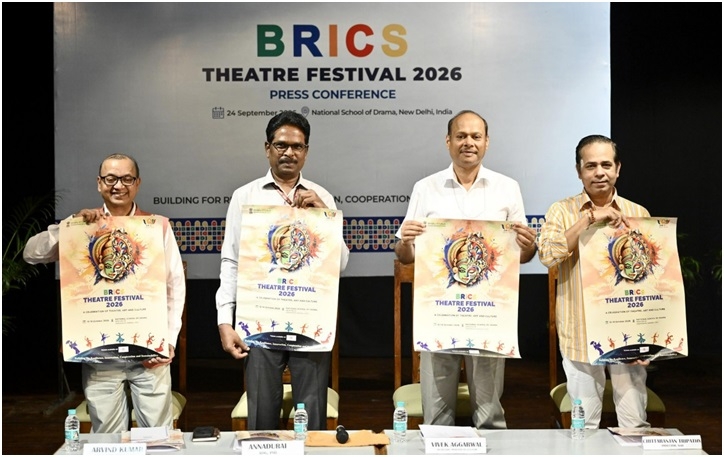
NEW DELHI: India hosted the BRICS Theatre Festival 2026 at the National School of Drama (NSD) in New Delhi from October 12 to 14, bringing together theatre practitioners, scholars, students and cultural representatives for a three-day celebration of performing arts. Organised by the Ministry of Culture as part of India’s BRICS Presidency in 2026, the festival was held under the theme “Shared Stories, Shared Futures.” It highlighted the role of theatre in promoting cultural understanding, encouraging artistic collaboration and strengthening connections among countries through creative expression.
The festival provided a platform for exploring diverse theatrical traditions, contemporary stage productions and storytelling practices. By bringing artists and cultural professionals together, the event aimed to demonstrate how performing arts can cross linguistic, geographical and social boundaries while preserving the distinctive cultural identities of participating communities.
The initiative also underlined India’s commitment to using cultural engagement as a means of strengthening international relationships. Theatre, with its combination of literature, music, movement, dialogue and visual expression, offers a powerful medium through which societies can share their histories, values, challenges and aspirations.
Theatre becomes a bridge between cultures
The BRICS Theatre Festival offered an opportunity to explore the diversity of performing arts and the cultural experiences that shape societies around the world. Theatre is one of the oldest forms of artistic communication, combining spoken language, physical expression, music, costumes, lighting and stage design to convey stories and emotions.
Although theatrical traditions differ from country to country, many productions explore universal themes such as family relationships, social justice, identity, love, conflict, human dignity and the search for a better future. These shared themes make theatre an effective medium for connecting audiences across cultural boundaries.
The theme “Shared Stories, Shared Futures” reflected this idea. It encouraged a broader understanding of how stories rooted in particular communities can also communicate experiences that resonate internationally. Performances can introduce audiences to unfamiliar customs, historical events and social realities while helping them recognise similarities in the human experience.
For participating artists, the festival also created opportunities to learn from different approaches to acting, directing, choreography and dramatic storytelling. Such exchanges can inspire new productions and encourage artists to experiment with creative methods without losing their cultural identities.
National School of Drama provides a platform for artistic dialogue
The National School of Drama in New Delhi served as the venue for the festival. The institution is an important centre for theatre education and professional training in India, with a focus on acting, direction, stagecraft and other aspects of theatrical production.
Hosting an international theatre festival at such an institution provides a valuable setting for interaction between established practitioners and emerging performers. Students and young theatre enthusiasts can gain insights into professional practices, while experienced artists can exchange ideas about the changing demands of contemporary performance.
Theatre education extends beyond learning dialogue or memorising scripts. It includes understanding characters, interpreting texts, developing movement and voice, designing stage environments and working collaboratively with technical teams. International cultural events can expose students to different interpretations of these disciplines.
The festival’s workshops and discussions complemented the performances by creating space for professional exchange. Directors, actors and production teams could discuss their artistic approaches, technical experiences and creative challenges.
Such engagement is important because theatre is a collaborative art form. Successful productions depend on the coordination of performers, writers, designers, musicians, technicians and stage managers. Learning how other theatre communities organise and develop their work can broaden professional perspectives and strengthen future cooperation.
Cultural diplomacy gains importance
The festival also highlighted the growing importance of cultural diplomacy in international relations. Diplomatic engagement is not limited to political meetings, economic agreements or official statements. Cultural programmes can establish connections between people by encouraging dialogue, mutual respect and a better understanding of different societies.
Performing arts have particular value in this process because they communicate through several forms of expression. Even when audiences do not understand the language spoken on stage, gestures, music, movement and visual storytelling can communicate emotions and dramatic situations.
An international theatre festival can therefore help audiences approach other cultures with greater curiosity and openness. It can challenge stereotypes, encourage discussion and provide artists with opportunities to build professional relationships beyond national borders.
The BRICS framework offers a setting for such exchanges among participating countries. Alongside cooperation in economic, political and developmental matters, cultural initiatives can contribute to a broader understanding of shared interests and differences.
For India, hosting the festival during its 2026 BRICS Presidency provided an opportunity to highlight the country’s performing arts institutions and its commitment to international cultural engagement. It also demonstrated how creative collaboration can complement formal diplomatic initiatives.
However, the long-term impact of cultural diplomacy depends on continued engagement beyond individual events. Sustained partnerships, artist exchanges, collaborative productions and educational programmes can help transform short-term encounters into lasting professional relationships.
Traditional theatre meets contemporary expression
One of the important aspects of international theatre festivals is the opportunity to examine how traditional art forms respond to modern audiences. Traditional theatre often draws upon folklore, mythology, historical narratives, regional languages, music and community customs. These elements preserve cultural memories and transmit stories from one generation to another.
At the same time, contemporary theatre frequently addresses present-day issues, including urbanisation, migration, inequality, technology, environmental concerns and changing social relationships.
The two approaches need not be treated as opposites. Traditional storytelling techniques can provide inspiration for modern productions, while contemporary stagecraft can make historical and cultural narratives accessible to younger audiences.
Festivals create opportunities for artists to examine these possibilities. Through exposure to different performance traditions, theatre practitioners can explore how music, movement, narrative structure and visual design can be adapted or combined to create new artistic experiences.
Such experimentation must also respect the cultural context of the material being presented. Meaningful exchange involves more than borrowing costumes, gestures or dramatic techniques. It requires an understanding of the traditions, histories and communities from which artistic forms emerge.
By encouraging dialogue between performers and cultural professionals, international festivals can support creative innovation while recognising the importance of preserving artistic heritage.
Opportunities for young artists and theatre audiences
Theatre festivals can play an important role in developing the next generation of performers, directors and cultural professionals. For young artists, exposure to different theatrical practices can encourage experimentation, improve professional understanding and provide inspiration for future work.
Workshops and discussions can also help participants understand the practical challenges of building a career in theatre. These may include finding performance spaces, securing financial support, developing audiences, collaborating with institutions and reaching people outside major cultural centres.
Accessibility remains another important consideration. Theatre can sometimes be limited by ticket prices, language barriers, geographical distance or a lack of suitable venues.