Greenland, Trump And India: Why A Distant Arctic Dispute Isn’t So Distant
Total Views |


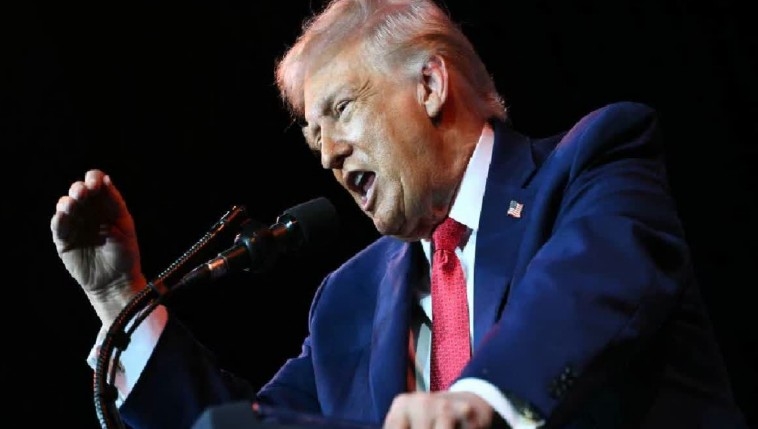
New Delhi : US President Donald Trump’s blunt assertion at the World Economic Forum in Davos, Switzerland, on Wednesday that Greenland should be brought under American control may be aimed at Europe, but its strategic consequences reach as far as New Delhi.
For India, thousands of kilometres away, Trump’s renewed claim over the Arctic island carries implications that extend far beyond trans-Atlantic politics, touching on New Delhi’s growing strategic, scientific and governance interests in the rapidly changing Arctic region.
“We want a piece of ice for world protection, and they won’t give it,” Trump said in his Davos speech. “You can say yes, and we will be very appreciative. Or you can say no, and we will remember.” Trump called for “immediate negotiations” for the US to acquire Greenland from Denmark during his speech.
Greenland is an autonomous territory within the European nation of Denmark. Trump’s earlier suggestion that the US could “buy” Greenland – and his recent rhetoric questioning Denmark’s control – signals a troubling mindset: that territorial arrangements can be renegotiated through power and pressure rather than law and consent.
For India, this precedent is dangerous. India has consistently opposed unilateral territorial claims, whether in Ukraine, the South China Sea, or its own border disputes with China. If a major power like the US normalises the idea that strategic territory can be acquired or coerced due to its “strategic value”, it weakens the very norms India depends upon to protect its sovereignty.
Greenland sits at the heart of the Arctic, an emerging geopolitical frontier driven by climate change, new shipping routes, and access to critical minerals. Trump’s claim matters to India because it challenges the sanctity of sovereignty and international law. It also accelerates great-power rivalry in fragile global commons and sets precedents that weaken India’s ability to resist coercion elsewhere. Trump’s claims undermine multilateralism in favour of raw power politics.
For India, the real concern is not whether the US controls Greenland, but what kind of world emerges if powerful states feel entitled to redraw maps at will. In that world, India’s strategic autonomy, regional leadership, and long-term security would all be harder to protect.
According to Robinder Sachdev, president of the New Delhi-based Imagindia think tank, Trump’s claims over Greenland do matter to India. “One is world order,” Sachdev told ETV Bharat. “It implies that any power can go and muscle its way to any territory. It matters for our Shaksgam valley. Does it mean China can do it? It encourages a predatory behaviour by a big power against smaller powers.”
He said that half of the Arctic is under Russia’s control. The other 50 percent is with Greenland, Norway, Finland and Sweden, which, in other words is in NATO’s control.
“That is why it matters for India,” Sachdev said. C Uday Bhaskar, strategic affairs expert and the Director of the New Delhi-based Society for Policy Studies think tank, is of the view that, as a major power, India has a locus in the governance of the Arctic as a region.
“The current Trump claims and threats articulated at Davos would have a non-linear but substantive bearing on India’s long-term core strategic interests,” Bhaskar said. Apart from this, India today sees the Arctic not as a remote geography, but as an integral part of the global system that shapes its climate, economy, energy security, and foreign policy.
In 2022, India released its first comprehensive Arctic Policy, titled ‘India and the Arctic: Building a Partnership for Sustainable Development’. The policy identifies six pillars: science and research; climate and environmental protection; economic and human development; connectivity and transport; governance and international cooperation; and national capacity building.
Earlier, India had become an Observer at the Arctic Council in 2013, recognising the region’s global importance while respecting the sovereignty of Arctic states.
The Arctic holds an estimated 13 percent of the world’s undiscovered oil and 30 percent of its undiscovered natural gas reserves, along with critical minerals such as rare earth elements. For India, diversifying energy sources is a strategic necessity. Arctic resources could offer long-term options. Partnerships - not territorial claims - are India’s preferred route. India has already engaged with Russia on Arctic energy projects, viewing them through the lens of commercial cooperation rather than geopolitical contestation.
Meanwhile, melting ice is also opening new maritime corridors, particularly the Northern Sea Route (NSR), which could significantly shorten shipping times between Asia and Europe. For India, these routes could reduce transportation costs, improve trade efficiency, and reshape global supply chains.
Sachdev said that as the NSR opens up, the goods from India can be transported through the International North South Transport Corridor (INSTC) to northern Europe and beyond, even to the US.
“India is impacted by the Arctic as a region and its wider global linkages, as related to maritime connectivity and global trade routes,” Bhaskar said. “These include climate change and monsoon patterns, and the natural resource potential viz., rare earths et al.”
According to Sachdev, if the US owns Greenland, it will create a rupture between Washington and Europe. “Europe will then feel drastically to develop closer relations with India,” he said.
To sum up, Greenland may lie thousands of kilometres from India, but the principles at stake are uncomfortably close to home. For India, the real concern will be not whether the US controls Greenland, but what kind of world emerges if powerful states feel entitled to redraw maps at will. Greenland is a reminder that US’ Arctic gambit could become tomorrow’s Indo-Pacific crisis.