Punjab Engineering Students Build Indigenous Low-Cost Rocket That Can Fly Up To 3 Km
Total Views |


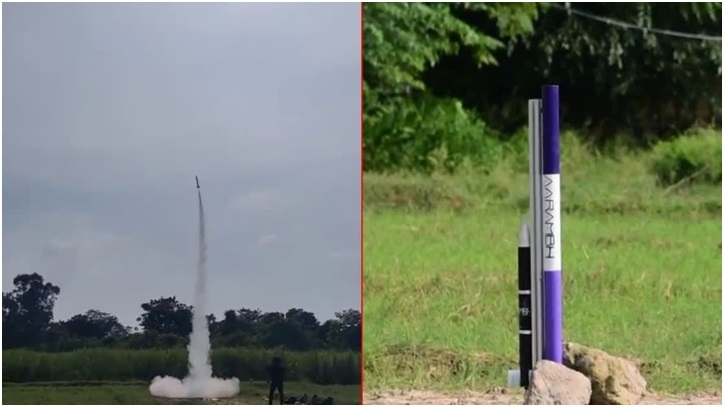
The 2026 International Rocket Engineering Competition (IREC) is scheduled to take place in the United States, continuing its tradition of annual gatherings. A team of 15 students from Punjab Engineering College (PEC) have built a low cost rocket for this competition, which can fly up to three kilometres in altitude. This rocket has been prepared within four months of hard work.
The initial testing of this rocket was conducted in New Chandigarh, where it successfully reached an altitude of 500 metres. The rocket is equipped with a parachute to ensure a safe landing. Based on this performance, PEC selected the team to participate in IREC 2026.
The low cost rocket has been built similarly to a professional one, using advanced technology in its design, testing, and simulation. It uses a solid rocket motor whose performance is nearly 95 per cent accurate compared to motors available in the market.
The 15 aerospace engineering students are now working on a new carbon-fibre-based rocket, which is both robust and lightweight. It is expected to take around three months to complete. The team has completed the Preliminary Design Review (PDR) and will submit it for the competition on December 15. The report will include the complete details about the rocket’s technical features, capabilities, and performance.
The project has now entered the next testing phase and may further enhance PEC’s reputation internationally in the coming months.
In a conversation with ETV Bharat, the students said that the rocket was built on a very low budget of Rs 3,000. From design, testing, and simulation to manufacturing, in every stage, they used indigenous solutions. Even though the rocket is small in size, its performance is considered to match international standards. Its efficiency meets nearly 95 per cent of the required benchmarks.
A big leap for PEC on the international stage
After a rigorous selection process, PEC’s team secured a place in the top 5 position at the Spaceport America Cup 2026, the world’s prestigious Rocket Engineering Competition. The team believes that their model will perform exceptionally well on the global stage and showcase India’s engineering capabilities to the world.
Team leader and Aerospace HOD Dr Rakesh Kumar told ETV Bharat, "Our design is fully ready, and the team is moving forward with complete confidence. We are sure PEC’s rocket will perform brilliantly on the international stage. The level of technical understanding shown by the students is commendable. This success is the result of their continuous effort."
"We always aim to promote innovation. This achievement will inspire future generations. One of the major accomplishments of the project is the development of an indigenous solid rocket motor, which delivers nearly 95 per cent performance accuracy compared to commercial motors, and that too at a very low cost," Kumar added.
PEC’s aerospace team says that this achievement not only reflects their research capability but is also an important step towards providing a new identity to rocketry culture in North India.
Students share their experience
Third year student Ashish Sharma said, “Our biggest strength is teamwork. Building such a precise rocket with limited resources is a proud moment for us. It’s not something we achieved suddenly—there are four years of hard work behind it. We are preparing for the competition in the US. We have already launched a 500 metre rocket. For the competition, we are building a separate rocket that will reach three kilometres.”
Fourth year student Rahul Bansal said, “Contributing to the rocket motor design was challenging, but seeing the results makes the effort worthwhile. We even built the motor ourselves. It has been developed at a very low cost. A parachute has been added for safe landing, which worked successfully.”
Fourth year student Ketan Jain said, “This project became a great learning platform for us. We handled every stage ourselves—from design to launch. We have completed the design for the competition.”
Third year student Kaustubh Srivastava said, “The success of the flight has boosted our confidence many times. Now we are ready to aim higher. The team is also planning to develop new rocket models capable of reaching higher altitudes. This will inspire us to contribute to India’s space tech ecosystem.”